
Rayzon Solar, India’s top solar panel manufacturing company, has emerged as a leader in the industry with its innovative solutions and widespread presence PAN India. With a strong foothold in india the United States and Europe, the company has garnered the trust of more than 1000 satisfied customers worldwide. Renowned for our commitment to quality, Rayzon Solar has been consistently recognized as one of the top manufacturer of solar panel since 2017.
Rayzon Solar’s production capacity has reached to an impressive 11.3 GW with the latest TOPCon technology. This achievement is made because of our Visionary and inspirational founder’s continuous drive for an innovation and excellence.
As a leading manufacturer Of PV module and smart energy solution, Rayzon delivers world class solar PV products, applications, and services to promote global sustainable development…
United we innovate, together we achieve
Integrity in every action
Excellence in every detail
Your success drives us
Impactful, measurable results
Pioneering sustainable solutions
We're writing a story where economic growth and environmental preservation go hand in hand. Every panel we produce is a chapter in India's journey toward energy independence.
“Switching to solar solutions reduced our factory’s carbon footprint by 40%. It feels good to grow without harming the planet.”
“Electricity reached our village consistently for the first time. Our children can now study at night.”
Be a part of India's green energy revolution. Every installation counts towards a cleaner, stronger nation.
Rayzon Solar has established itself as a dominant force in the solar energy sector, boasting a formidable global presence that spans continents. As a leading solar panel manufacturer, Rayzon Solar's footprint extends across key markets worldwide, from North America to Europe, Asia, and beyond. Through cutting-edge technology and a commitment to sustainability, Rayzon Solar has earned a reputation for delivering high-quality solar solutions tailored to meet the diverse needs of businesses and consumers alike. With an extensive network of distributors and partners, coupled with a dedication to innovation and customer satisfaction, Rayzon Solar continues to illuminate the path towards a brighter, more sustainable future for generations to come.
Discover More

News, updates, and expert articles from the solar industry.

Rayzon Solar is an Indian solar panel manufacturer, headquartered in Gujarat, making solar panels since 2017. The company now runs an 11.3 GW manufacturing capacity (FY 25–26), with a strong focus on TOPCon technology, and serves customers across India, the USA, Canada, Germany, South Africa, and Kenya.
Since 2017, the company has focused on manufacturing reliable, high-performance solar panels for homes, businesses, industries and large solar projects.
With a manufacturing capacity of 11.3 GW, Rayzon Solar produces advanced TOPCon, bifacial, monofacial and all-black solar modules. Its products are used across India and supplied to international markets, including the USA, Canada, Germany, South Africa and Kenya.
Rayzon Solar combines modern manufacturing technology with strict quality checks to build modules that can perform reliably for many years. The company serves more than 1,000 customers and works with solar installers, EPC companies, distributors, businesses and project developers.
Rayzon Solar has been recognised as a Top Performer in the 2026 Kiwa PVEL PV Module Reliability Scorecard. This independent recognition reflects the company’s focus on product quality and long-term module reliability.
The company’s Founder and Managing Director, Chirag Nakrani, also appeared as an investor on Shark Tank India Season 4, where he supported entrepreneurs working on innovative and sustainable business ideas.
Through Indian manufacturing, advanced solar technology and a growing global presence, Rayzon Solar supports the country’s transition towards cleaner and more dependable energy.
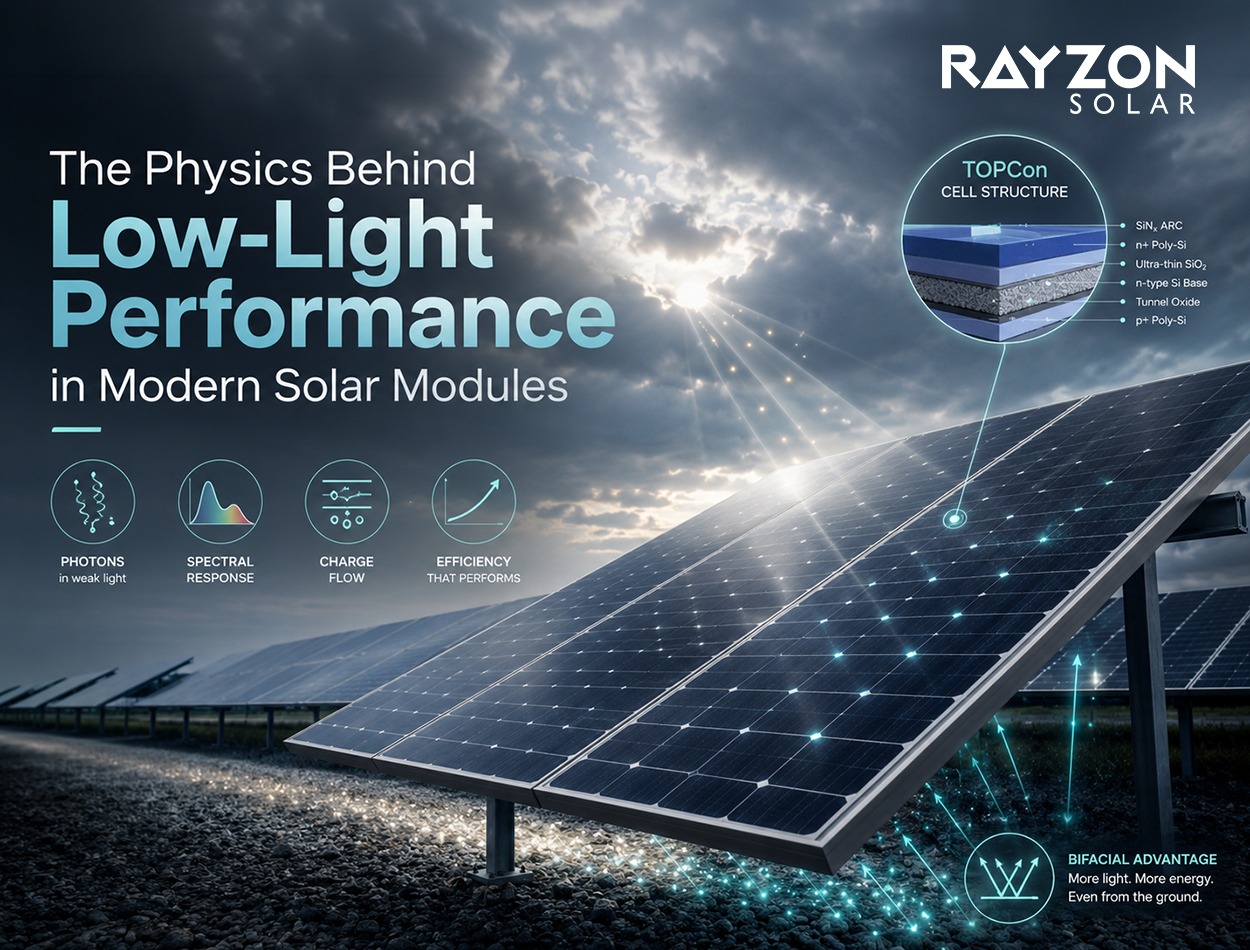
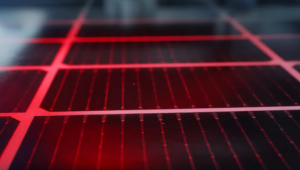
TOPCon (Tunnel Oxide Passivated Contact) is a solar cell design that adds an extra thin layer to the back of the cell, cutting down energy loss and pushing efficiency higher than older panel technologies.
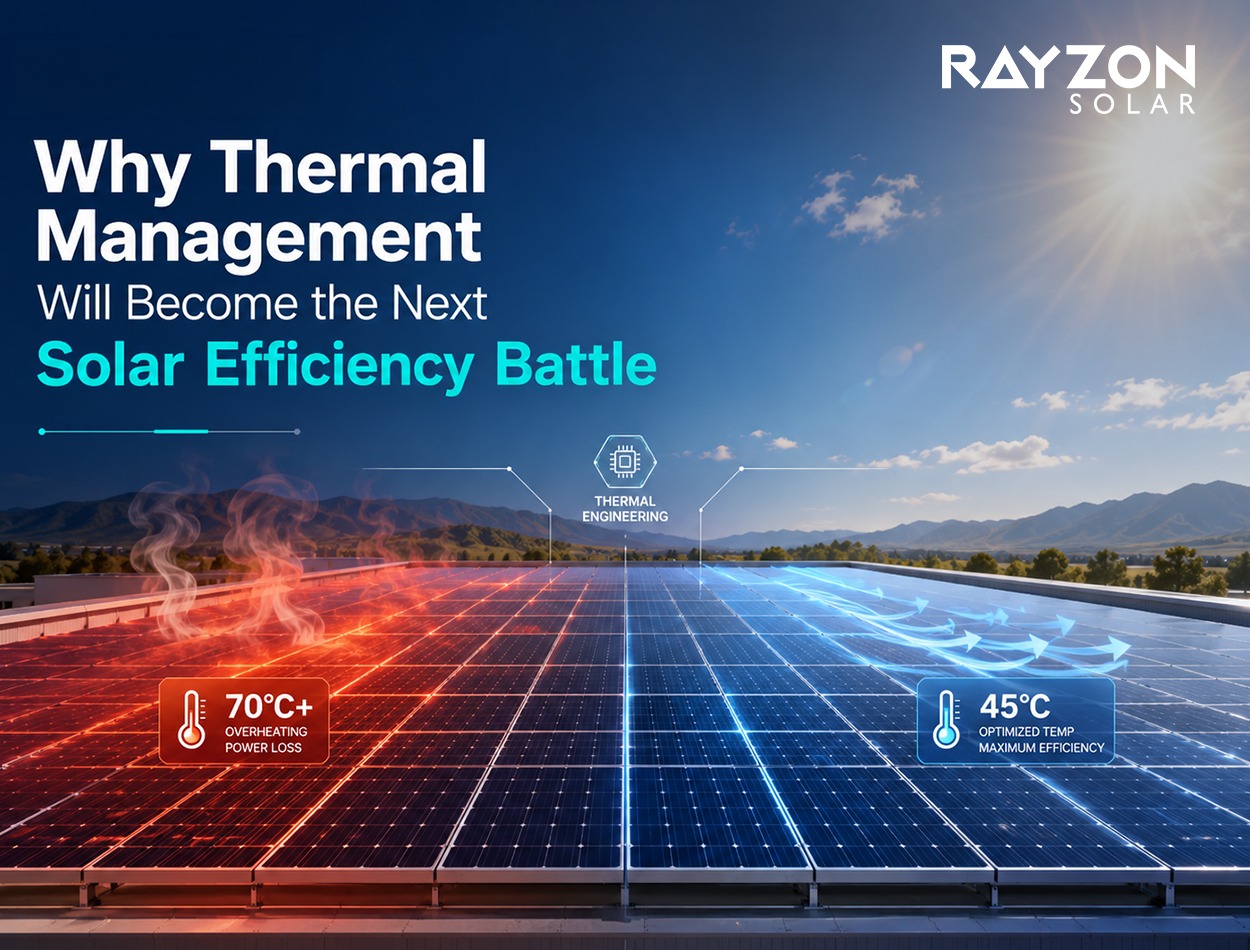
TOPCon solar panels generally offer better efficiency, lower degradation and stronger performance in hot weather compared with conventional PERC panels.
Think of a standard solar cell as a bucket with a few small leaks — some of the sunlight that hits it never turns into usable electricity. TOPCon technology patches those leaks. The result is a panel that converts more sunlight into power, holds up better in heat, and loses less output as the years go by.
This matters a lot in India. Rooftops in most Indian cities run hot for a good part of the year, and panels that suffer less power loss in high heat simply generate more electricity, day after day. It's one of the reasons Rayzon Solar's L'lios TOPCon modules are built around this technology.
Rayzon Solar manufactures TOPCon monofacial, bifacial, and all-black solar modules under its L'lios range, each suited to a different kind of roof, budget, and priority - from everyday homes to large industrial rooftops.
Different solar projects have different requirements. The right solar panel depends on the available space, installation type, energy target, budget and appearance expected by the customer. Rayzon Solar manufactures multiple module types for residential rooftops, industrial buildings, open-land solar plants and large utility projects.
Browse our solar panel Product Range to compare specifications, efficiency, wattage, and technology before choosing the ideal module.
| Solar Panel Type | Best Suited For | Main Advantage | Rayzon Solar Range |
|---|---|---|---|
| TOPCon Monofacial | Homes, offices and standard rooftop systems | High efficiency and reliable front-side generation | L’lios Monofacial |
| Bifacial | Ground-mounted plants, carports, elevated systems and industrial rooftops | Generates energy from direct sunlight and reflected light | L’lios Bifacial |
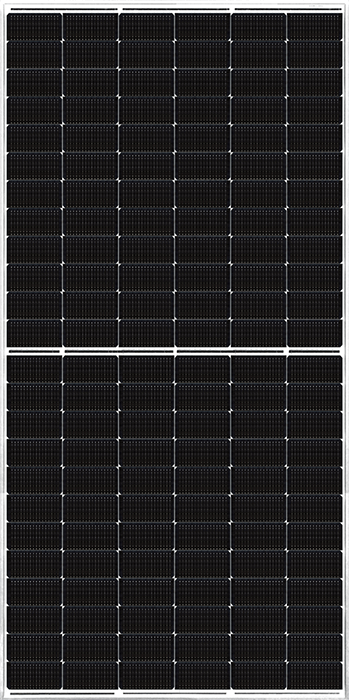
| All-Black Module | Villas, premium homes and visible rooftops | Clean and uniform black appearance | L’lios Black Module |
| TOPCon Core Range | Commercial, industrial and utility-scale projects | Higher output with improved heat performance | L’lios TOPCon |
For a normal residential RCC terrace, a high-efficiency monofacial or TOPCon module may be suitable.
Bifacial panels can work well on elevated structures, reflective rooftops and open-land projects where light can reach the back of the module.
For sloped roofs, villas and homes where appearance matters, all-black solar modules offer a more uniform and premium finish.
Industrial sheds and large commercial rooftops may benefit from high-power TOPCon modules because they can generate more electricity from limited usable space.
A professional site assessment should be completed before selecting a module. Roof strength, shadow-free area, orientation, structure height, wind conditions and expected electricity consumption must all be considered.
Buying from an ALMM-listed, India-manufactured brand like Rayzon Solar matters because it keeps you eligible for government subsidies, gets you faster after-sales support, and protects you from the price swings that come with imported panels.
Choosing an Indian solar panel manufacturer can make project coordination, product availability, after-sales support and warranty communication easier.
Locally manufactured solar panels are also less exposed to international shipping delays and sudden price changes caused by import duties or overseas supply-chain issues.
Solar panels are long-term assets. Customers may need technical documents, product verification or warranty support several years after installation.
Working with an established Indian manufacturer can make communication faster and reduce dependence on overseas suppliers.
ALMM stands for the Approved List of Models and Manufacturers. It is maintained by the Ministry of New and Renewable Energy.
For projects covered under certain government schemes or procurement rules, eligible solar modules may need to be included in the applicable ALMM list. Buyers should confirm the latest model-level approval before finalising a purchase because the list is updated periodically.
Rayzon Solar manufactures solar modules in Gujarat, India. Its domestic manufacturing base allows the company to serve Indian customers, EPC partners, distributors and project developers while also supplying international markets.
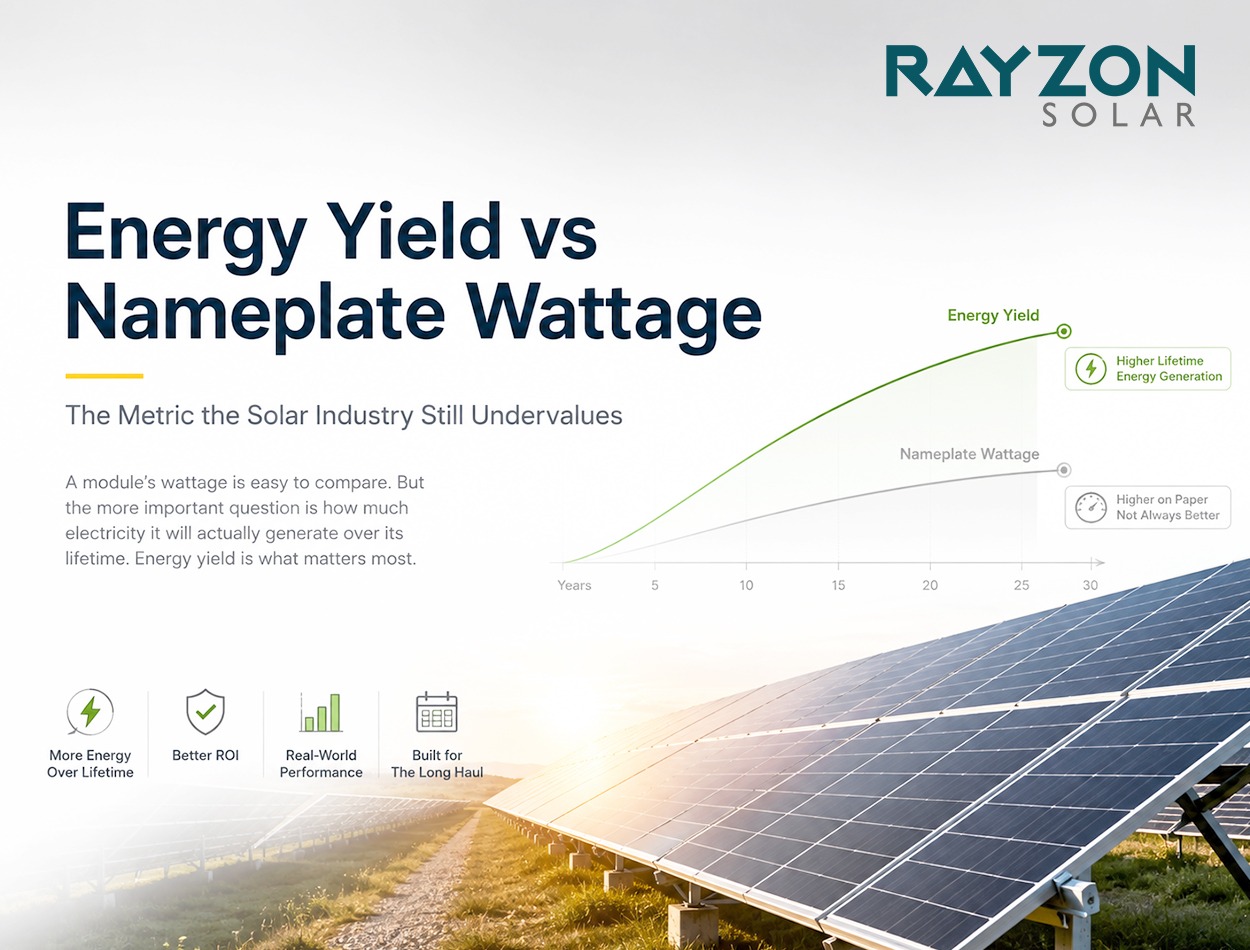
A solar panel may remain in operation for more than two decades. Therefore, buyers should look beyond only the initial price.
Module reliability, degradation, temperature performance, warranty terms and manufacturer support can directly affect the amount of electricity a solar plant generates over its operating life.
Rayzon Solar’s recognition in the Kiwa PVEL reliability scorecard supports its focus on independently evaluated module performance and long-term product reliability.
Making a solar panel involves sourcing and testing solar cells, connecting them together, layering them with protective glass and backsheet material, laminating and framing the whole unit, and then running it through multiple quality checks before it ever reaches a rooftop.
Solar panel manufacturing involves several carefully controlled stages. Solar cells are inspected, connected, protected between layers and tested before the finished module is packed for dispatch.
At Rayzon Solar, modern manufacturing lines and in-house quality processes support module production at scale. Every stage is important because even a small manufacturing defect can affect long-term energy generation.
Rayzon Solar's panels are used across residential rooftops, commercial and industrial buildings, housing societies, and large open-access ground-mount projects — each with a different system size and setup.
Solar energy is not limited to one type of customer. It can be used by homeowners, housing societies, shops, offices, warehouses, factories and large industrial facilities. The right system depends on electricity consumption, available space, location and the customer’s long-term energy goals.
Residential solar systems are commonly installed on RCC terraces, sloped roofs and independent homes.
System sizes may range from around 1 kW for a small household to 10 kW or more for a larger home with higher electricity consumption.
A properly designed rooftop system can reduce dependence on grid electricity during the daytime. Eligible homeowners may also apply for support under the PM Surya Ghar scheme, subject to the latest government guidelines.
Before installation, the roof should be checked for shadow, structural strength, water drainage, access and available space.
Factories, warehouses, hospitals, hotels, schools, cold-storage facilities and commercial buildings often have high daytime electricity use.
Installing solar on rooftops or available land can help these businesses reduce grid consumption and plan their long-term energy costs more effectively.
The system must be designed according to the facility’s load pattern, sanctioned load, operating hours, roof condition and electrical infrastructure.
Housing societies can install solar systems to power common-area loads such as lifts, water pumps, passage lights, clubhouses and security systems.
The available terrace space, common electricity connection and local DISCOM rules should be studied before planning the project.
some locations, group or virtual net-metering options may also be available, depending on state regulations.
Large businesses may require more solar capacity than their rooftops can support. In such cases, power can be generated at an off-site solar plant and supplied through the electricity grid under an eligible open-access arrangement.
Ground-mounted solar can also be considered by industrial parks, institutions and landowners with suitable open land. These projects require detailed technical, regulatory and financial planning.
Under the PM Surya Ghar: Muft Bijli Yojana, Indian households can receive a central subsidy of up to ₹78,000 for a right-sized rooftop solar system, paid directly into the applicant's bank account after the DISCOM completes its inspection.
| System Size | Central Subsidy (PM Surya Ghar: Muft Bijli Yojana) |
|---|---|
| Up to 1 kW | ₹30,000 |
| Up to 2 kW | ₹60,000 (₹30,000/kW) |
| 3 kW and above | ₹78,000 (capped, additional 1 kW at ₹18,000/kW) |
Launched in February 2024, PM Surya Ghar: Muft Bijli Yojana aims to bring rooftop solar to 1 crore households across India, with eligible homes able to receive up to 300 units of free electricity every month for a right-sized system. Once the DISCOM inspects and commissions the installation, the subsidy is usually credited to the applicant's bank account within 30–45 days — though for the most accurate, up-to-date timeline, it's best to check directly on the official portal, pmsuryaghar.gov.in. Some states also run their own top-up subsidies on top of this central scheme.
Net metering, in simple terms, means any extra solar electricity a home generates and sends back to the grid gets credited against what that home draws from the grid later. So if a house generates more power than it uses during the day, that surplus effectively lowers the bill at the end of the month. The exact process and export limits differ slightly from state to state, so it's worth checking with the local DISCOM for specifics.
Subsidy amounts and eligibility criteria are set by the Government of India and may be revised from time to time - readers should always confirm current details on pmsuryaghar.gov.in before making a purchase decision based on subsidy figures alone.
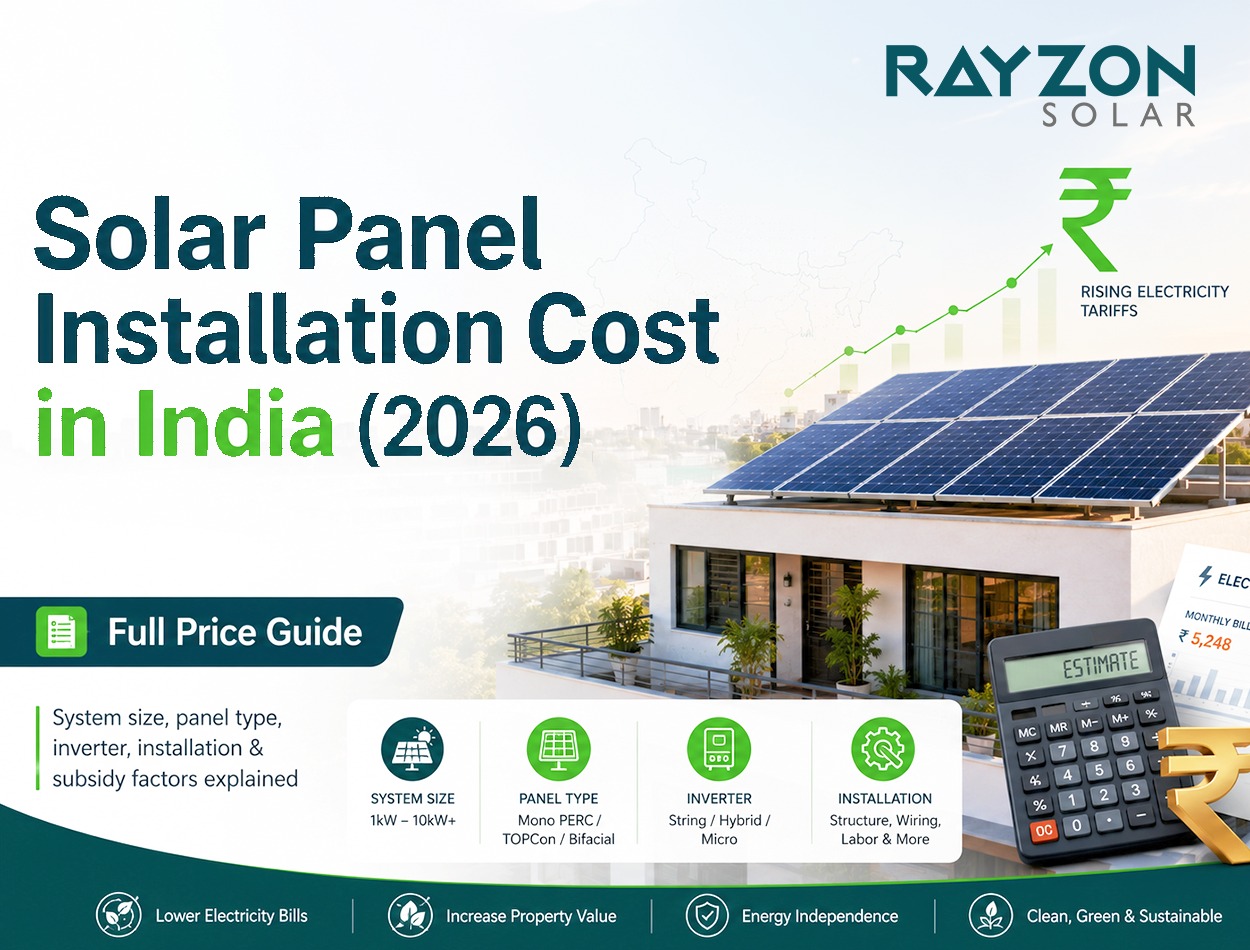
Solar panel cost in India changes with system size, panel type, and how complex the installation is, but residential rooftop systems typically fall between ₹40,000 and ₹60,000 per kW before subsidy. A right-sized 3 kW home system generally costs around ₹1.5–2 lakh before the central subsidy kicks in. (Confirm the current price band with the sales team before publishing, since prices move with input costs and GST.)
Under PM Surya Ghar: Muft Bijli Yojana, homeowners can get up to ₹78,000 in central subsidy for a 3 kW or larger residential rooftop system, paid straight into the applicant's bank account once the DISCOM inspects and signs off on the installation.
Yes. Rayzon Solar manufactures its TOPCon, bifacial, monofacial, and black solar modules at its facility in Gujarat, India, with a current production capacity of 11.3 GW.
TOPCon (Tunnel Oxide Passivated Contact) panels generally run more efficient and handle heat better than standard PERC panels — meaning they lose less power output on hot days, which matters across most Indian regions.
Solar panels typically carry a 25-year performance warranty along with a separate product workmanship warranty. Exact terms vary by product line, so it's best for buyers to confirm the specific warranty for their chosen panel — TOPCon, bifacial, monofacial, or black module — at the time of purchase.
(To confirm current ALMM listing status directly with the compliance team before publishing — ALMM approval is model-specific and the list is updated periodically by MNRE.)
A 3 kW solar system usually needs around 300–330 sq. ft. of shadow-free roof space, though this can shift slightly depending on the panel wattage and mounting structure used.
Net metering lets a rooftop solar owner send surplus electricity generated during the day back to the DISCOM grid, which is then credited against the electricity drawn from the grid at other times — lowering the net monthly bill. Exact rules and export limits vary by state.
Yes. Housing societies can install rooftop solar on common-area terraces to power lifts, pumps, and shared lighting, subject to DISCOM approval and, in many states, group net metering provisions for the society's shared electricity connection.
Yes. Panels certified to IEC standards and tested for Indian conditions are built to handle high ambient temperatures, coastal humidity, dust build-up, and monsoon rainfall — though regular cleaning and a well-rated mounting structure help keep long-term output steady.
An on-grid system stays connected to the DISCOM grid and uses net metering, with no battery backup. An off-grid system runs on batteries and works independently of the grid. A hybrid system combines both — grid connectivity plus battery backup during outages.
Rayzon Solar's Joint Managing Director, Chirag Nakarani, appeared as an investor ("Shark") on Shark Tank India Season 4, where he backed and mentored eco-friendly and sustainability-focused startups.
With today's electricity tariffs and the PM Surya Ghar central subsidy factored in, most Indian residential rooftop solar systems pay back their net investment in roughly 3–5 years — after which the electricity generated is essentially free for the rest of the panel's life.
Interested businesses can apply directly through Rayzon Solar's distributor application page. The company's channel team then reviews each application based on region, business profile, and market requirements.
Yes. Rayzon Solar's TOPCon and bifacial module ranges are supplied for residential, commercial, and industrial rooftop and ground-mount installations, both across India and internationally.
Rayzon Solar manufactures out of its Gujarat facility and reaches customers across India through an established distribution and project network, backed by an EcoVadis sustainability rating and a growing environmental impact footprint.
Beyond manufacturing, Rayzon Solar's panels have already been credited with helping power 500K+ homes and preventing an estimated 1M+ tons of CO₂ emissions. These aren't just brand numbers — they connect directly to India's own renewable energy roadmap, which targets 500 GW of non-fossil fuel capacity by 2030. Every rooftop and industrial installation using Rayzon Solar panels adds, in a small but real way, to that national goal.
Rayzon Solar operates from Gujarat and serves customers, distributors, EPC companies and project developers across India.
Its growing international presence includes markets such as the USA, Canada, Germany, South Africa and Kenya. This wider reach reflects the company’s focus on meeting different technical, quality and market requirements.
Rayzon Solar also works to make its manufacturing and business practices more responsible. Its sustainability initiatives and EcoVadis assessment support the company’s approach to environmental, social and governance performance.
Through Indian solar manufacturing, advanced module technology and long-term industry partnerships, Rayzon Solar contributes to the wider transition towards cleaner energy. The company’s purpose goes beyond producing solar panels. It is focused on helping homes, businesses and large projects generate dependable clean electricity for many years.