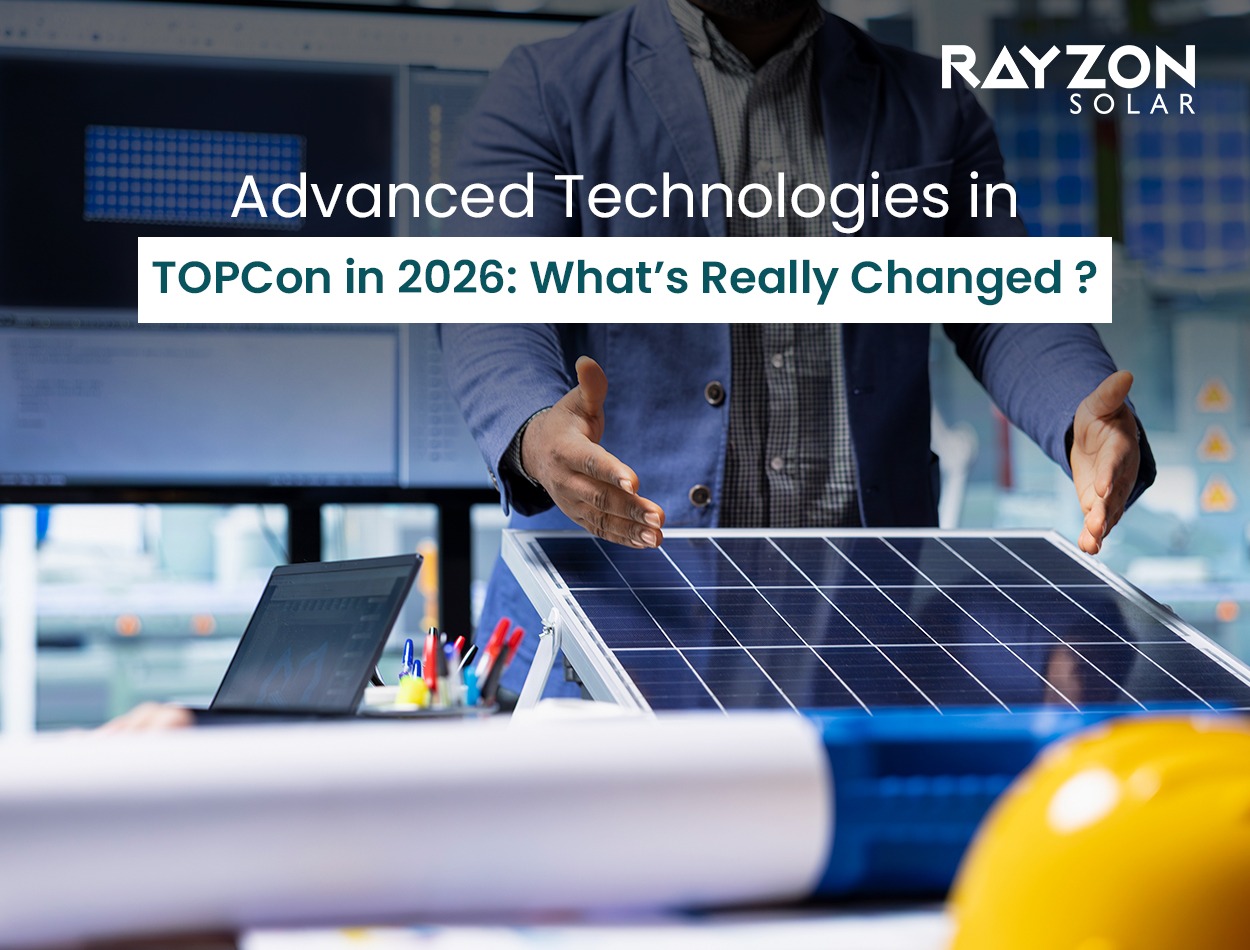
Advanced Technologies in TOPCon in 2026: What’s Really Changed?
A few years ago, TOPCon was spoken about the way new technologies usually are — with excitement, comparisons, and a lot of “this might be the future” of energy.
By 2026, that phase is over.
TOPCon is no longer the exciting new kid in the solar industry. It’s the technology most serious manufacturers, developers, and EPCs have adapted and rely on. And the interesting part is not that TOPCon exists — it’s how much it has evolved without making too much noise.
If you last looked at TOPCon in 2022 or 2023, you might think you already understand it. In reality, like any other technology development, now TOPCon in 2026 is a very different beast.
From “High Efficiency” to Controlled Efficiency
Early conversations around TOPCon were all about efficiency numbers. Who touched 25%. Who crossed it. Who published the next lab result.
What changed over time is focus.
Manufacturers realised that efficiency only matters when it can be controlled, repeated, and delivered at scale. That’s where most of the real innovation in TOPCon has gone in 2026 — not into flashy headlines, but into stability.
Tunnel oxide layers, for example, are no longer just “thin layers” on a datasheet. They are now engineered with extremely tight thickness control, simply because even microscopic inconsistencies show up as voltage losses when you’re producing gigawatts, not megawatts.
This is boring innovation. And that’s exactly why it works.
The quiet improvement inside the poly layers
Another place where TOPCon has matured is the poly-silicon passivation layer. Early designs focused on getting the concept right. In 2026, the focus is on getting every wafer to behave the same way.
Better doping precision, cleaner interfaces, and reduced parasitic absorption mean something very practical on the ground: power classes are more consistent, mismatch losses drop, and EPCs stop getting unpleasant surprises after installation.
For large developers, this matters more than a decimal increase in efficiency. Predictability has become a feature — even if it’s not advertised loudly.
Metallization: doing more with less
One of the least glamorous but most important upgrades in TOPCon has been metallization.
Silver prices didn’t politely wait for the solar industry to catch up. So manufacturers did what they always do under pressure — they innovated.
By 2026, TOPCon cells are using finer grid lines, smarter busbar designs, and in many cases, copper-assisted approaches to reduce silver dependency. The outcome isn’t just cost control. It’s also better current collection, lower resistive losses, and stronger mechanical performance during transport and installation.
Again, this is the kind of progress that doesn’t sell itself well — until a project runs smoothly because of it.
Designed for the real world, not the lab
Another noticeable shift in TOPCon development is where performance gains are being chased.
Instead of obsessing only over standard test conditions, manufacturers are optimising TOPCon for how solar plants actually operate — in heat, dust, humidity, and low-light conditions.
Lower temperature coefficients, stronger bifacial response, and better early-morning and late-evening generation have quietly improved energy yields per watt installed.
This is why TOPCon has become particularly attractive in hotter regions and emerging solar markets. It performs when conditions are less than ideal — which, in the real world, is most of the time.
Bigger modules, stronger confidence
TOPCon’s compatibility with large wafers, bifacial designs, and glass-glass modules has also matured by 2026. Early concerns around handling, breakage, and reliability have largely been engineered out.
What remains is a module architecture that delivers higher output without compromising durability — something financiers and insurers care deeply about, even if end-users does or doesn’t see always at it.
This is one of the reasons TOPCon projects today are easier to finance than many experimental alternatives.
So what should decision-makers really ask in 2026?
Not whether a module is TOPCon.
That question is already outdated.
The real question is how well that TOPCon has been engineered, controlled, and manufactured.
Because in 2026, the difference between average and excellent solar performance doesn’t come from buzzwords. It comes from thousands of small, invisible improvements — and TOPCon happens to be where many of those improvements are quietly coming together.