Energy Yield vs Nameplate Wattage: The Metric the Solar Industry Still Undervalues
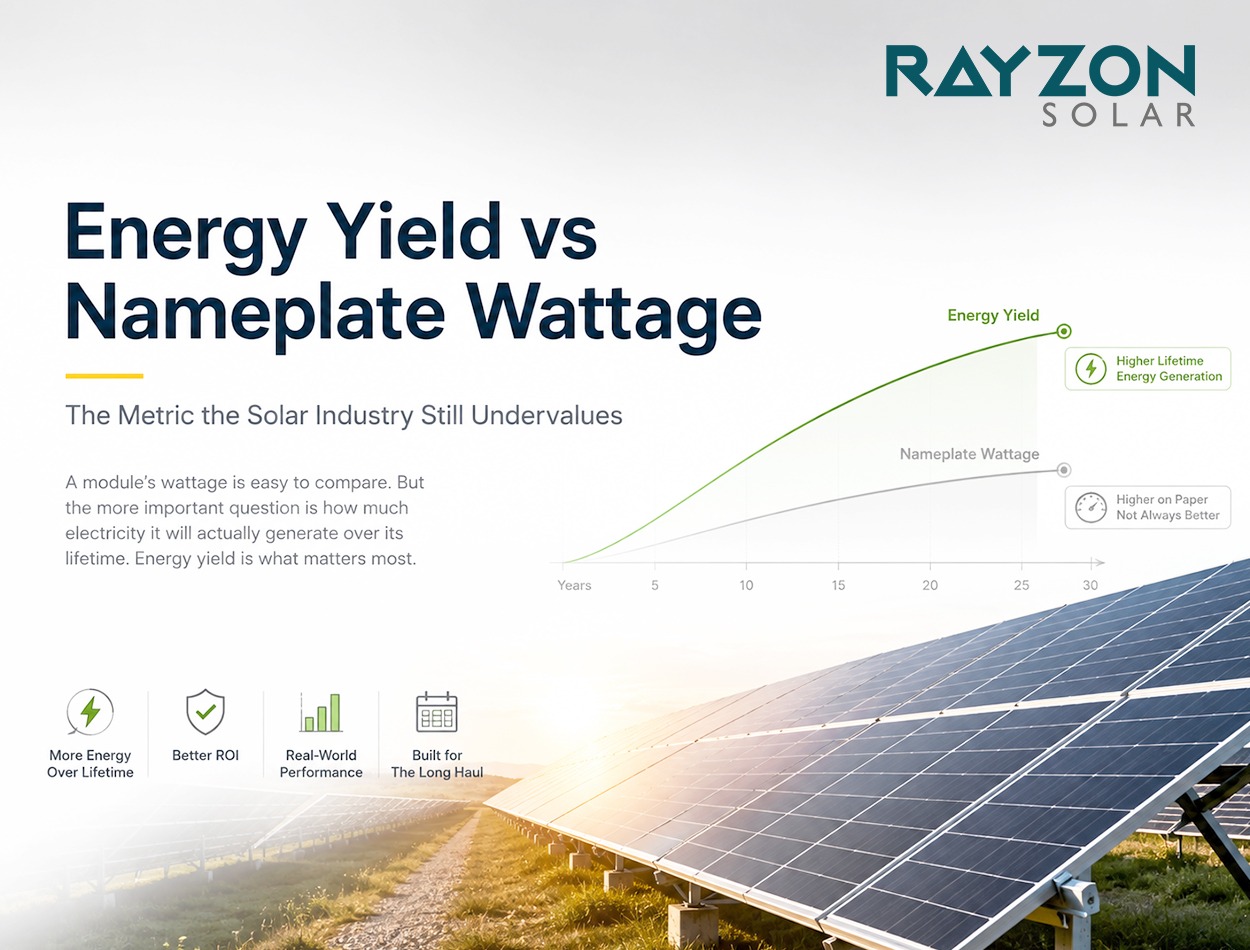
A solar module’s wattage is easy to compare. A 550 W panel appears better than a 540 W panel. But nameplate wattage tells only part of the story.
For project owners, the more important question is: How much electricity will the module actually generate over its lifetime? The energy yield matters the most here.
Wattage Is a Test-Condition Number
Manufacturers rate modules under Standard Test Conditions (STC): 1,000 W/m² irradiance, 25°C cell temperature and AM1.5 spectrum. Real operating conditions rarely match these conditions.
Temperature can quickly change the equation. Most crystalline-silicon modules have a negative power temperature coefficient. NREL’s SAM documentation lists around -0.49%/°C as a representative value for crystalline silicon modules. As cell temperature rises, maximum power falls. So, a higher-wattage module does not automatically deliver higher annual energy.
Degradation Changes Lifetime Yield
Modules also lose some performance over time. NREL’s long-term field studies show that degradation varies significantly by technology and module. Some modules have recorded annual degradation below 0.3%, while others have exceeded 1% per year.
Therefore, module selection should consider the degradation profile, not only the first-year nameplate rating.
Inverter Clipping Can Change the Outcome
A larger DC array can also interact with inverter capacity. When PV power exceeds the inverter’s limit, the inverter clips the excess output. NREL and Sandia describe this as inverter saturation or clipping.
This makes the DC-to-AC ratio an important design metric. A well-designed system can use a higher DC capacity to improve production during lower-irradiance periods while accepting some peak clipping.
Measure What the Project Actually Produces
The better comparison is specific energy yield: annual AC energy generated per kW of installed DC capacity (kWh/kW). SAM uses this metric to evaluate PV system performance.
For developers and asset owners, the smarter question is not simply, “How many watts does this module have?
It is: “How many kilowatt-hours will this module generate, and how consistently will it do so over its lifetime?” That is the metric that turns module wattage into real project value.