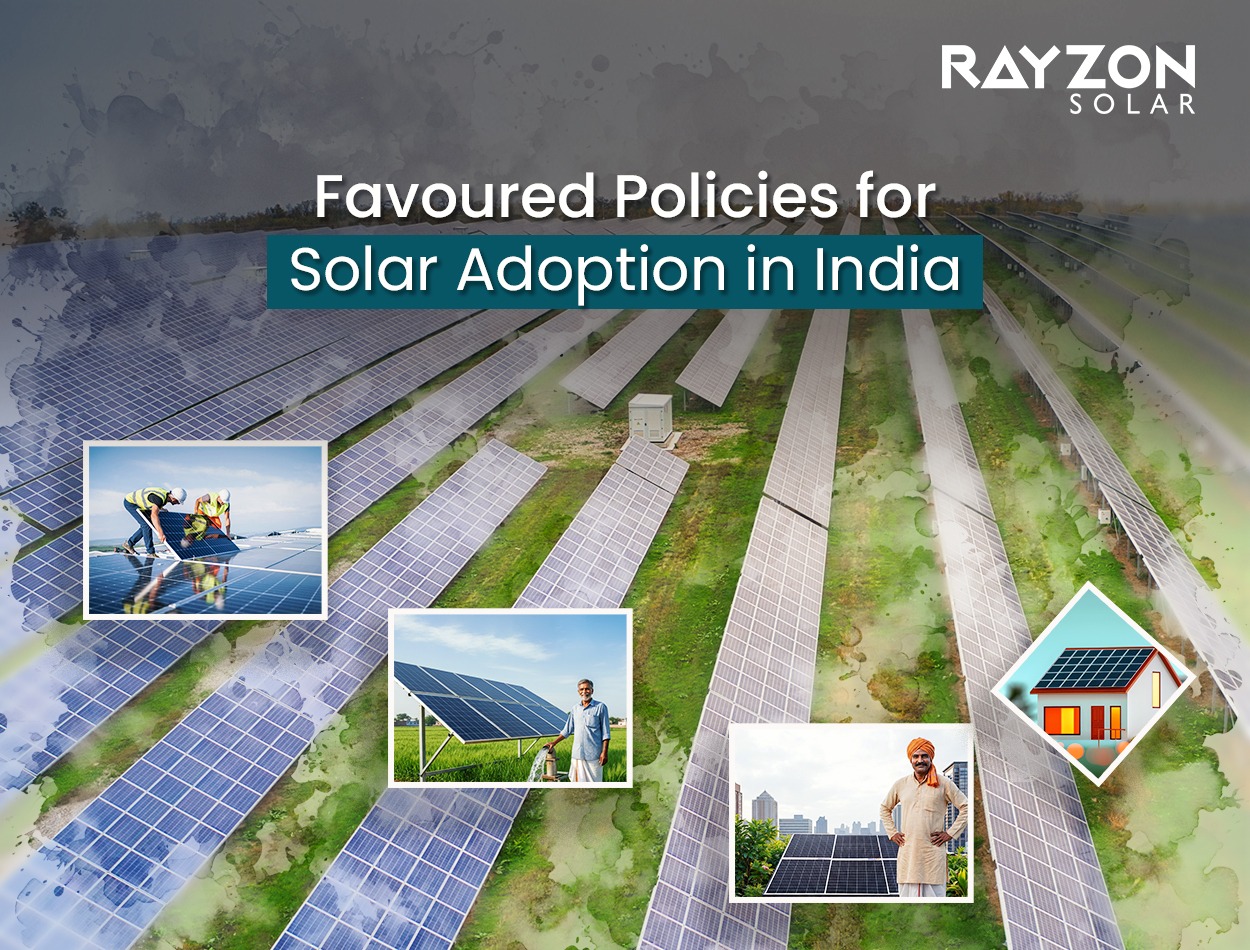
Favoured Policies for Solar Adoption in India
Solar adoption in India is no longer driven only by environmental intent. For industries, commercial establishments, and large businesses, solar energy has become a strategic power decision—supported by well-defined government policies that improve cost efficiency, energy security, and long-term predictability.
This blog explains the key government-backed policies that favour solar adoption for the commercial and industrial (C&I) sector, written in simple, practical language and strictly aligned with official policy frameworks.
Solar as a Strategic Power Source for Industry
Electricity cost is one of the substantial component of operating expenses for manufacturing units, warehouses, IT parks, hospitals, malls, and commercial complexes. Government policies are designed to help such consumers:
- Reduce dependency on grid power
- Hedge against rising electricity tariffs
- Achieve long-term cost visibility
- Meet sustainability and ESG requirements
Solar policies in India focus on self-generation, grid optimisation, and domestic manufacturing support, making them particularly relevant for the industrial ecosystem.
Rooftop Solar Policy for Commercial & Industrial Buildings
The MNRE’s solar rooftop solar framework allows factories, office buildings, warehouses, hotels, and institutions to install rooftop solar systems primarily for captive consumption.
Key benefits for C&I consumers:
- Reduced daytime power procurement from DISCOMs
- Faster payback period
- Insulation from future tariff hikes
- Better utilisation of idle rooftop space
While direct capital subsidies are largely focused on the residential segment are not required in C&I due to higher utility tariffs, industries benefit through policy stability, simplified approvals, and predictable net metering mechanisms.
Net Metering & Gross Metering – Improving Project Economics
For businesses, net metering plays a crucial role in optimising solar returns.
In practical terms:
- Excess solar power generated during low-load periods can be exported to the grid
- Exported energy is adjusted against imported grid power
- Monthly electricity bills are adjusted based on overall import and export resulting in maximized savings
Some states also follow gross metering or hybrid models, depending on load size and voltage level. These frameworks ensure that industrial solar projects remain bankable and financially attractive for investment.
Net metering regulations are governed by State Electricity Regulatory Commissions (SERCs), ensuring region-specific grid stability.
Open Access & Captive Solar Policy (For Large Power Consumers)
For industries with high power demand, government policies allow procurement of solar power through:
- Open Access Solar
- Captive Power Plants
These mechanisms enable businesses to source solar energy from off-site plants while complying with regulatory norms.
Policy advantages include:
- Reduced energy charges from the day plant is commissioned remotely
- Flexibility in power sourcing
- In case of captive plants waiver on electricity duties
- Alignment with renewable purchase obligations (RPOs)
Several states have introduced policy measures to streamline open access approvals and rationalise charges, improving adoption among large consumers.
GST Benefits on Solar Projects
The reduced GST structure on solar photovoltaic modules and related components directly impacts project cost for commercial and industrial installations.
For businesses, this results in:
- Lower capital expenditure
- Improved internal rate of return (IRR)
- Better financial planning for solar assets
GST rationalisation has played a key role in positioning solar power as a cost-competitive alternative to conventional electricity.
State-Level Industrial Solar Policies
State governments play a critical role in industrial solar adoption through:
- Solar policies tailored for industrial estates and SEZs
- Faster grid approvals and connectivity
- Open access charge rationalisation
States such as Gujarat, Rajasthan, Maharashtra, Tamil Nadu, Karnataka, Haryana, and Telangana have structured solar policies that actively support industrial and commercial installations.
These state-level frameworks complement central policies and help address local grid and demand conditions.
Why Solar Policies Matter for Businesses
From an industrial perspective, these policies help:
- Predict and Control long-term power costs
- Improve energy security
- Meet sustainability and compliance goals
- Enhance operational resilience
Solar adoption, supported by policy clarity, has moved from being an optional initiative to a core business decision.
Conclusion
India’s solar policy framework is designed to support scalable, reliable, and economically viable adoption across industries and commercial establishments. With clear regulations, manufacturing incentives, and grid integration mechanisms, solar energy has become a dependable component of industrial power planning.
For businesses evaluating solar investments, understanding these policies is essential to structuring projects that are both compliant and commercially sound.
At Rayzon Solar, we closely align our manufacturing and solutions with India’s evolving policy ecosystem to support the country’s industrial energy transition.