How Do Solar Panels Work? Complete Beginner’s Guide
Choosing to install a Solar Panel on your rooftop is the most effective way to shield your family from rising electricity prices in 2026. A modern Solar Panel system not only provides a reliable backup during power cuts but also offers an incredible return on investment through the PM Surya Ghar: Muft Bijli Yojana. With India now ranking as the world’s third-largest solar producer, there has never been a better time to adopt solar solutions in India to achieve true energy independence.
The shift toward renewable energy is no longer just about the environment; it is a smart financial move. By installing high-efficiency solar panels, you can:
- Reduce your monthly electricity bills by up to 90%.
- Protect your home from annual utility tariff hikes.
- Benefit from "Made in India" module quality and robust government support.
What Are Solar Panels?
Solar panels are defined as advanced semi-conductor devices that convert electromagnetic radiation from the sun directly into electricity using the photovoltaic (PV) effect. These modules are comprised of an array of individual solar cells, typically manufactured from high-purity silicon. When photons from sunlight strike these cells, they interact with the silicon's atomic structure, dislodging electrons and initiating a flow of direct current (DC) electricity.
Primary Solar Panel Types for the Indian Market
The choice between different technologies significantly impacts the overall solar panel efficiency and the long-term return on investment (ROI). The three dominant types available in 2026 include:
- Monocrystalline Panels: The urban favourite. These sleek, dark modules provide the highest solar panel efficiency, squeezing every possible watt out of small city rooftops.
- Polycrystalline Panels: The reliable workhorse. While they require a bit more space, they remain a fantastic budget-friendly choice for larger rural homes.
- Bifacial Solar Panels: The 2026 trendsetter. Unlike standard modules, bifacial solar panels capture light from both sides, using the reflection from your roof to boost generation by up to 30%.
Comparative Technical Analysis of Residential Solar Modules
|
Feature |
Monocrystalline (Mono-PERC) |
Polycrystalline |
Bifacial (TOPCon) |
|
Typical Efficiency |
20% – 22% |
15% – 17% |
22% – 24.5%+ |
|
Aesthetics |
Solid Black / Dark Grey |
Speckled Blue |
Clear / Transparent Back |
|
Temperature Coefficient |
-0.35% / °C |
-0.42% / °C |
-0.30% / °C or better |
|
Degradation Rate |
0.5% – 0.7% / Year |
0.7% – 0.9% / Year |
0.35% – 0.45% / Year |
|
Bifaciality Factor |
0% (Standard) |
0% |
75% – 90% |
|
Best Application |
Urban homes with small roofs |
Large rural sheds |
Open terraces / White roofs |
Integrating high-efficiency solar panels into a home setup allows for a more compact footprint and lower balance-of-system (BOS) costs, as fewer mounting structures and wires are required to meet th e household's energy demand.
How Do Solar Panels Work?
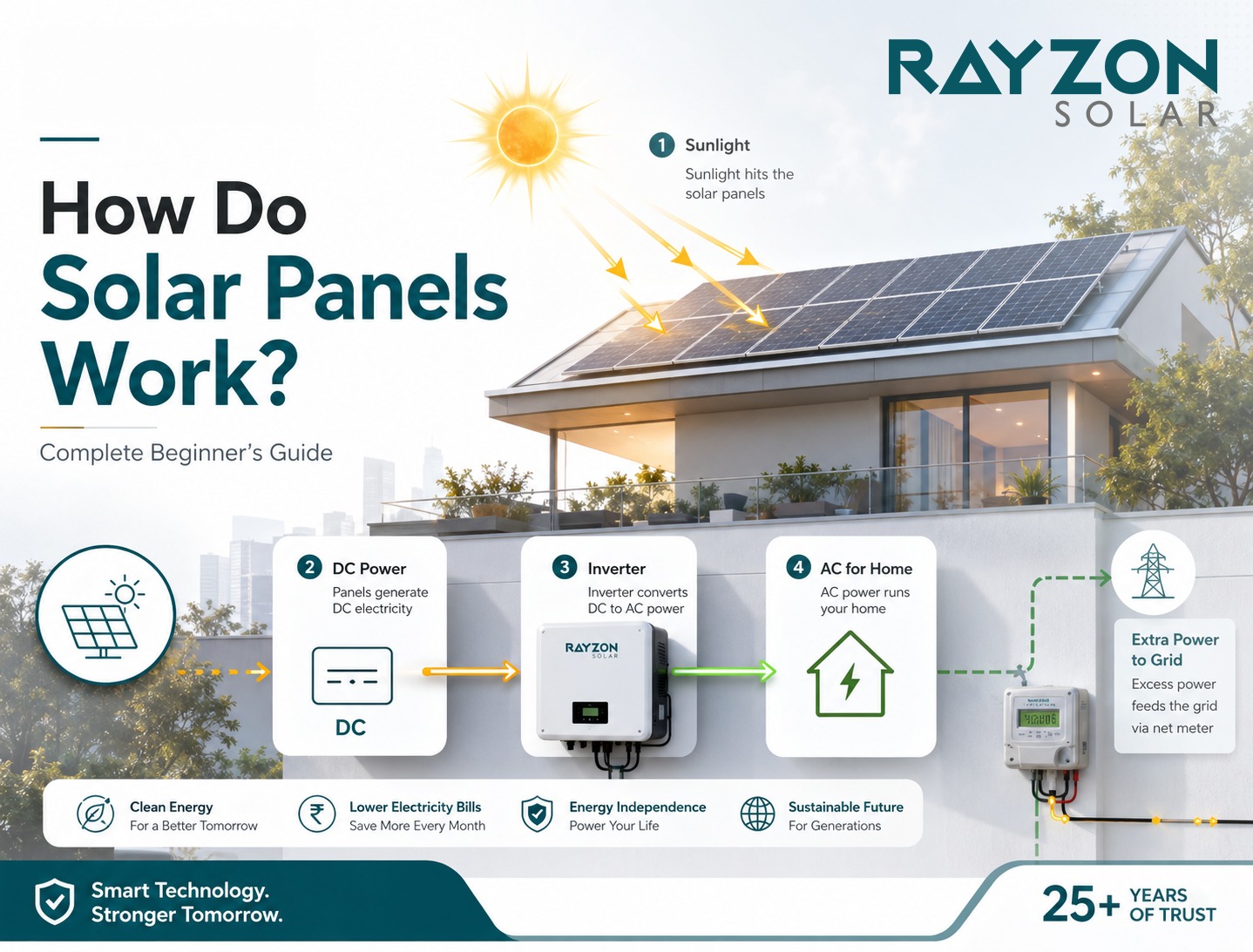
Understanding how solar panels work is essential for homeowners to optimize their energy usage patterns and maximize the benefits of net metering. The process is a seamless transition of energy across four distinct stages:
Step 1: Photon-Silicon Interaction
The process begins when sunlight—made of energy packets called photons—hits the surface of the solar panel. Modern 2026 modules use Anti-Reflective Coating (ARC) to absorb more sunlight and reduce reflection losses. Advanced technologies like TOPCon (Tunnel Oxide Passivated Contact) further improve efficiency by minimizing electron loss through a microscopic tunnel oxide layer, enabling higher energy conversion than conventional solar cells.
Step 2: Generation of DC Electricity
Inside the solar cell, photons transfer energy to electrons in the silicon, freeing them from their atoms and creating electron-hole pairs. The cell’s built-in electric field directs these electrons toward metal contacts, generating a flow of direct current (DC) electricity.
Step 3: Power Conversion via Inverter
The DC electricity flows through solar cables to the inverter, where it is converted into alternating current (AC) suitable for Indian homes operating at 50 Hz. Modern smart inverters in 2026 deliver over 98% conversion efficiency while also providing integrated surge protection for safer and more reliable performance.
Step 4: Household Consumption and Grid Export
The converted AC power powers household appliances first. Any excess electricity is exported to the utility grid through a bi-directional net meter, earning credits that reduce monthly electricity bills.
This works through the inverter, which synchronizes with the grid’s voltage and frequency to ensure a safe two-way flow of electricity.
Key Components of a Solar Power System
A reliable residential energy setup is a sophisticated ecosystem of hardware and software. Each component must be engineered to withstand the diverse Indian climate, from the intense heat to the heavy monsoons
Solar PV Modules: These are the primary collectors of energy. In 2026, the trend has shifted toward high-wattage modules, such as the L'lios TOPCon 580 Wp, which uses 144 half-cut cells to improve shade tolerance and durability.
- Solar Inverter: Acting as the system's brain, modern inverters in 2026 come with remote monitoring apps. Homeowners can choose from string inverters, which are cost-effective for clear roofs, or micro-inverters, which optimize each panel individually to mitigate the impact of partial shading.
- Mounting Structure: The skeleton that holds the panels must be made of Hot-Dip Galvanized Iron (HDGI) or Aluminum to prevent corrosion. For rooftops in coastal areas, high-grade 6005-T6 aluminum frames are essential to withstand salt mist and high humidity.
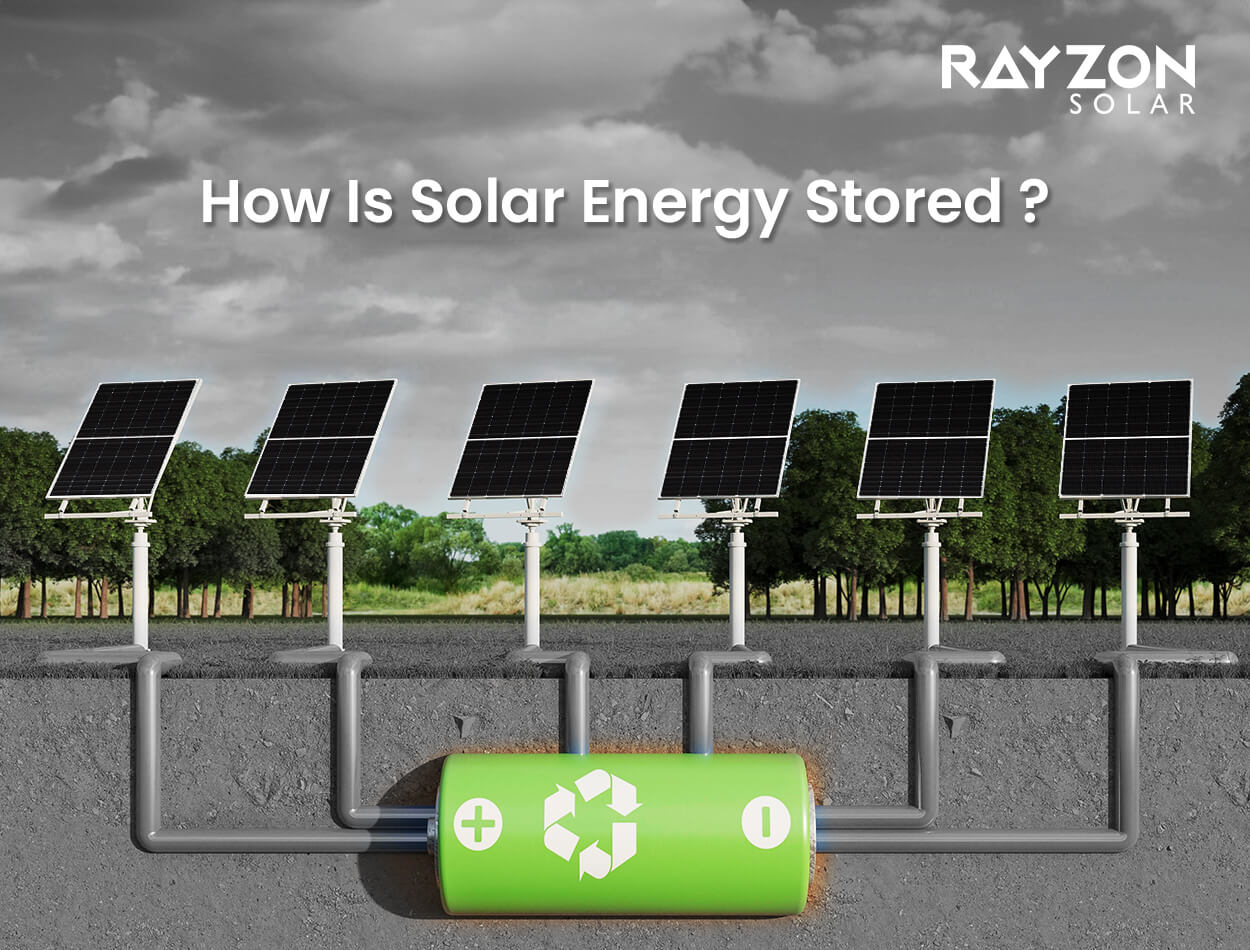
- Battery Storage (Optional): While not required for urban on-grid systems, batteries are crucial for energy security in areas with frequent power outages. Lithium-ion batteries (LiFePO4) have become the standard in 2026, offering 3,000 to 5,000 cycles and 10-year lifespans compared to traditional lead-acid variants.
- Net Meter: This is a bi-directional digital meter provided by the local DISCOM (Electricity Distribution Company). It tracks every unit (kWh) imported from and exported to the grid, enabling accurate billing adjustments.
- Earthing and Surge Protection: To protect the Solar Panel investment from lightning strikes and electrical surges, a complete system includes DC and AC surge protection devices (SPDs) and at least two separate earthing pits—one for the panels and one for the inverter and internal circuitry.
The integration of these hardware elements ensures complete solar system solutions that provide reliable power for three decades.
Types of Solar Panel Systems in India
Selecting the right system configuration depends on the homeowner's specific goals, whether it is maximum bill reduction, protection from power cuts, or complete energy independence.
1. On-Grid Solar Systems (The Urban Standard)
The on-grid or grid-tied system is the most popular choice for urban India in 2026. It is designed to work in tandem with the state utility grid. These systems are highly efficient and offer the fastest payback period because they do not require expensive battery banks.
- Financial Advantage: It leverages net metering to the fullest, allowing homeowners to "store" their excess daytime generation in the grid as credits.
- Urban Use-Case: A family living in a Mumbai or Bangalore apartment can install an on-grid system to bring their monthly bill of ₹5,000 down to zero, utilizing the grid as a "virtual battery".
2. Off-Grid Solar Systems (The Remote Solution)
Off-grid systems operate completely independently of the utility grid. They rely on large battery banks to store electricity for use at night or during cloudy days.
- Strategic Use: These are essential for rural homes or farmhouses where the grid is either absent or highly unreliable.
- Rural Use-Case: A remote farmhouse in Bihar can use an off-grid system with TOPCon modules to run lights, fans, and a refrigerator 24/7 without ever needing a grid connection.
3. Hybrid Solar Systems (The Best of Both Worlds)
Hybrid systems are connected to the grid but also feature a dedicated battery backup. This configuration ensures that the homeowner can earn net metering credits while also having power during utility failures.
- Flexibility: Smart hybrid inverters can prioritize self-consumption, battery charging, or grid export based on the time of day and battery status.
- Suburban Use-Case: A homeowner in Gurgaon, where grid power is available but afternoon outages are common during summer, can benefit from a hybrid system to ensure the AC stays running during a power cut.
Benefits of Solar Panels: The Indian Perspective
The value proposition of the Solar Panel in 2026 extends far beyond simple cost-cutting. It has become a tool for social empowerment and financial security.
- Electricity Bill Reduction: By generating their own electricity, Indian households can reduce their monthly expenses by 70% to 90%.
- Government Financial Incentives: The PM Surya Ghar Yojana provides a central subsidy of up to ₹78,000 for residential rooftops, effectively covering 40% to 50% of the installation cost for most middle-class homes.
- Exceptional ROI and Payback: With the abundant sunshine in India (averaging 4 to 7 peak sun hours daily), the payback period for a residential system has dropped to a record low of 3 to 4 years. After this period, the electricity generated is essentially free for the remaining 20+ years of the system's life.
- Protection from Inflation: Grid electricity prices in India are sensitive to global fuel prices and infrastructure costs. Solar power provides a fixed, zero-marginal-cost energy source that shields families from future tariff hikes.
- Eco-Friendly and Sustainable: A 5kW system prevents approximately 6 tons of carbon emissions annually. By early 2026, residential solar has collectively helped India save over 1 million tons of CO₂.
The benefits of installing solar panels are increasingly visible in communities where the "neighbor effect" is taking hold; seeing one house with a zero-rupee bill often inspires the entire colony to make the switch.
Detailed Analysis of Solar Panel Price in India
Navigating the solar panel price landscape in 2026 requires an understanding of how technology and scale have influenced market dynamics. While module prices have fallen significantly since 2023, the total solar panel cost includes engineering, procurement, and construction (EPC) services that ensure safety and compliance.
Factors Influencing the Cost per Kilowatt
- Cell Technology: Monocrystalline PERC modules are currently the most cost-effective. Premium N-type TOPCon and bifacial modules carry a 10% to 15% price premium but offer higher total lifetime energy generation.
- Domestic Content Requirement (DCR): To avail of central subsidies, homeowners must use "Made in India" DCR-compliant cells and modules. These are specifically tracked under the ALMM list.
- Installation Complexity: Costs can vary based on whether the roof is a standard flat concrete terrace (RCC) or a sloped metal shed, which may require specialized mounting hardware costing an extra ₹8,000 to ₹15,000.
2026 Average Residential Solar Price & Subsidy Estimates
|
System Capacity |
Total Estimated Price (₹) |
Central Subsidy (₹) |
Effective Net Price (₹) |
|
1 kW |
₹65,000 – ₹85,000 |
₹30,000 |
₹35,000 – ₹55,000 |
|
2 kW |
₹1,10,000 – ₹1,50,000 |
₹60,000 |
₹50,000 – ₹90,000 |
|
3 kW |
₹1,65,000 – ₹2,10,000 |
₹78,000 |
₹87,000 – ₹1,32,000 |
|
5 kW |
₹2,75,000 – ₹3,50,000 |
₹78,000 (Capped) |
₹1,97,000 – ₹2,72,000 |
|
10 kW |
₹5,50,000 – ₹7,50,000 |
₹78,000 (Capped) |
₹4,72,000 – ₹6,72,000 |
Understanding the solar panel pricing in India also involves checking for state-level top-up subsidies. For example, Uttar Pradesh and Delhi provide an additional ₹30,000 for 3kW systems, which can bring the effective cost down to nearly ₹70,000—a historic low for energy infrastructure.
Energy Generation: What to Expect from a 1 kW System?
Homeowners often base their sizing decisions on the potential output of the system. In the Indian climate, a 1 kW setup is the fundamental building block of energy estimation.
The 1 kW Benchmark in India
On average, a 1 kW Solar Panel system in India will generate 4 to 5 units (kWh) of electricity per day. This equates to:
- Monthly Generation: 120 to 150 units.
- Yearly Generation: 1,440 to 1,800 units.
Household Sizing Calculation Example
To calculate the ideal capacity for a home, the owner should analyze the latest electricity bill. If a household consumes 360 units per month, a 3kW system is the "sweet spot."
- Calculation: 3kW x 4.5 units/day x 30 Days = 405 units/ month
- Buffer: This 405-unit generation provides a healthy margin for seasonal variations and the 0.5% annual degradation typical of high-quality modules.
In sun-abundant states like Rajasthan and Gujarat, peak generation can reach up to 5.5 units per kW, while during the overcast days of the monsoon in Western Ghats, it may dip to 2.5 units.
Is Your Home Suitable for Solar Panels?
Before investing in a Solar Panel setup, a technical feasibility check is mandatory. A professional site assessment ensures that the system delivers its rated performance for the full 25-year duration.
Technical Suitability Checklist
- Shadow-Free Roof Area: A 1 kW system requires approximately 80 to 100 square feet. A standard 3 kW residential setup needs about 250 to 300 square feet of clear, unobstructed space.
- Shadow Analysis: High-rise buildings, water tanks, trees, or nearby mobile towers must not cast shadows on the panels between 9:00 AM and 4:00 PM, which are the peak solar radiation hours.
- Rooftop Structural Integrity: The roof must be capable of supporting a load of approximately 15-20 kg per square meter. If the roof is old or made of lightweight materials, it may require structural reinforcement.
- South-Facing Orientation: In the Northern Hemisphere (including India), panels must face true South to maximize sunlight capture. Deviations toward East or West are acceptable but will result in a 10% to 15% reduction in annual units generated.
By utilizing expert solar consultation services, homeowners can obtain a detailed 3D shadow layout of their terrace, identifying the precise coordinates for every module to ensure maximum ROI.
Maintenance and Longevity: Protecting Your Investment
One of the most attractive features of the Solar Panel is its minimal maintenance requirement. However, in the dusty and polluted urban environments of India, "minimal" does not mean "zero."
- Lifespan Expectations: Modern Tier-1 solar panels are engineered to last 25 to 30 years. By 2026, linear performance warranties typically guarantee that the panels will still produce 80% to 85% of their original output after three decades.
- Cleaning Protocol: Due to the high levels of suspended particulate matter (dust) in Indian air, panels should be cleaned every 10 to 15 days. A layer of dust can block up to 30% of sunlight, directly impacting the units generated. Cleaning should be done with plain water and a soft brush during early morning or late evening to avoid thermal shock to the hot glass.
- Inverter and Wiring Check: An annual inspection of the inverter's cooling fans, electrical connections, and earthing resistance is recommended. Most installers in 2026 offer an Annual Maintenance Contract (AMC) for a nominal fee of ₹3,000 to ₹5,000.
Keeping the inverter area well-ventilated and the rooftop free of bird droppings (which can cause "hot spots") are the two most important habits for a successful solar owner.
The Technical Edge: TOPCon vs. Mono PERC in 2026
If you are evaluating the best solar panels for your home in 2026, the discussion will inevitably center on TOPCon (Tunnel Oxide Passivated Contact) versus traditional Mono PERC technology.
- Efficiency Superiority: TOPCon modules achieve commercial efficiency levels of 22.5% to 24.5%, whereas Mono PERC has hit a ceiling around 21% to 22%.
- Lower Temperature Coefficient: In Indian summer conditions where rooftops reach temperatures of 60°C to 70°C, TOPCon modules lose significantly less power than older designs, resulting in up to 10% more units generated in states like Rajasthan or Gujarat.
- Bifacial Compatibility: TOPCon is inherently better suited for bifacial module designs. With a bifaciality factor of 80% to 88%, these panels capture more reflected light from the back side than older bifacial PERC modules.
Conclusion: The Path to Energy Independence
The mass adoption of the Solar Panel has permanently shifted the balance of power in India—literally. No longer are we just consumers; we are owners of our energy destiny. By combining modern TOPCon technology with the incredible support of the PM Surya Ghar Yojana, your rooftop can become your most productive financial asset for the next 30 years.
The choice is clear: keep paying for electricity forever, or "pre-pay" for it once and enjoy decades of freedom. To take your first step toward a zero-rupee bill, explore Rayzon Solar solutions and watch your home join the clean energy revolution today
FAQ: Essential Questions for Indian Homeowners
What is the average lifespan of solar panels in India?
Modern, high-quality solar panels have a functional lifespan of 25 to 30 years. Most reputable solar panel manufacturers in 2026 provide a 25-year or 30-year linear power warranty, guaranteeing that the module will still operate at over 80% efficiency at the end of its life.
How do solar panels work during the monsoon?
While they produce less power on very dark days, they still absorb "diffuse" light. A great bonus of the rainy season is that the rain naturally scrubs the dust off your modules, often leading to a surge in solar panel efficiency once the sun breaks through!
What happens to my solar power at night?
Solar panels require sunlight and do not generate electricity at night. For on-grid systems, the home automatically draws power from the utility grid. If your state has a net metering policy, the "units" you exported during the day are used to offset this nighttime consumption.
Are solar panels worth it in India in 2026?
Yes, they are one of the best financial investments available today. With government subsidies of ₹78,000 and the rising cost of grid power, the annual return on investment (ROI) for solar is between 18% and 28%—significantly higher than fixed deposits or most mutual funds.