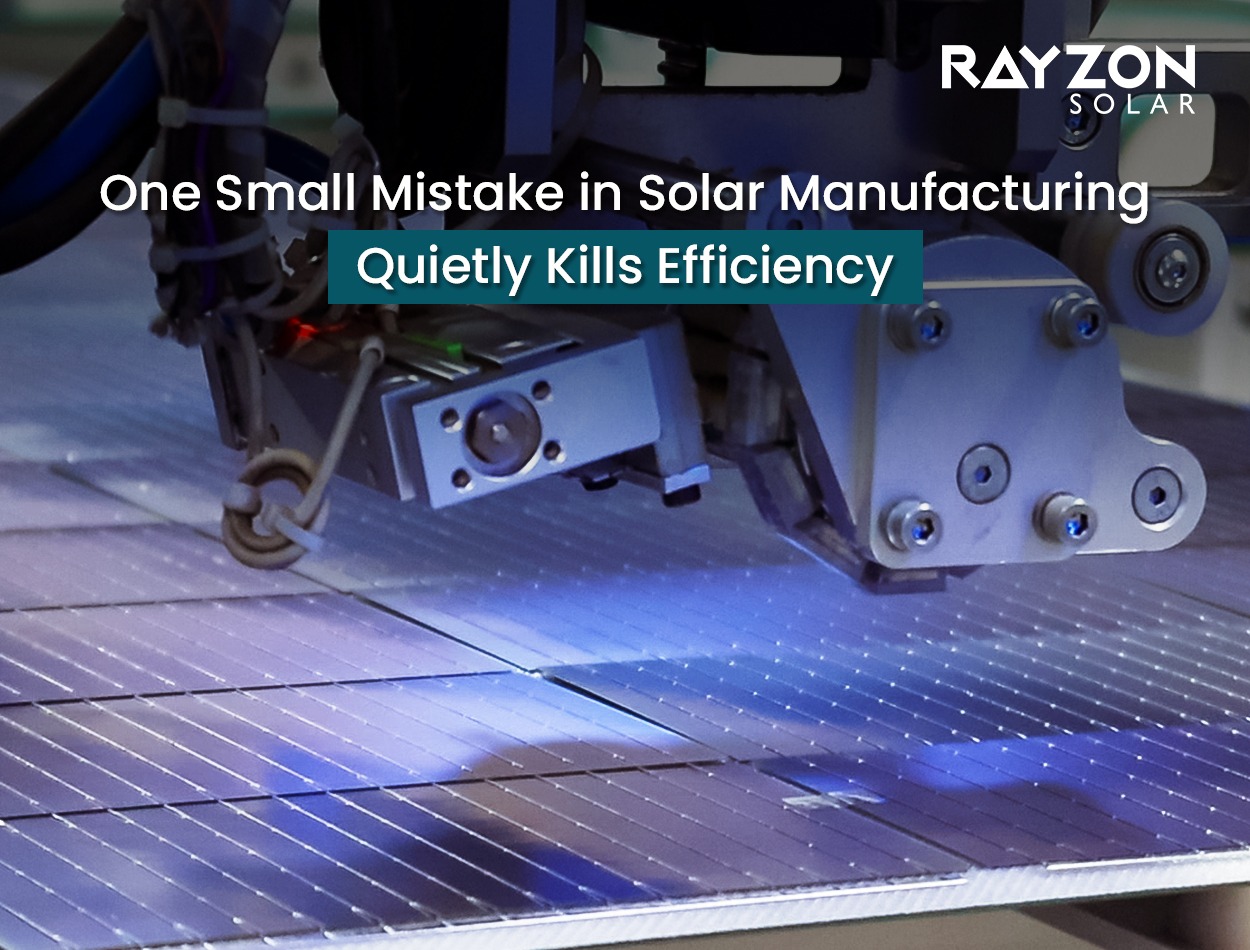
One Small Mistake in Solar Manufacturing Quietly Kills Efficiency
Solar panels look solid, silent, and reliable once they are installed on a rooftop or in a solar park. But what most people won’t see is this:
A panel’s longevity and its performance is decided long before it even kisses sunlight for first time. It is decided inside the factories those converts polysilicon to solar panels and others where balance of components gets produced. A slight variation. A missed check. A process that was “almost right.”
And in solar manufacturing, almost right is not enough.
It Always Starts With Silicon
Everything begins with silicon. If the silicon is not pure enough, the rest of the process is only damage control.
Impurities don’t announce themselves. They sit quietly inside the material, impacting performance. The panel still works. The wattage still looks fine on paper. But over time, its performance starts sliping.
That’s why serious manufacturers obsess over raw material quality. Because once impure silicon enters the line, there is no fixing it later.
Thin Wafers, Thick Consequences
Silicon wafers are sliced from ingots which gets casted from electronic grade polysilicon, any impurity that remains while casting of ingots would remain there through the life weakening a point in the cell which can become non conducing spot as compared to rest of cell area making that spot suspectable for HOT spots leading to ultimate accelerated degradation and eventually failure of module.
None of this is visible once the panel is laminated. But days later, those tiny flaws show up as reduced output.
The Coating That Decides How Much Sunlight Even Enters the Cell
Solar cells are designed to absorb light, not reflect it. That’s where the anti-reflective coating comes in.
If this coating is uneven or slightly off in thickness, more sunlight bounces away than it should. The panel still looks perfect. But it is already losing part of energy before conversion even begins.
This is one of those steps where the eye sees nothing, but performance feels everything.
Those Silver Lines Are Not Just Lines
Look closely at a solar cell, and you’ll see fine metallic lines running across it. Their job is to collect free electrons from the area connected.
If these lines are too thick, they block light.
If they are too thin, resistance increases.
It’s a balancing act. A few microns here and there can change how efficiently current flows. Metallization is one of those processes where “good enough” quietly becomes “not good enough.”
When Cells Meet Each Other, New Problems Can Appear
A solar panel is not one cell. It’s many cells working together. If the interconnections are not perfect—slightly misaligned, overheated, or weakly soldered—resistance builds up. Sometimes it turns into hotspots. Sometimes it just reduces output over time.
One bad connection can limit the performance of an entire module. That’s how unforgiving series connections are.
Lamination: The Step That Decides How Long the Panel Will Last
Lamination is where everything gets sealed for decades. It’s like making a delicious dish in cooker so temperature, pressure, or vacuum and duration of lamination plays important role in quality of solar panels. It’s a master chef who perfects the recipe, if not done well
- Moisture finds a way in
- Layers start separating
- Degradation speeds up
Most lamination issues don’t show up immediately. They show up months later, when replacement is expensive, and trust is already lost.
Glass Matters More Than It Looks
Solar glass is not just a protective layer. It is an active participant. Lower transparency means less light reaches the cells. Minor defects increase reflection. Over 25 years, even a small reduction in light transmission adds up to serious energy loss. Good glass quietly boosts performance every single day.
The Real Point Most People Miss
A single machine or innovation does not create solar to perform. It is created and protected by discipline at every stage.
A 1% loss today doesn’t sound serious. But over 25 years, it means lost units, lost savings, and lost trust. That’s why in solar manufacturing, the smallest details matter the most—because they stay with the panel for its entire life.