Microcracks in Solar Modules: The Silent Revenue Leakage in Solar Investment
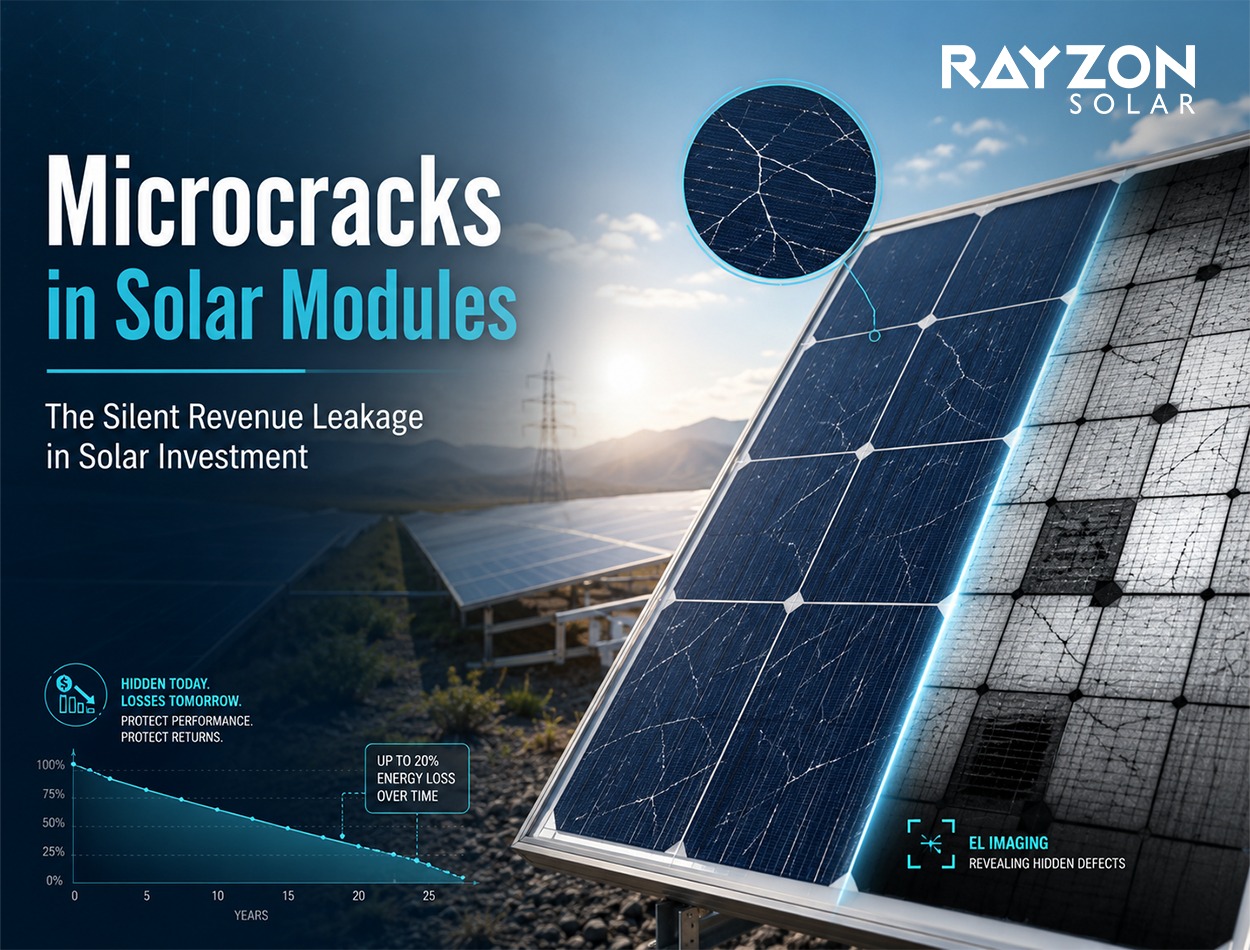
Microcracks are among the most overlooked threats to solar plant performance. They are often invisible to the naked eye, yet they can reduce energy generation over time. If left undetected, these tiny fractures gradually turn into significant generation losses impacting project financials.
Solar cells experience mechanical stress through its life, including manufacturing, transportation, installation, and operation. Even careful handling alone cannot eliminate every risk. Vibrations, improper loading, or extreme weather can initiate microcracks that slowly propagate across the cell.
The real challenge begins after installation. As modules undergo thermal cycling and mechanical loading, these microcracks expand. Damaged cell areas become electrically inactive, reducing the module's power output. According to studies by the International Energy Agency (IEA PVPS), the National Renewable Energy Laboratory (NREL), and Fraunhofer ISE, microcracks are among the leading contributors to long-term photovoltaic module degradation and performance loss.
Electroluminescence (EL) imaging plays a critical role in detecting these hidden defects. Unlike visual inspection, EL imaging reveals inactive cell regions and crack patterns before they become visible in field conditions. Hence, manufacturers use this technology to identify defective modules during production and quality assurance, while installers use it post-installation and as part of O&M services.
Microcracks also increase the risk of hotspot formation. When damaged cells carry uneven current, or breaks flow of current, localised heating develops. These hotspots accelerate material degradation, reduce module reliability, and may shorten the overall system lifespan. In large utility-scale projects, even a small percentage of affected modules can translate into measurable annual revenue losses.
Preventing microcracks requires quality-focused manufacturing and sophisticated handling practices. Advanced cell interconnection technologies, optimised lamination processes, controlled transportation, and multiple EL inspections throughout production significantly reduce defect risks before modules reach project sites.
At Rayzon Solar, quality assurance extends beyond standard visual inspection. Comprehensive testing and advanced inspection processes help identify hidden defects before shipment. This proactive approach supports long-term module reliability, maximises energy yield, and protects project returns throughout the asset's operating life.
Invisible defects should never become invisible losses. Detecting microcracks early is one of the most effective ways to safeguard solar investments and maximise lifetime energy production.