Net Metering Solar: Complete Guide to Net Metering for Rooftop Solar in India (2026)
The transition to sustainable energy has accelerated across the country as Net Metering Solar systems become the standard for reducing rising commercial and residential electricity expenses. Adopting Net Metering Solar technology allows properties to generate power locally and export surplus energy back to the utility grid. Implementing solar net metering provides a robust financial mechanism that makes grid-interactive rooftop systems highly lucrative. Setting up a net meter for solar system installations ensures that no excess electricity goes to waste.
With rising electricity costs, growing rooftop solar adoption, and government support through PM Surya Ghar: Muft Bijli Yojana, solar net metering is now a key part of India’s clean-energy shift. MNRE reported 27.88 GW of grid-connected rooftop solar capacity as of 31 May 2026, showing how quickly rooftop solar is scaling across the country.
This complete 2026 guide by Rayzon Solar details the regulatory framework, application steps, and financial benefits of rooftop solar net metering. Installing a bidirectional solar net meter serves as the primary asset to unlock massive savings and achieve energy independence.
What is Net Metering Solar?
To define the mechanics of bidirectional grid interaction, energy analysts examine how a distributed solar generator balances local consumption with the wider grid. Under conventional billing systems, a property draws energy unilaterally from the local distribution company (DISCOM) and is billed linearly for total consumption. By integrating a structured Net Metering Solar framework, consumer meters record both energy consumed and energy returned. This two-way tracking replaces unilateral power purchases with an offset system. Securing a solar net meter connection shifts the property owner's role from a consumer to an active energy producer. Processing a solar net meter application with the regional utility represents the primary administrative step in grid-tied solar projects.
The physical and electrical offset is mathematically modeled using standard LaTeX notation.
Net Consumption (kWh)=Import (kWh)−Export (kWh)
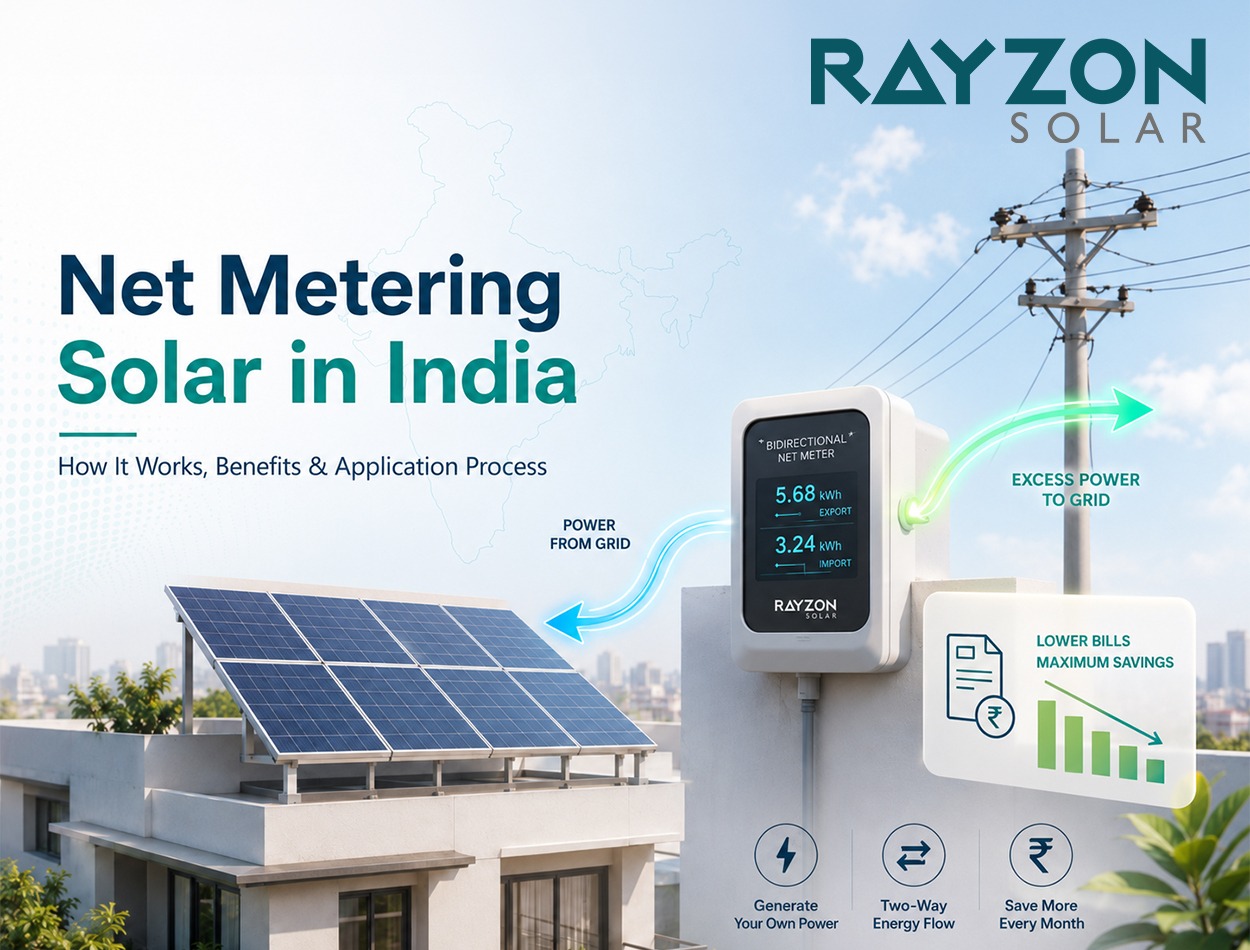
Net metering acts like a "bank account" for your electricity. During sunny midday hours, your panels often generate more power than your property needs—this surplus is "deposited" (exported) into the grid. At night or during cloudy weather when solar generation stops, you "withdraw" (import) that power back. At the end of the billing cycle, you are only charged for the net difference between your deposits and withdrawals.
To illustrate these financial dynamics under standard operating conditions, consider a residential property consuming 500 units of electricity in a billing cycle. If the rooftop solar array generates 650 units during the same period, the excess 150 units are automatically exported to the grid. The monthly billable consumption drops to zero, and the utility rolls the 150 surplus units forward as an energy credit to offset future imports, leaving only the standard fixed service charges.
Traditional Billing vs Net Metering
|
Billing Type |
How It Works |
Impact on Consumer |
|
Traditional electricity billing |
You pay for all units consumed from the grid |
No credit for self-generated solar power |
|
Net metering solar system |
You consume solar first and export surplus power |
Imported units are adjusted against exported units |
|
Gross metering |
Solar generation is sold separately to DISCOM |
Savings depend on feed-in tariff |
Net Metering Solar Definition
How Does Net Metering Work in a Solar System?
To understand how net metering works, one must examine the real-time electrical balance of a grid-tied property. The flow of energy operates through five highly
Step 1 – Solar panels generate electricity
Solar panels convert sunlight into DC electricity. The inverter converts this into AC electricity that can be used by your home, building, or factory.
Step 2 – Your property consumes solar power first
Your appliances, machines, lights, pumps, or office loads use the solar power generated during the day. This direct self-consumption is where solar savings begin.
Step 3 – Excess electricity is sent to the grid
When your solar generation is higher than your immediate consumption, the surplus electricity flows to the DISCOM grid through a solar net meter connection.
Step 4 – Bidirectional meter records import and export
A net meter for solar system is a bidirectional meter. It records:
- Import units: electricity taken from the grid
- Export units: solar electricity sent to the grid
- Net units: final units considered for billing adjustment
Step 5 – Electricity bill is adjusted
At the end of the billing cycle, the DISCOM adjusts exported units against imported units. This is the main benefit of solar net metering.
Simple flowchart
Solar Panels → Inverter → Home/Business Load → Excess Power → Solar Net Meter → DISCOM Grid → Bill Adjustment
Does the electricity meter run backwards in net metering?
In the past, older mechanical analog meters with rotating disks would physically spin in reverse when electricity was exported to the grid. However, modern utility grids utilize electronic digital bidirectional meters. These digital meters do not run backward; instead, they record import and export values in separate, dedicated electronic registers (frequently labeled as IMP and EXP codes on the display screen).
What is a Net Meter?
A bidirectional meter is a highly calibrated digital utility instrument approved by your local DISCOM that can measure electricity flow in two distinct directions. Unlike conventional meters that only record the volume of energy drawn from the utility, a bidirectional meter continuously monitors current phase and voltage angles to track energy moving from the grid into your property (import) and energy moving from your solar panels out to the grid (export). The utility company replaces your standard billing meter with a designated solar net meter once your solar installation has passed grid safety checks.
Difference Between Conventional and Net Meter
The core operational difference lies in the meter's register mechanics. Conventional electricity meters are designed for unilateral current flows. If a grid-tied solar system is connected to a conventional meter and begins exporting power, the meter may either fail to record the export, register an error code, or in some older analog mechanical configurations, count the exported power as additional imported consumption—effectively charging you for the electricity you generate.
The technical differences between standard billing meters and net meters are outlined below:
|
Feature |
Normal Meter |
Net Meter |
|
Import Register |
Yes, tracks consumption from grid |
Yes, tracks grid draw |
|
Export Register |
No, cannot record power flow back to grid |
Yes, tracks solar export |
|
Solar Compatibility |
No, may register export as import or error |
Yes, designed for grid-interactive solar |
|
Billing Adjustment |
No, bills for total grid consumption only |
Yes, calculates imports minus exports |
|
Display Mechanics |
Single register display |
Multi-register rolling display |
Benefits of Net Metering Solar in India
Analyzing the impact of decentralized generation reveals why bidirectional metering is the primary financial driver for solar energy adoption. One of the prominent advantages of Net Metering Solar in India is the ability to offset high utility tariff slabs. While the upfront solar net meter price is paid directly by the consumer, its long-term impact on bill savings is substantial. Project developers note that the total net metering cost is relatively minor compared to the overall PV system expenditure.
1. Lower electricity bills
The biggest benefit of solar net metering is monthly bill reduction. You use your own solar power first, and exported units help reduce your payable grid units.
2. Faster solar ROI
A rooftop solar system gives better payback when surplus generation is properly adjusted. This is why many consumers check solar net meter calculator tools before finalizing system size.
3. Better use of excess solar energy
Without rooftop solar net metering, unused daytime solar power may not deliver full value. Net metering helps you get benefit from excess generation.
4. Reduced dependence on grid power
With a well-designed solar system, your daytime grid dependency reduces. For homes, offices, schools, hospitals, and factories, this improves long-term energy planning.
5. Higher property value
A rooftop solar system with a proper solar net meter connection can make a property more energy-efficient and future-ready.
6. Environment-friendly energy usage
Every unit generated from rooftop solar reduces dependence on conventional grid power and supports cleaner energy use.
Savings Snapshot
|
Consumer Type |
Typical Solar Use Case |
Possible Benefit |
|
Residential users |
Daytime home load, appliances, EV charging |
Lower monthly bill and PM Surya Ghar subsidy eligibility |
|
Commercial users |
Offices, showrooms, schools, hospitals |
Reduced operational electricity cost |
|
Industrial users |
Factories, warehouses, process load |
Better long-term energy planning and sustainability reporting |
Actual savings depend on location, electricity tariff, DISCOM rules, sanctioned load, consumption pattern, solar generation, and applicable settlement policy.
Net Metering vs Gross Metering
A common search query is net metering vs gross metering. Both are solar billing mechanisms, but they work very differently.
|
Factor |
Net Metering |
Gross Metering |
|
Core Energy Consumption |
Priority is given to local self-consumption; only the surplus is exported. |
No local consumption; 100% of generated power is exported to the grid. |
|
Meter Setup |
A single bidirectional net meter is utilized. |
Two separate meters are installed: one for import and one for export. |
|
Financial Savings |
High; offsets high-slab retail utility tariffs directly. |
Moderate; depends on set feed-in tariff rates. |
|
Billing Method |
Calculated using net units (Imports minus Exports). |
Imports and exports are billed separately under different rates. |
|
Adoption in India |
Highly popular, especially for residential and small commercial users. |
Limited; typically restricted to utility-scale or specific commercial projects. |
Who Can Apply for Solar Net Metering in India?
The basic criteria for solar net metering eligibility depend on a property owner holding an active grid connection. Understanding how to get net metering approval is critical for avoiding administrative delays with utility engineers. Most state frameworks allow a broad spectrum of consumers to apply, provided they hold an active electricity connection and own or have legal rights to the installation premises.
- Homeowners: Individual residential properties with sufficient, shadow-free rooftop space can apply for systems ranging from 1 kW up to their sanctioned load.
- Housing Societies: Resident Welfare Associations (RWAs) and Group Housing Societies can install shared solar arrays on common terrace spaces to offset common area electricity loads, such as water pumps, elevators, and corridor lighting.
- Commercial Buildings: Offices, retail malls, and hotels can leverage solar systems to lower peak daytime operating costs.
- Factories and Industrial Units: Manufacturing facilities with high daytime energy requirements can install systems up to 1 MW (or higher in states like Maharashtra) under commercial net metering programs. Before applying for a solar net meter connection, industrial entities must ensure compliance with pollution control rules.
- Educational Institutions: Schools, colleges, and university campuses with large rooftop areas can offset high daytime air conditioning and lighting loads.
Commercial operators frequently ask what is net metering in solar system feasibility for plants larger than 100 kW. Municipalities and resident welfare associations utilize rooftop solar net metering to significantly offset common facility lighting costs.
These consumer categories must satisfy technical constraints before the DISCOM will approve an application. The primary requirement is that the proposed solar inverter capacity cannot exceed the property's sanctioned load. For example, if a home has a sanctioned load of 5 kW, the maximum solar inverter capacity that can be connected is 5 kW.
Net Metering Rules and Regulations in India (2026)
Rooftop solar regulations in India have undergone significant updates to streamline grid integration, expand project size limits, and introduce virtual accounting mechanisms. The central guidelines governing Net Metering Solar rules aim to protect consumers and standardize the operational timelines of utilities.
The draft National Electricity Policy signals a potential shift from net metering vs gross metering for installations above 5 kW. Some states are transitioning from net billing vs net metering structures for high-capacity C&I installations. The table below outlines the diverse limits across key states in 2026:
|
State |
Residential Sizing Limit |
Commercial Sizing Limit |
Export Rate Details |
|
Gujarat |
Up to 15 kW typical |
Up to 1,000 kW (1 MW) |
₹2.25 per unit |
|
Maharashtra |
Up to 10 kW guaranteed |
Up to 5,000 kW (5 MW) |
APPC rate (₹3.50–₹4.00) |
|
Delhi |
No capacity restriction |
No capacity restriction |
Retail tariff + GBI incentive |
|
Karnataka |
Up to 500 kW |
Up to 500 kW |
₹3.57 per unit |
|
Kerala |
≤3 kW (Proposed restriction) |
Up to 500 kW |
Consumption tariff |
|
Tamil Nadu |
Up to 1,000 kW (1 MW) |
Up to 1,000 kW (1 MW) |
₹2.25 per unit |
|
Rajasthan |
Up to Sanctioned Load |
Up to 1,000 kW (1 MW) |
Retail tariff or APPC rate |
|
Uttar Pradesh |
Up to 500 kW |
Up to 500 kW |
Consumption tariff |
State Regulatory Highlights (2026)
- Gujarat (GERC 2026): The 2026 regulatory update introduced a structured five-tier metering matrix. Sizing limits for Net Metering run from 1 kW up to 1 MW. For systems above 100 kW contract demand, BESS integration is mandatory if the solar capacity exceeds the sanctioned load. The storage must hold at least 2 hours of daily charge/discharge capacity for 50% of the excess solar capacity. Deemed acceptance is granted for systems up to 10 kW without a feasibility study, and systems up to 6 kW are exempt from grid strengthening charges.
- Maharashtra (MERC 2026): Net metering is a consumer right for residential systems under 10 kW. The settlement cycle runs annually to March. Time-of-Day (TOD) billing is mandatory for connections above 10 kW. Under TOD, peak-hour consumption (Zone 3, 5 PM to 12 AM) carries a 20% surcharge, while daytime solar hours (Zone 2, 9 AM to 5 PM) offer seasonal rebates of 15% to 25%, penalizing users who do not store daytime generation for evening use.
- Delhi (DERC 2024–2027): The 2024 policy targets 4.5 GW solar capacity by 2027. It offers free net meter installation and a state capital subsidy of ₹2,000 per kW (capped at ₹10,000). Residential users receive a Generation-Based Incentive (GBI) of ₹3/unit (up to 3 kW) and ₹2/unit (3 to 10 kW) adjusted directly on monthly bills.
Documents Required for Net Metering Application
Executing a solar net meter application requires submitting a detailed single-line diagram signed by a certified engineer. Property owners must apply to procure an approved solar net meter that matches the local DISCOM’s phase configuration. Estimating the upfront net metering cost helps commercial establishments structure their payback calculations.
The standard documentation package must include:
- Latest Electricity Bill: High-resolution copy showing the consumer name, address, and sanctioned load.
- Consumer Identification: Aadhaar Card and PAN Card matching the name on the electricity account.
- Property Ownership Proof: Sales deed, property tax receipt, or index copy.
- Roof Ownership/Consent Declaration: Non-objection certificate (NOC) if the system is installed on a shared roof or rental property.
- Technical Single Line Diagram (SLD): Signed by a chartered electrical engineer, illustrating the electrical layout, grid isolation switches, and safety disconnects.
- Equipment Certificates: Bureau of Indian Standards (BIS) and ALMM registration certificates for the panels and inverter.
Pro Tip: Before submitting a solar net meter application, match the name on your electricity bill, ownership proof, and portal application. Many net metering application delays happen because basic details do not match.
Step-by-Step Net Metering Application Process
The timeline for securing a solar net meter connection is legally capped at 30 days under central electricity guidelines. A structured roadmap on how to get net metering details the technical feasibility check and installation testing steps. The administrative process follows seven operational milestones :
Step 1: Site Survey & Technical Layout
An engineer evaluates the structural strength of the roof, the pitch, and shadow patterns.
Step 2: Sizing and SLD Drafting
Design teams calculate system requirements, ensuring the solar inverter rating does not exceed the consumer's sanctioned load.
Step 3: Application Filing
The empanelled solar installer files the application on the online portal of the local DISCOM (or via the national portal).
Step 4: Technical Feasibility Report (TFR)
A DISCOM engineer inspects the local transformer capacity. If the local transformer has adequate capacity, the utility issues a TFR within 7 to 15 days.
Step 5: Solar System Build
The solar array is installed by an empanelled contractor using ALMM-listed and BIS-compliant components.
Step 6: Joint Inspection
Upon installation completion, the installer submits a work completion report. DISCOM inspectors test earthing systems and confirm the inverter's anti-islanding safety feature shuts down solar power generation when grid power is cut.
Step 7: Meter Sealing and Commissioning
The unidirectional meter is replaced with a calibrated bidirectional meter. The DISCOM issues a formal commissioning certificate, activating the solar billing mechanism.
How Much Money Can You Save with Net Metering?
Savings from net metering solar depend on how much solar power you use directly, how much you export, and how your DISCOM adjusts exported units.
The table below outlines typical financial performance across three standard solar system sizes in India in 2026:
Financial Offsets for Standard Solar System Configurations
|
Sizing Parameter |
3 kW Residential System |
5 kW Residential System |
10 kW Commercial System |
|
Monthly Generation Yield |
~360 Units (kWh) |
~600 Units (kWh) |
~1,200 Units (kWh) |
|
Property Monthly Baseline Draw |
400 Units (kWh) |
700 Units (kWh) |
1,500 Units (kWh) |
|
Grid Export Volume (Surplus) |
~100 Units (kWh) |
~200 Units (kWh) |
~400 Units (kWh) |
|
Average Retail Tariff Slab |
₹7.00 per Unit |
₹8.00 per Unit |
₹9.50 per Unit |
|
Estimated Monthly Savings |
₹2,500 – ₹3,500 |
₹4,800 – ₹6,000 |
₹11,000 – ₹13,000 |
|
Typical Project Payback Period |
3 to 3.5 Years |
3.5 to 4 Years |
4 to 5 Years |
Common Challenges in Net Metering
Prosumers facing grid connection issues should ensure their net meter for solar system conforms to standard utility specifications. When planning how to get net metering authorization, coordinating closely with an empanelled contractor is recommended.
- Approval Delays: Site inspections and technical reviews can take longer than the mandated 30 days due to localized administrative backlogs or staffing constraints.
- Grid Capacity Constraints: DISCOMs limit total solar solar injection on a single distribution transformer to 30% or 50% of its rated capacity. If the transformer is overloaded, new applications may be rejected until the utility upgrades the infrastructure.
- State Policy Changes: Retroactive policy adjustments—such as transitioning from net metering to lower-priced net billing or altering settlement rates—can change project economics.
- Meter Availability: Utilities may experience shortages of approved bidirectional meters. To resolve this, consumers are typically permitted to purchase a certified, compatible meter directly from approved private manufacturers and submit it to the utility's testing laboratory for calibration and sealing.
Net Metering Solar for Residential Users
Deploying Net Metering Solar setups for residential consumers aligns with national green energy programs. Homeowners opting for solar net metering can dramatically reduce their monthly dependencies on grid power. Under the PM Surya Ghar Muft Bijli Yojana, residential installations receive structured central subsidies :
- 1 kW Systems Eligible for a central subsidy of ₹30,000.
- 2 kW Systems: Eligible for a central subsidy of ₹60,000.
- 3 kW & Larger Systems: Eligible for a maximum central subsidy capped at ₹78,000.
To claim the central subsidy, residential systems must use Domestic Content Requirement (DCR) solar panels manufactured using Indian-made cells.
However, to bypass supply chain bottlenecks and rising domestic equipment costs, the Ministry of New and Renewable Energy introduced the "Give It Up" campaign on June 8, 2026. This regulatory update allows residential consumers to use more affordable, imported non-DCR panels under the PM Surya Ghar program, provided they voluntarily forgo the central capital subsidy. These consumers can still connect their systems to the grid through net metering and receive full unit-for-unit bill credits, offering an alternative pathway for budget-conscious or timeline-sensitive installations.
Homeowners frequently inquire, how does net metering work when solar panels are covered in dust or during monsoons? While generation drops, accumulated summer credits roll forward to offset winter consumption.
Net Metering Solar for Commercial and Industrial Consumers
Industrial prosumers find that utilizing a Net Metering Solar structure provides high return on investment. Transitioning commercial properties to solar power lowers daytime operating expenses, hedges against rising utility tariffs, and satisfies corporate ESG sustainability goals.
C&I consumers face unique regulatory structures:
- Time-of-Day (TOD) Mismatch: In states with mandatory TOD billing, exported solar energy generated during daytime hours (Zone 2) cannot be used to offset evening peak bills (Zone 3) at a 1:1 financial rate. Because evening consumption is subject to a 20% surcharge, businesses face a financial mismatch if they consume heavily after sunset.
- BESS Requirements: Under GERC 2026, large commercial prosumers with a contract demand exceeding 100 kW who install solar capacity beyond their contracted load must deploy a Battery Energy Storage System (BESS). The battery must support at least two hours of daily charging/discharging for at least 50% of the excess solar capacity, ensuring localized energy balancing and reducing peak demand on the grid.
Future of Net Metering in India
As smart grid technologies develop, the integration of rooftop solar net metering with decentralized battery storage will expand. The future landscape of grid-interactive solar in India is characterized by three major shifts:
AI-powered Energy Management
Smart grids utilize real-time communication between solar inverters and central utility control systems to prevent localized grid instability and optimize localized consumption.
Storage-Linked Sizing
Regulatory frameworks are shifting from simple grid-exporting models to storage-integrated systems. This allows prosumers to store excess daytime generation locally and discharge it during evening peak periods, reducing strain on the grid.
Why Choose Rayzon Solar for Rooftop Solar Solutions?
Choosing the right solar module and partner is as important as understanding net metering. A high-quality rooftop solar system should be designed for performance, safety, durability, and long-term energy output.
Rayzon Solar supports consumers and businesses with high-efficiency solar solutions, advanced solar module technology, and a strong renewable energy vision.
Rayzon Solar advantages
- Premium solar panels for long-term performance
- High-efficiency module technology
- Reliable solar manufacturing expertise
- Suitable for residential, commercial, and industrial rooftop projects
- Support for India’s clean energy transition
- Trusted solar technology partner
Conclusion
Selecting a high-efficiency Net Metering Solar configuration guarantees decades of low-cost energy generation and operational peace of mind. By turning a passive rooftop into a bidirectional power generation asset, net metering allows homes and businesses to offset high electricity tariffs, lower their operating costs, and contribute to national carbon reduction goals. While the application process requires careful attention to technical and documentation details, working with experienced installers and choosing high-performance modules ensures a smooth installation and a fast return on investment.
Looking to maximize your solar savings with net metering? Explore Rayzon Solar's high-performance solar modules and start your solar journey today.
Frequently Asked Questions
What is net metering in solar?
To define what is net metering in solar system frameworks, utilities refer to the netting of exported and imported energy. It subtracts exported solar units from imported grid units, billing the consumer only for the net difference.
How does a solar net meter work?
How does a net meter for solar system work under daily conditions? It records import and export values separately. Can a layman explain how does net metering work in plain English? Unused solar energy is deposited into the grid and withdrawn later. Where can a homeowner find instructions on how to read solar net meter in India rolling digital displays? Most utility portals provide a parameter code guide.
Is net metering available in all Indian states?
Can any domestic electricity consumer apply for a solar net meter connection in India? Yes, provided their system matches their sanctioned load. Net metering is available across most Indian states, though capacity limits, rules, and credit rates vary by state.
What is the difference between net metering and gross metering?
What are the core distinctions of net billing vs net metering configurations? One uses monetary credits while the other uses unit energy offsets. What is the physical difference under net metering vs gross metering installations? Net metering uses a single bidirectional meter while gross metering utilizes separate import and export meters.
Can I earn money by exporting solar power to the grid?
Yes, if your solar exports exceed your imports over the designated settlement period, you will accumulate energy credits. At the end of the settlement year (typically in March or April), the DISCOM will pay you for any remaining credits, usually at the state-approved Average Pooled Power Purchase Cost (APPC) rate.
What documents are required for net metering approval?
Which specific documents must accompany a solar net meter application to avoid DISCOM delays? Property papers, latest bills, and component certifications are required.
How long does net metering approval take?
How long does a solar net meter installation take after the completion of physical works? It typically takes 7 to 10 days, while the entire application process takes 20 to 45 days.
Is net metering beneficial for residential solar users?
Is solar net metering beneficial for residential solar users? Yes, it is the primary method to generate electricity bill credits and reduce bills by up to 90%.
What is virtual net metering?
Virtual net metering allows solar energy generated from a single, centralized array (such as a shared apartment roof or remote solar park) to be proportionally credited across multiple individual beneficiary electricity bills within the same DISCOM area.
Can commercial buildings use net metering?
Is the physical solar net meter price included in standard solar installation quotes or billed separately? It is frequently billed separately by the DISCOM. Commercial buildings can utilize net metering to offset high daytime operating costs and lower their retail energy expenses.