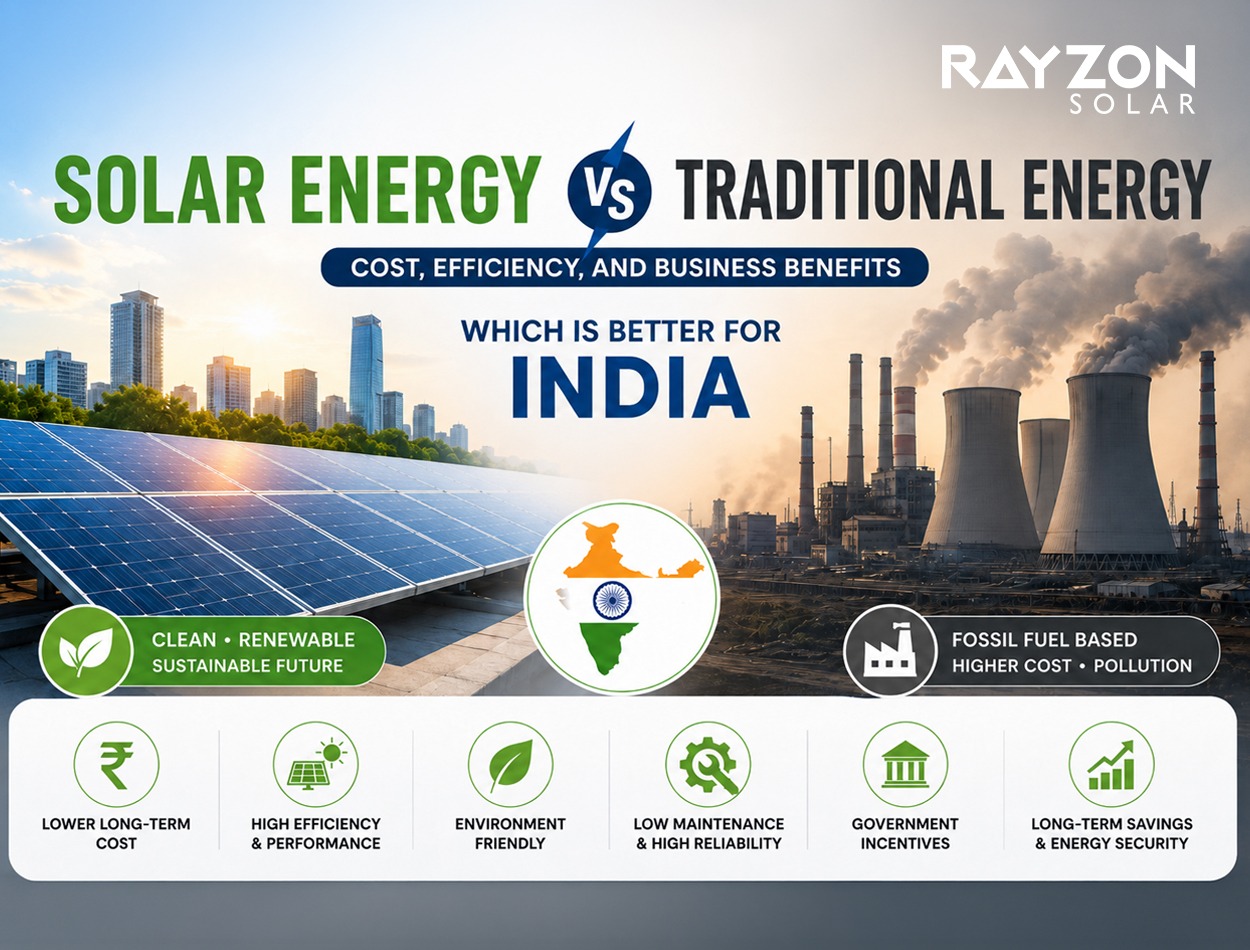
Solar Energy vs Traditional Energy: Cost, Efficiency, and Business Benefits
As India's economic growth accelerates, the nation faces a massive rise in electricity consumption, driving unprecedented interest in solar energy to meet this demand. Simultaneously, the transition away from traditional fossil fuels has highlighted the cost-effectiveness and scalability of decentralized solar power solutions. With conventional utility tariffs climbing steeply, households and commercial entities are actively seeking ways to stabilize their monthly operating budgets. Underpinned by supportive government policies, adopting solar energy has transitioned from a corporate responsibility into a core operational necessity. By integrating modern solar power systems, Indian businesses can lock in long-term operational savings and insulate themselves from volatile fuel markets.
This transition is not merely a localized shift but a nationwide movement driven by severe urban air quality concerns and international carbon reduction commitments. Traditional conventional power plants struggle with fluctuating fuel costs and distribution inefficiencies, prompting a comprehensive alignment of India's immense geographic solar potential with its rising power consumption.
What is Solar Energy?
Solar energy is defined as the electromagnetic radiation emitted by the sun, which can be harvested and converted into usable electricity or heat. The technology responsible for this conversion is solar photovoltaic (PV) technology. Solar PV panels function at the atomic level: when photons from sunlight strike the semiconductor material (typically highly purified silicon) inside a solar cell, they knock electrons free, creating an electric current. An inverter then converts this direct current (DC) into alternating current (AC), making it compatible with standard home appliances and commercial machinery.
Modern setups operate under two main configurations:
- Grid-Connected Systems: These are linked directly to the local utility grid. They utilize net-metering systems to feed surplus power back to the utility company, allowing users to earn credits or offset their night-time bills.
- Off-Grid Systems: These run completely independently of the utility grid, using battery storage banks to save daytime generation for use during cloudy weather or night hours.
Depending on the scale of deployment, these systems are categorized as rooftop solar systems installed on residential or commercial roofs, or utility-scale solar farms spanning vast tracts of land to feed power directly into the national transmission lines.
What is Traditional Energy?
Traditional energy refers to electricity generated from finite, conventional resources like coal, natural gas, and petroleum. These non-renewable fossil fuels are combusted in massive utility plants to drive the country's daily power grid.
Key aspects of India's traditional energy landscape include:
- Conventional Energy Sources:<
- Coal: The primary driver of India's energy grid, supporting over 72% of actual electricity generation due to its massive domestic abundance.
- Natural Gas & Petroleum: Mostly used for peak-load gas turbines and specialized industrial generation, though highly vulnerable to global price fluctuations.
- Diesel Generators: Heavily relied upon as localized backup systems in commercial and residential districts to manage grid instability and blackouts.
- Fossil Fuel-Based Thermal Power Plants: These utilities heat purified water to produce high-pressure steam, which spins massive generator turbines to produce electricity
- Grid and Distribution System: Once generated, power travels through high-voltage transmission lines to the electricity distribution system, managed by state-owned and private distribution companies (DISCOMs). DISCOMs handle last-mile delivery to end-consumers but face persistent Aggregate Technical and Commercial (AT&C) losses, which hover around 15.04% in 2026.
- Depletion of Non-Renewable Resources: Unlike solar, fossil resources are non-renewable and have limited availability. This inevitable depletion, combined with intense carbon taxation, is forcing a shift toward clean energy.
What are traditional sources of energy?
Traditional sources of energy refer to non-renewable, depleting fossil fuels such as coal, natural gas, and petroleum liquids that are combusted to produce electricity or localized mechanical power.
Why is coal still widely used in India?
Coal remains heavily utilized in India because it supports over 72% of actual electricity generation. It provides cheap, highly reliable, and easily dispatchable baseload power that stabilizes the grid during peak demand hours, despite the long-term environmental toll and depleting domestic reserves.
Solar Energy vs Traditional Energy: Major Differences
Understanding the performance and financial divergence between modern and conventional power is critical for long-term planning. The table below summarizes the key differentiators between these two models
|
Parameter |
Solar Energy |
Traditional Energy |
|
Energy Source |
Renewable (Sunlight) |
Non-renewable (Coal, Gas, Diesel) |
|
Pollution |
Very low operational emissions |
High carbon emissions and localized particulates |
|
Electricity Cost |
Lower long-term amortized cost |
Increasing continuously due to fuel inflation |
|
Maintenance |
Low; no moving parts |
High; ongoing mechanical wear |
|
Fuel Requirement |
Sunlight (zero operational fuel cost) |
Continuous supply of coal, gas, or diesel |
|
Sustainability |
Sustainable over 25+ years |
Depleting fossil resources |
|
Initial Investment |
Higher upfront CAPEX |
Lower initial connection or equipment cost |
|
Long-Term Savings |
Significant ROI and bill elimination |
Limited savings; exposed to tariff hikes |
|
Government Subsidies |
Significant central and state grants |
Rare; phased out for conventional fuels |
|
Environmental Impact |
Eco-friendly; aids carbon neutrality |
Harmful; causes smog and acid rain |
Cost
While traditional energy features lower initial installation costs, its lifecycle costs are exceptionally high due to fuel expenses and transmission fees. This contrast makes solar energy highly cost-effective over its 25-year operational lifespan.
Maintenance
Traditional combustion systems require heavy, scheduled maintenance to replace worn-out engine parts and turbines. Solar systems have zero moving parts, requiring only simple periodic cleaning of glass panels and basic inverter checks.
Pollution
Burning coal and diesel releases heavy particulates (PM₂.₅), sulfur dioxide, and nitrogen oxides. Conversely, solar systems produce zero operational air or water emissions, keeping surrounding neighborhoods clean.
Reliability
Centralized grids provide consistent baseload power but are vulnerable to mechanical blackouts and fuel shortages. Solar panels depend on the weather, requiring battery systems or hybrid net-metering structures to ensure uninterrupted night-time power.
Scalability
Expanding traditional thermal plants requires massive land acquisitions, heavy water supplies, and years of civil construction. Solar arrays are modular and can be expanded incrementally from a few residential kilowatts to massive industrial megawatts.
Sustainability
Fossil fuels are finite and depleting, leaving future generations vulnerable to resource scarcity. Sunlight is an inexhaustible, free resource, ensuring long-term energy security.
Carbon Footprint
The combustion of fossil fuels is the primary driver of global greenhouse gas emissions. While panel manufacturing carries an initial carbon footprint, it is fully offset within two years of operation, proving the long-term viability of solar power systems.
Cost Comparison: Solar Energy vs Traditional Electricity in India
The economic advantage of transitioning from fossil grid power to solar energy is driven by rising utility tariffs and falling solar asset costs.
Key Cost Dynamics and Financial Drivers
- Rising Grid Tariffs: Indian state DISCOMs adjust tariff structures annually to cover fuel cost inflation. The average residential tariff is ₹7.20 per unit, peaking at ₹9.80 in Maharashtra. For businesses, commercial rates carry a premium of 34% to 45%, with effective rates in Delhi reaching ₹12.50 to ₹15.60 per unit—representing a 42% hike over four years.
- Upfront Solar CAPEX: In 2026, a basic 1 kW rooftop setup costs between ₹65,000 and ₹85,000, while a standard 3 kW system ranges from ₹1,50,000 to ₹1,70,000. Larger commercial installations cost around ₹4,50,000 to ₹4,60,000 for a 10 kW system.
- Net Metering Operational Advantages: This grid-connection mechanism allows consumers to export excess daytime solar generation to the local utility in exchange for energy credits, offsetting expensive night-time consumption.
- Long-Term ROI: Solar panels carry a guaranteed 25 to 30-year operational lifespan. Spreading the installation costs over this timeline yields a levelized electricity cost of only ₹3.50 to ₹4.00 per unit, fully protecting users from grid inflation.
- Rapid Payback Periods: Capital recovery periods are short across all sectors.
Sector-Wise Practical Examples
- Residential Example: A home installing a 3 kW rooftop solar system spends about ₹1,50,000 to ₹1,70,000. A PM Surya Ghar subsidy of ₹78,000 reduces the net capital cost. Saving ₹15,000 to ₹18,000 annually, the household achieves full payback in 4 to 5 years.
- Commercial Example: An office in Delhi with a 10 kW connected load faces commercial tariffs of up to ₹15.60 per unit. By installing a 10 kW solar array costing ~₹4,50,000, the business eliminates high consumption slabs, securing full payback in 3 to 4 years.
- Industrial Example: A textile processing unit in Gandhi Nagar with a 50 kW load was paying ₹1,80,000 monthly. After installing a 40 kW rooftop solar system (~₹20 Lakhs), monthly bills dropped to ₹45,000, saving ₹1,35,000 monthly and reaching complete payback in 15 months.
Is solar energy cheaper than electricity?
Yes, solar energy is significantly cheaper than grid electricity over its lifetime. It generates power at a levelized cost of roughly ₹3.50 to ₹4.00 per unit, bypassing the progressive tariff slabs and surcharges levied by state DISCOMs.
How much can Indian households save with solar?
An average Indian household can save ₹15,000 to ₹18,000 annually. By deploying a 3 kW rooftop solar system, families can eliminate up to 300 units of monthly consumption, backed by a PM Surya Ghar subsidy of ₹78,000.
What is the payback period for solar panels in India?
The payback period for residential installations is typically 4 to 5 years. For commercial and industrial (C&I) entities with higher tariffs, the payback period is 3 to 4 years and can be as low as 15 months under high-consumption CAPEX structures.
To understand this with a concrete example, consider a textile processing unit in Gandhi Nagar with a 50 kW load. Facing average monthly bills of ₹1.8 Lakhs, the business installed a 40 kW rooftop solar system. Post-installation, its monthly grid bill dropped to ₹45,000, saving the owner ₹1,35,000 every single month and yielding a complete payback in just 15 months
Environmental Impact Comparison
The environmental profiles of traditional and clean energy sources showcase a stark contrast.1 Traditional coal-based thermal plants generate immense volumes of sulfur dioxide, carbon dioxide, and fine particulate matter (PM₂.₅), leading to dense winter smog and toxic air quality in northern Indian cities like Delhi. Thermal plants also require millions of gallons of water for cooling, competing directly with local agriculture.
On the other hand, solar arrays generate zero operational greenhouse gases or localized air pollutants. They also require minimal water, restricted purely to occasional panel cleaning. The localized air-quality benefits of solar energy are undeniable, helping India meet its international carbon reduction commitments
Is solar energy environmentally friendly?
Yes, solar energy is exceptionally environmentally friendly, as it generates electricity directly from sunlight with zero operating emissions, zero toxic waste, and minimal water consumption.
How do fossil fuels harm the environment?
Fossil fuels harm the environment by releasing greenhouse gases and fine particulates during combustion, which drives global warming, worsens urban smog, and contaminates local water sources with toxic fly ash.
Reliability and Energy Availability
Traditional fossil-fuel power plants offer high reliability as a baseload power source, running continuously without weather disruption. However, this supply is increasingly threatened by mechanical grid failures, peak-hour bottlenecks, and localized fuel distribution bottlenecks.
The inherent intermittency of solar power requires smart planning, as generation is restricted to daytime hours. To overcome this challenge, modern installations are increasingly paired with advanced battery storage systems or integrated into hybrid energy grids. This ensures that excess energy generated during the day can be stored or exported, providing a reliable and balanced supply
Advantages of Solar Energy Over Traditional Energy
Transitioning to clean energy offers massive operational advantages. The primary advantages of solar energy include:
- Lower Electricity Bills: Homeowners and businesses can cut their electricity costs by up to 90% by generating their own power.
- Energy Independence: Users are insulated from fuel price spikes, PPAC surcharges, and localized grid blackouts.
- Government Subsidies: The PM Surya Ghar Yojana provides up to ₹78,000 in direct bank transfers for residential rooftop systems.
- Low Maintenance: With no moving parts, systems require only occasional cleaning, avoiding high mechanical repair bills.
- Sustainable Future: Solar power reduces dependence on expensive fossil fuel imports, supporting national self-reliance.
- Increased Property Value: Rooftop solar installations are viewed as high-value upgrades, enhancing real estate resale rates.
- Better for Rural Electrification: Decentralized microgrids can easily power remote villages where high-voltage transmission lines are too expensive to build.
The agricultural sector also showcases this transition, where the PM-KUSUM scheme has successfully deployed over 10.2 GW of solar capacity, allowing farmers to power irrigation pumps reliably during the day.
Challenges of Solar Energy in India
Evaluating solar energy realistically is essential for establishing technical authority and consumer trust. Despite its immense advantages, several distinct hurdles remain in its widespread deployment across India:
- Upfront Capital Costs: While operational fuel is free , the initial setup cost for a high-quality residential or commercial array remains high, ranging from ₹1.5 Lakhs to ₹5 Lakhs depending on the configuration.
- Intermittent Weather Dependency: Generation occurs only during daylight hours. Heavy cloud cover during the monsoon or extreme cyclonic events can drop daily solar output to near-zero levels.
- High Space Footprint: Rooftop arrays demand substantial space—roughly 80 to 100 square feet per kilowatt —which poses logistical challenges for high-density multi-story complexes with limited shared roof areas.
- Prohibitive Battery Costs: For complete off-grid reliability, battery storage is required. Integrating high-capacity battery banks can easily double the cost of a standard installation.
To overcome these challenges, technological and policy innovations are rapidly advancing:
- Improving PV Efficiency: Transitioning from older mono-PERC cells to high-efficiency n-type TOPCon modules has boosted power output, generating more energy in limited space.
- Concessional Financing: The government has structured low-interest loan programs (7% to 13% p.a.) with long tenures up to 10 years, minimizing the upfront capital burden on middle-class families.
- Ebbing Component Prices: Scaling global supply chains has driven down solar panel costs, reducing levelized generation rates to a record ₹3.50 to ₹4.00 per unit over the system's lifetime.
Why India is Rapidly Moving Towards Solar Energy
India's transition to renewable energy is one of the world's fastest. This rapid shift from traditional power to solar energy is driven by clear national targets and strategic economic initiatives:
- Ambitious Renewable Targets:India surpassed its initial target of 50% non-fossil installed capacity five years ahead of schedule. The updated Nationally Determined Contributions (NDC) aim for 60% non-fossil capacity by 2035, with solar power serving as the core expansion driver.
- Energy Security & Reduced Import Dependency: India is the third-largest global electricity producer and consumer. Transitioning away from volatile coal imports is vital to securing national energy grids and preserving foreign reserves.
- High-Impact Government Schemes:
- National Solar Mission: This foundational policy revised its goals to reach 100 GW of solar capacity, achieving grid parity in 2017.
- PM Surya Ghar: Muft Bijli Yojana: Backed by a ₹17,967 crore disbursement, this scheme has funded over 26 lakh rooftop solar installations as of March 2026, aiming to solarize 1 crore homes.
Expanding Domestic Solar Manufacturing:
- Capacity Expansion under PLI: Backed by a ₹24,000 crore outlay , the PLI scheme has accelerated the solar panel manufacturing process in india , lifting total module capacity to a colossal 172 GW in March 2026.
- Addressing Upstream Integration: Currently, the domestic solar pv manufacturing process remains heavily reliant on imported polysilicon and wafers. To build self-sufficiency, the government is incentivizing the solar manufacturing process step by step to build fully integrated facilities.
- Advanced Cell Technologies: Indian developers are mastering the monocrystalline solar panel manufacturing process and transitioning from older mono-PERC lines to high-efficiency n-type TOPCon cells to reduce spatial requirements.
- Upstream Standardization: Under the Approved List of Models and Manufacturers (ALMM), developers are strictly monitored across the solar panel manufacturing process steps to ensure that only certified, high-quality components hit the market.
- Next-Gen Tech and Research: Innovations in continuous roll-to-roll thin-film coating are transforming the flexible solar panels manufacturing process for military and portable use , while local R&D is refining the raw solar panel manufacturing process.
- Local Value Chain Development: The local solar module manufacturing process is seeing massive automation to boost output. Streamlining the overall manufacturing process of solar pv modules helps companies control quality and stay globally competitive.
- Cost Competitiveness: By successfully scaling the local solar manufacturing process, project developers can drive down the cost-per-watt of clean energy below traditional coal tariffs.
Solar Energy Use Cases in India
The real-world versatility of solar energy is visible across multiple sectors in India, demonstrating how decentralized systems can completely replace or supplement conventional energy sources :
- Residential Sector:
- Individual Homes: Homeowners install 1 to 3 kW on-grid systems on their roofs. These setups utilize high-efficiency panels to generate independent power, wiping out high-tier electricity bills.
- Apartments and Societies: Resident Welfare Associations (RWAs) utilize shared rooftop space to set up common solar configurations (up to 500 kW) . The power generated runs high-load assets like shared elevators, common area lighting, and community water pumps, reducing monthly maintenance fees .
- Commercial Infrastructure:
- Offices & Business Parks: Modern corporate parks with large cooling loads bypass high commercial slabs by utilizing rooftop solar to secure fixed tariffs for 25 years.
- Malls, Schools, & Hospitals: These facilities feature extensive flat roofs ideal for medium-scale solar installations. Hospitals, in particular, rely on solar power paired with backup systems to run non-critical lighting and laboratory equipment, cutting operating expenses.
- Industrial Applications:
- Manufacturing Units: Energy-heavy manufacturing lines (like textile factories) deploy massive CAPEX-based solar systems, cutting monthly bills by up to 70%.
- Warehouses & Distribution Hubs: Logistics centers with vast empty metal roofs lease their roofs for solar installations, exporting excess Sunday generation back to the grid via net-metering to turn space into active revenue.
- Agricultural Support & Rural Areas:
- Solar Irrigation Pumps: Under the flagship PM-KUSUM scheme, farmers utilize standalone solar-powered pumps. This removes their dependency on erratic night-time grid supply and expensive diesel generators.
- Rural Electrification: Decentralized solar microgrids power remote villages where extending conventional high-voltage transmission lines is physically and financially impossible.
Future of Solar Energy in India
The long-term trajectory of solar power indicates that clean technology will inevitably become the primary foundation of the country's grid infrastructure and energy security:
- Sustained Exponential Adoption: Driven by India's updated NDC target to achieve 60% non-fossil capacity by 2035, utility-scale solar farms and decentralized installations will experience massive growth over the next decade.
- Advanced Battery Storage Solutions: To combat day-night intermittency, the grid is integrating large-scale Battery Energy Storage Systems (BESS) and Pumped Hydro Storage (PSP). This will allow solar systems to deliver stable, dispatchable, round-the-clock (RTC) power.
- Smart Grids and AI-Driven Dispatch: Upgrading regional networks into smart grids using Green Energy Corridors allows utilities to balance real-world power flows dynamically. AI scheduling will predict weather changes, preventing sudden voltage variations on the grid.
- EV Charging Integration: As electric vehicles (EVs) scale up, DISCOMs are linking solar generation with EV charging plazas. This allows EVs to charge during peak sunlight hours using cheap, local solar generation, reducing grid load.
- Domestic Solar Manufacturing Expansion: Backed by the ₹24,000 crore PLI scheme, India's annual module capacity has reached a colossal 172 GW. The focus is now shifting to backward integration—incentivizing the raw solar manufacturing process to build fully domestic supply chains for polysilicon, ingot casting, and silicon wafer slicing.
- India as a Global Solar Hub & Export Hub: By mastering the monocrystalline solar panel manufacturing process and scaling cell fabrication, local manufacturers are transitioning toward high-efficiency TOPCon and perovskite designs. This scaling allows the country to replace foreign imports completely and capture massive export opportunities in western markets.
What is the future of solar energy in India?
The future of solar energy in India lies in fully integrated national smart grids, cheap localized storage, and self-sufficient manufacturing chains that protect consumers from traditional fuel inflation.
Will solar replace traditional energy?
Yes. As levelized costs drop and battery storage achieves grid parity, the superior economics of solar systems will naturally replace high-emission coal assets as India's primary source of power.
Frequently Asked Questions
Is solar energy better than traditional energy?
Yes, solar energy is superior due to its zero operating emissions, near-zero lifetime fuel costs, and low maintenance needs. Traditional energy remains vulnerable to rising coal prices and volatile utility surcharges.
Why is solar energy considered renewable?
Solar energy is considered renewable because it is harvested from sunlight, an inexhaustible natural resource that does not deplete over time, unlike finite coal and natural gas reserves.
Can solar energy fully replace fossil fuels?
While standalone solar generation is limited to daytime hours, the integration of utility-scale battery storage, pumped-hydro systems, and smart grids will allow hybrid clean-energy networks to fully replace fossil fuels over the coming decades.
Is solar power reliable during monsoon season?
Yes, solar power remains reliable. While heavy cloud cover during monsoon season can reduce daily power output by 50% to 70%, grid-tied net-metering systems and localized battery storage ensure an uninterrupted power supply.
What are the disadvantages of traditional energy?
The primary disadvantages of traditional energy are its severe carbon footprint, rising fuel costs, heavy water consumption, and vulnerability to global supply chains. Additionally, coal combustion worsens air pollution in major urban centers.
How much money can solar panels save in India?
Residential consumers can save ₹15,000 to ₹18,000 annually and completely eliminate their bills. Commercial consumers can cut their energy expenses by 70%, saving lakhs of rupees every year.
Which energy source is more eco-friendly?
Solar is vastly more eco-friendly, as it produces zero emissions during operations. Coal and oil-based traditional power generation continues to release immense quantities of greenhouse gases.
Is solar energy suitable for industries?
Yes, solar energy is highly suitable for industries. Commercial and industrial facilities can install highly efficient arrays to lock in exceptionally low operational tariffs, bypassing expensive grid charges.
What is the lifespan of solar panels?
Modern solar panels have a guaranteed operational lifespan of 25 to 30 years. This durability is achieved through highly structured protective encapsulation sheets made of ethylene-vinyl acetate.
Why is India investing heavily in solar energy?
India is investing heavily in solar energy to secure its energy independence, reduce expensive coal and oil imports, and establish itself as a global clean-tech exporter. 12 This massive public-private push has driven rapid improvements in the local manufacturing sector.
Conclusion
Choosing solar energy over fossil options represents a critical step toward economic resilience and environmental stewardship. Traditional energy remains highly polluting, increasingly expensive, and structurally limited by finite fossil fuel reserves. Conversely, modern solar installations provide clean, reliable, and exceptionally cheap power that insulates consumers from rising utility tariffs. As public and private investments pour into expanding national solar power grids, India is positioned to become a leading global renewable energy hub. Adopting this transition is no longer merely an ecological choice but a core operational necessity for a sustainable future.