As the Solar Industry matures, it's deliberating more on long-term performance rather than talking only about efficiency
For a long time, the solar industry was built on a comforting idea. Install a good module, and it will quietly generate power for twenty-five years. That promise still exists. But today, the companies financing, installing, and operating large solar plants are asking a sharper question:
How exactly will this module age?
Not in theory.
Not in ideal conditions.
But in the real world — where heat is uneven, dust is constant, and stress repeats every single day, where climate change is more real than assumption.
When Performance Drops Without Failing
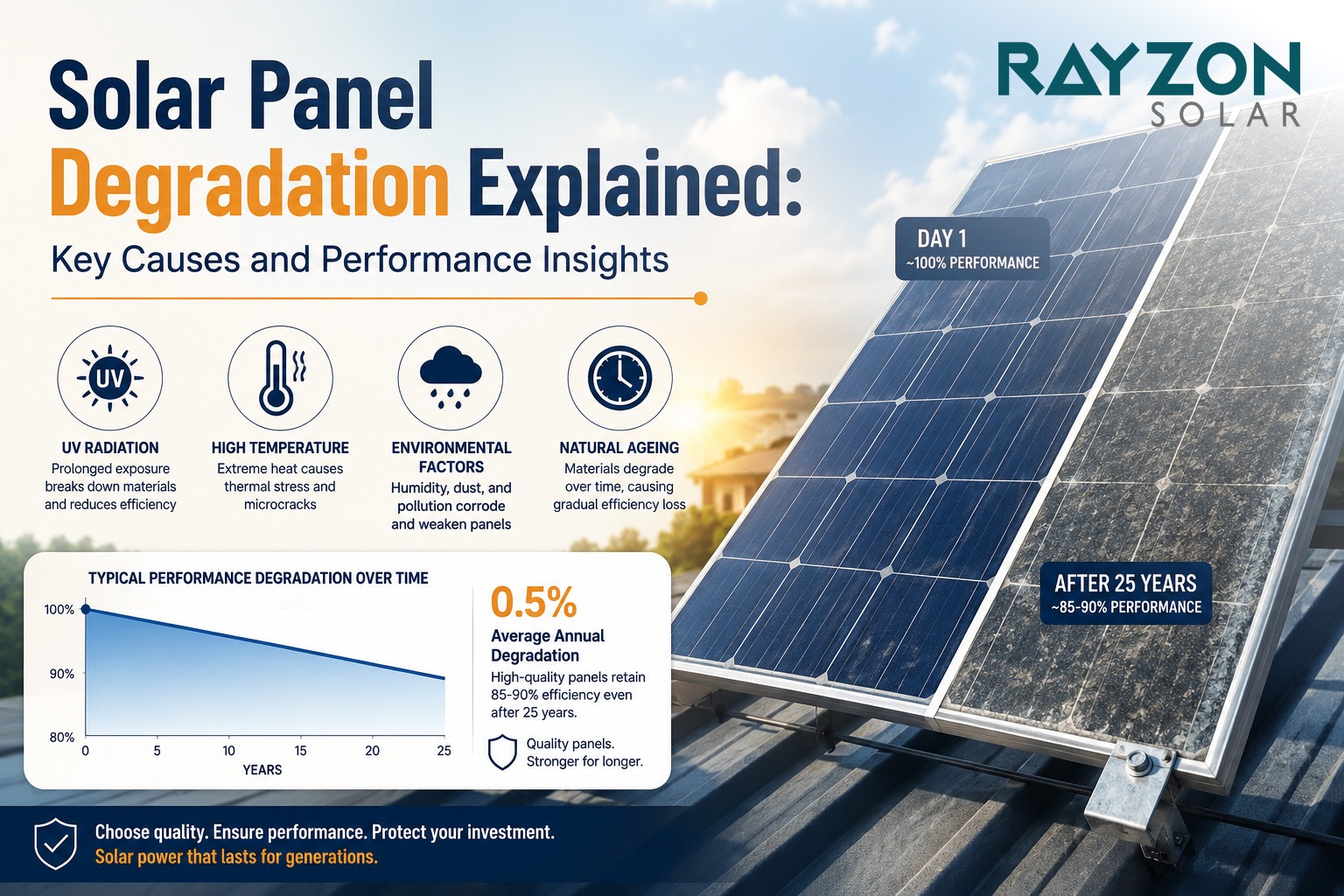
One of the most misunderstood aspects of solar modules is that they rarely “fail”. They degrade. And degradation is far more dangerous than failure. A failed module is visible and easy to track and replace, while a degrading module stays installed, keeps producing power, but slightly less every year than expected.
The slight difference becomes a serious problem when multiplied across thousands of modules and twenty-five years of financial projections.
Therefore, degradation, not efficiency, has quietly become one of the most discussed risks in serious solar circles.
Why Degradation Is Getting Worse?
Ironically, most of the innovations that improved efficiency have also increased mechanical and thermal sensitivity. Larger module formats mean longer spans and higher bending stress.
Thinner wafers improve electrical performance but reduce mechanical tolerance. And higher power density increases internal temperatures. None of these are bad innovations, but they demand far more discipline in manufacturing than earlier generations ever required.
Degradation today is less about material weakness and more about how well the entire system has been controlled for processes as well as quality, balanced while assembling and how well executed in the real world.
Degradation Is Not One Problem — It’s Many Small Ones
What makes degradation hard to control is that it rarely comes from a single defect.
It emerges from cumulative effects:
- Uneven thermal expansion.
- Encapsulation fatigue.
- Micro-stresses that don’t show up in flash tests.
- Cell behaviour drifting under long-term load.
Each on its own is manageable. Together, they decide whether a module ages gracefully or unpredictably.
Hence, solar manufacturers are being judged less on peak numbers and more on how well they control variation.
Manufacturing for Degradation Control Is Different
You cannot fix degradation after installation. You can only prevent it during manufacturing. That prevention lives in places most marketing never shows: process stability, material matching, thermal behaviour testing, and refusing to take shortcuts that look harmless in the short term. This is where solar manufacturing becomes less about scale and more about restraint.
Rayzon Solar’s Perspective on the Problem
At Rayzon Solar, degradation is treated as a design challenge, not an afterthought.
The focus is not only on how a module performs when it leaves the factory, but how it behaves after years of thermal cycling, mechanical stress, and environmental exposure. Because the real promise of solar is not high output in year one — it is dependable output over decades. And that promise can only be kept when manufacturing decisions are made with time in mind.
The Industry Is Maturing — And So Are Its Questions
As solar becomes core infrastructure, tolerance for surprises is disappearing.
Developers, EPCs, and financiers are no longer impressed by claims alone. They want predictability. They want modules that age well, and models say they will.
Efficiency tells you how a module starts. Degradation tells you how honest that start really was. And as the solar industry grows, that distinction is becoming impossible to ignore.