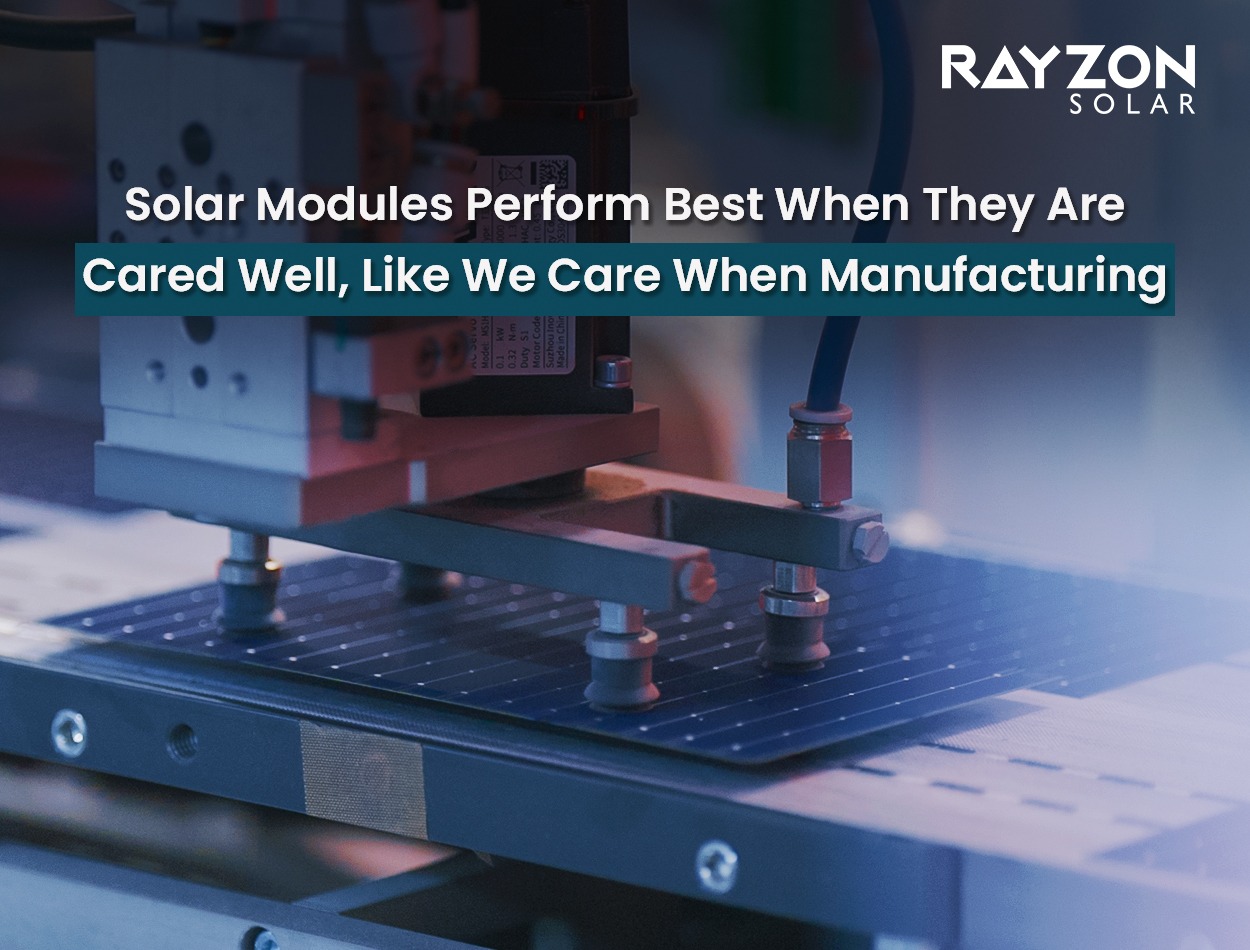
Solar modules Perform Best When They Are Cared well, like we care when manufacturing
At RAYZON Solar, we seriously take our shared responsibility right from the selection of materials to storage and handling, precise control of process control to performance consistency in real Indian conditions. Our approach is rooted in one belief: solar value is created over decades and not commissioning dates.
The future of solar will not be defined only by higher efficiencies or larger capacities. It will be shaped by manufacturers who understand how modules behave after year five, year ten, and beyond. And the solar companies that understand this early don’t just manufacture modules—they build trust that lasts just as long.
Consistent performance of Solar modules is not the responsibility of manufacturers alone.
A solar module reaches—and sustains—its maximum performance only when every stakeholder involved in its life treats it with informed care.
Solar is not a “fit once, forget forever” asset. It is a long-living system that responds continuously to how it is designed, installed, operated, and maintained.
Engineers Decide How Gracefully modules will perform
The performance of solar modules is decided even before the first watt is generated.
When engineers make decisions about materials, cell interconnections, glass, encapsulants, and back-sheets, they are defining how a module will respond to heat, moisture, dust, and electrical stress over time.
In Indian conditions, these decisions matter even more:
- Repeated thermal cycling strains solder joints
- Dust accumulation creates micro-hotspots
- High humidity challenges insulation integrity
- Voltage fluctuations stress cells unevenly
Engineering care means designing modules that don’t just meet lab standards but remain stable under real environmental pressure. Good engineering doesn’t eliminate degradation —it ensures that it remains slow, uniform, and predictable.
Installation sets the ball rolling
Installation is the first real test of a modules long term performance.
Improper handling, uneven mounting pressure, incorrect torque, poor grounding, or stressed cable routing may not show immediate effects. But over time, these issues translate into:
- Localised heating
- Mismatch losses
- Accelerated degradation in specific modules
Two identical modules installed on the same day can behave very differently simply because of installation quality. Installation care is not about speed or completion—it is about respecting the mechanical and electrical limits of the module from day one, ensuring longevity of performance.
Installers don’t just mount modules.
They determine how well those modules will endure years of stress
Maintenance Means Reading Patterns, Not Just Fixing Faults
Most monitoring systems are built to detect failure.
Modules rarely fail outright.
Instead, it appears as subtle patterns:
- Slower energy ramp-up in the morning
- Persistent temperature differences between modules
- Performance losses that fluctuate seasonally
- Recovery after dust or heat events takes longer than before
Maintenance care means recognising these patterns early. It requires moving from reactive checks to proactive interpretation—understanding not just what is happening, but why it is happening.
Cleaning modules restores surface performance; understanding these signals well in advance can
preserve lifetime performance.
End Users Protect Long-Term Value Through Awareness
End users often assume that if a system is running and under warranty, it is healthy. But a module can be contractually compliant and economically underperforming at the same time.
User care involves:
- Taking small, consistent losses seriously
- Avoiding the normalisation of gradual underperformance
- Supporting preventive action rather than corrective repair
Performance deterioration accelerates fastest when its early signs are ignored. End users who listen early protect not just energy output, but long-term financial confidence.
Maximum Performance Requires Shared Responsibility
No single stakeholder controls a module's lifetime behaviour.
- Engineers define resilience
- Installers influence early stress
- O&M teams interpret ageing signals
- End users decide when action is taken
When these roles work in isolation, performance may be impacted; when they work together, performance becomes manageable.
This is the shift the solar industry must make—from warranty thinking to lifespan thinking.
Care Is What Keeps modules performing at Their Peak
Modules that are engineered thoughtfully, installed carefully, maintained intelligently, and used responsibly continue to perform close to their potential for years longer.
The solar systems that listen early don’t just generate power.
They generate confidence—year after year, decades after commissioning day.