TOPCon Efficiency Ceiling: What Exactly Stops Cells from Crossing 27%?
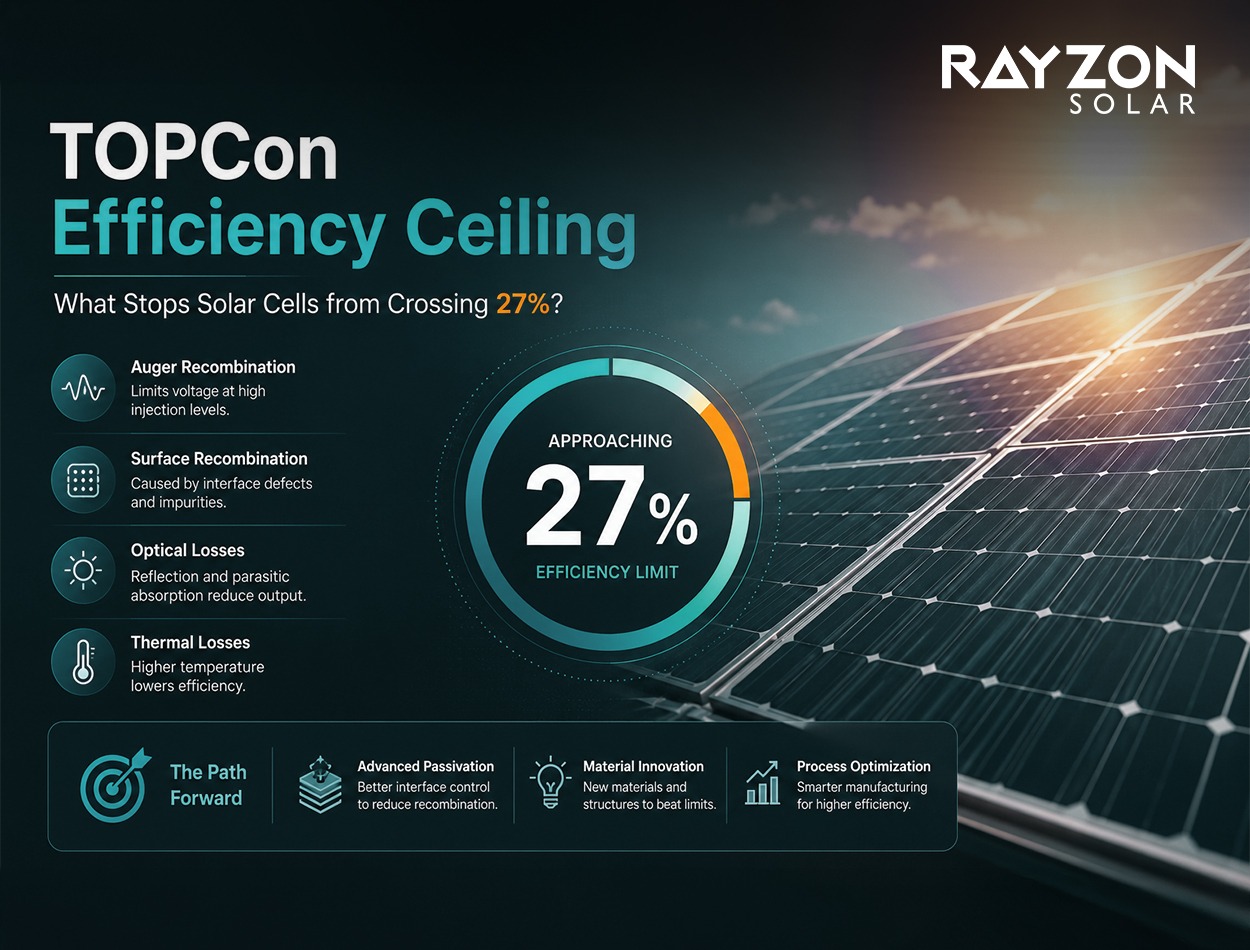
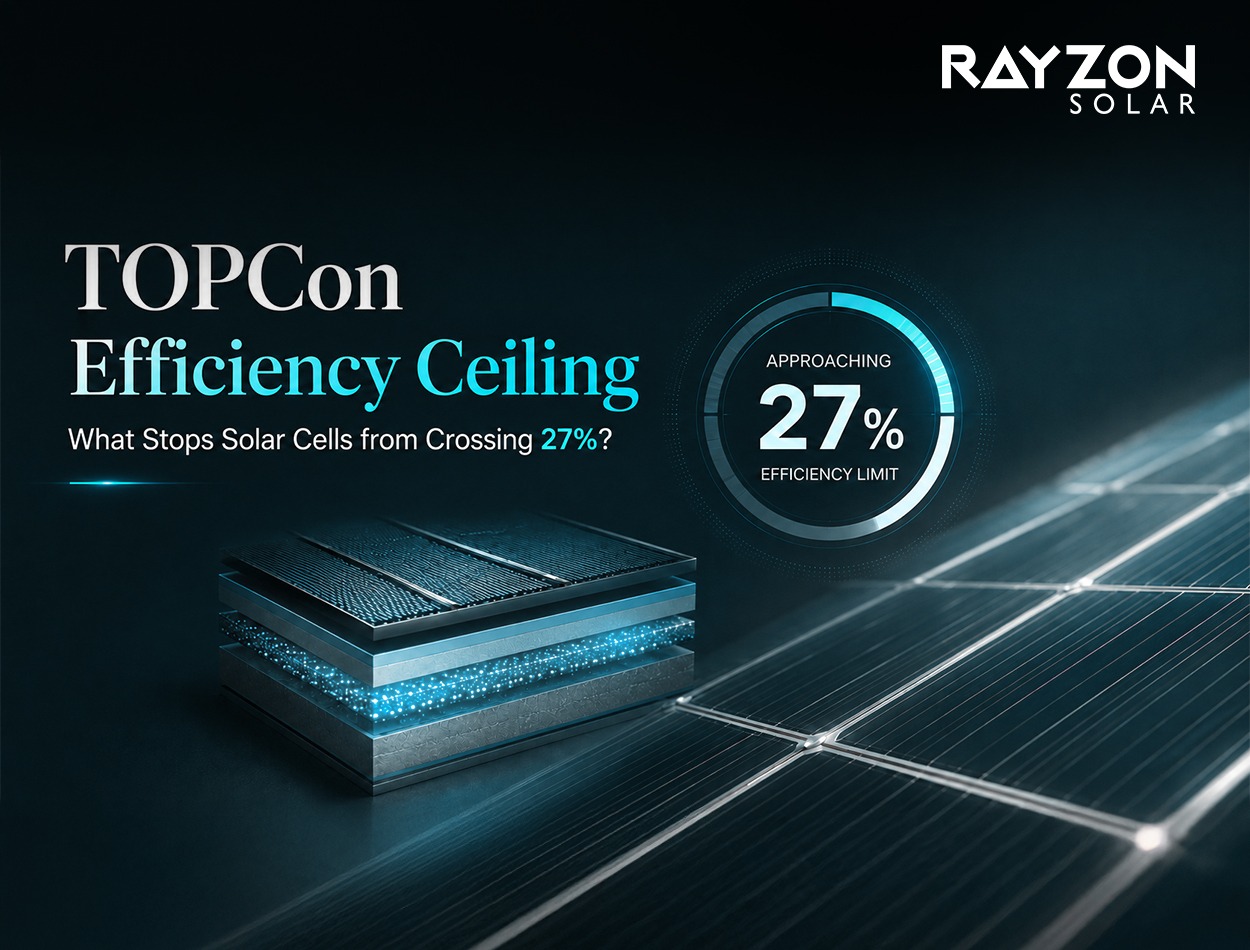
TOPCon technology has transformed the solar industry. Commercial cell efficiencies have already crossed 25%, while laboratory results are approaching 28%. However, pushing beyond the 27% threshold remains one of the biggest challenges in crystalline silicon photovoltaics. The reason lies in several fundamental trade-offs.
Tunnel Oxide Recombination Losses
The ultra-thin tunnel oxide layer is the heart of a TOPCon cell. It selectively allows charge carriers to pass while reducing recombination losses.
However, even small defects in the oxide layer can increase carrier recombination. As efficiency rises, every fraction of a percent matters. Researchers continue to optimize oxide quality, but eliminating recombination remains impossible in practical manufacturing.
Contact Resistivity vs. Passivation
TOPCon cells require an ideal balance between passivation and conductivity.
A thicker or higher-quality passivation layer reduces recombination but can increase contact resistance. Lower resistance improves current flow but may weaken passivation, so there is a trade-off.
Polysilicon Thickness Optimization
The doped polysilicon layer improves carrier selectivity. Yet excessive thickness creates parasitic optical absorption.
When the polysilicon absorbs sunlight, fewer photons reach the silicon wafer to generate electricity. Manufacturers must carefully optimize thickness to balance electrical and optical performance.
Wafer Quality Dependency
TOPCon performance heavily depends on wafer quality.
Impurities, crystal defects, oxygen concentration, and bulk lifetime limitations reduce voltage and carrier collection efficiency. Even the most advanced cell architecture cannot fully compensate for poor wafer quality. High-purity n-type wafers remain essential for achieving record efficiencies.
Why Theory and Mass Production Differ
The theoretical efficiency limit of TOPCon is estimated at around 28.7%. Yet laboratory cells operate under tightly controlled conditions using premium materials and advanced processing techniques.
Mass production introduces variability in wafer quality, metallization, deposition uniformity, and process control. Manufacturers must also balance efficiency with throughput, yield, and cost.
As a result, while research cells have already achieved efficiencies above 27%, commercial production lines typically operate closer to 25–26%. Recent laboratory records have reached 27.79%, demonstrating that the technology still has room for improvement.
The Future
Crossing 27% consistently in mass production will require breakthroughs in passivated contacts, wafer quality, metallization, and process control. TOPCon remains one of the most promising silicon cell technologies, but its next efficiency gains will become increasingly difficult and expensive to achieve.