Advantages of Solar Energy: Top Benefits You Must Know
The most transformative advantages of solar energy in India today are its ability to turn a recurring monthly liability into a high-yield financial asset. As electricity tariffs climb across states like Maharashtra and Gujarat, this advantage of solar energy provides a definitive shield against inflation for millions of homes and businesses. In a nation where 300+ days of sunshine are the norm, the economic benefits of solar energy have moved from a "green" luxury to a financial necessity.
Why Switch to Solar in 2026?
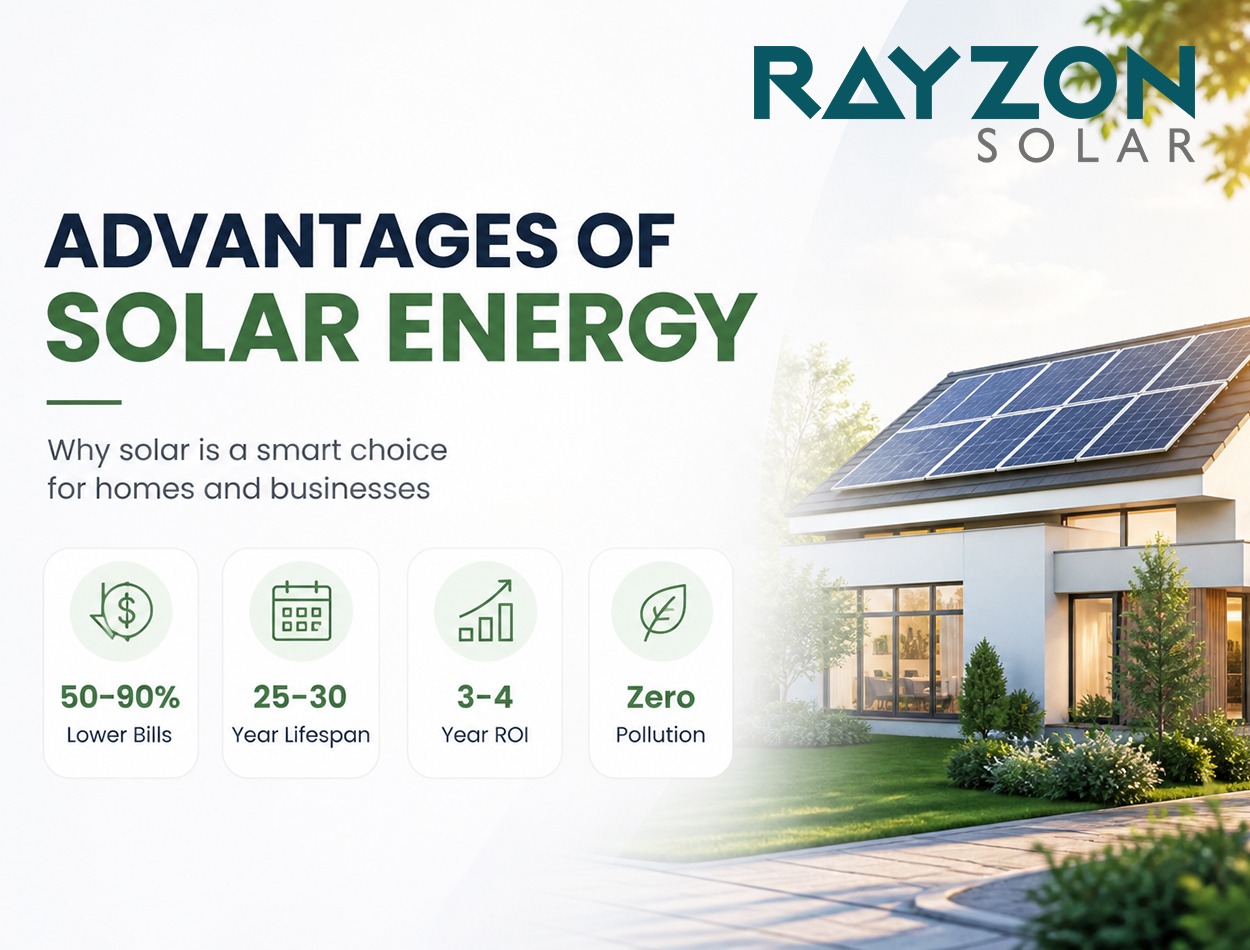
- Slash Bills: Reduce your monthly electricity expenses by 50% to 90%.
- Massive Subsidies: Get up to ₹78,000 back from the PM Surya Ghar scheme.
- Fast ROI: Recover your investment in just 3 to 4 years.
- Zero Pollution: Support the environmental advantages of solar energy by cutting CO2 emissions.
Advantages of Solar Energy in India
- Reduces electricity bills by 50–90% for homes and businesses
- Government subsidies up to 78% available for residential systems
- Low maintenance with 25–30-year lifespan
- Reduces carbon footprint and combats air pollution
- Works exceptionally well in India's high sunlight conditions (300+ sunny days)
- Provides energy independence and protection from power cuts
- Increases property resale value by 15-20%
- 3–6-year payback period with excellent ROI
- Scalable for homes, businesses, and industries
- Creates local jobs and supports India's net-zero goals
What is Solar Energy?
Solar energy is power derived from the sun's radiation, converted into electricity through photovoltaic (PV) technology. Here's how it works in simple terms
- Solar panels contain multiple photovoltaic cells made of semiconductor materials (usually silicon)
- When sunlight hits these cells, photons knock electrons loose, creating an electric current
- This direct current (DC) electricity is converted to alternating current (AC) by an inverter
- The AC power is then used to run your home or business appliances
- Excess energy can be stored in batteries or fed back to the grid (net metering)
Why India is the Ideal Ground for Solar
With a population exceeding 1.4 billion and a rapidly industrializing economy, India's energy demand is skyrocketing. Fortunately, the country's geographical position provides a massive advantage of solar energy potential, receiving roughly 5,000 trillion kWh of energy annually. Furthermore, the state-level push—with Gujarat and Maharashtra leading in rooftop installations—ensures that the environmental advantages of solar energy are backed by robust grid infrastructure and supportive policies.
Top 12 Advantages of Solar Energy in India
1. Drastic Reduction in Electricity Bills
The primary advantage of solar energy for most Indian families is the immediate drop in utility costs. By using your rooftop to generate power, you bypass expensive grid electricity which can cost as much as ₹19 per unit in high-consumption slabs. Through net metering, any excess power you generate during the day is sent back to the grid, earning you credits that cancel out your night-time usage.
How It Works:
- A typical 3 kW residential system generates 12-15 units per day
- This covers most household consumption (300-400 units/month)
- During peak sunlight hours, your solar panels power all appliances
- Excess energy is fed back to the grid, earning credits through net metering
- Net Metering Benefits:
Net metering allows you to sell excess solar power back to the grid. Your meter runs backward when you generate more than you consume, and you get credits on your electricity bill. Most states in India now offer net metering for residential and commercial installations up to 500 kW
2. Government Subsidies & Incentives
In 2026, the financial benefits of solar panels are more accessible than ever. Under the PM Surya Ghar Muft Bijli Yojana:
- Systems up to 3 kW: ₹18,000 per kW (60% subsidy)
- Systems 3-10 kW: ₹54,000 for first 3 kW + ₹9,000 per additional kW (gradually reducing percentage)
- Total subsidy can reach: ₹78,000 for a 3 kW system
Commercial & Industrial Incentives:
- Accelerated Depreciation: 40% depreciation in the first year for businesses
- Tax Benefits: Income tax benefits under Section 80-IA for solar power generation
- Concessional Financing: Low-interest loans from IREDA and other institutions
3. Minimal Maintenance & High Durability
One of the key advantages of using solar energy is the lack of moving parts. Modern solar systems are designed to last 25 to 30 years with nothing more than a simple cleaning every few weeks to remove dust—a critical factor in India’s dusty urban environments.
Minimal Servicing Required
- No moving parts: Unlike diesel generators or wind turbines, solar panels have zero mechanical components that can break down
- Annual maintenance cost: Only ₹2,000-4,000 per year for a typical residential system
- Warranty coverage: 25-year performance warranty on panels, 5-10 years on inverters
Simple Cleaning Routine:
Due to India's dusty conditions, panels need occasional cleaning:
- Clean panels every 2-3 months (more frequently in dusty areas)
- Use water and a soft brush—no harsh chemicals needed
- Monsoon rains naturally clean the panels
- Professional cleaning services available for ₹500-1,000 per session
What Maintenance Actually Involves:
- Visual inspection for physical damage or shading issues
- Checking inverter display for error messages
- Monitoring system performance through mobile apps
- Ensuring electrical connections remain secure
- Periodic inspection by certified technicians (annual)
4. Exceptional Return on Investment (ROI)
The economic benefits of solar energy are highlighted by a very short payback period. Solar energy systems offer exceptional returns on investment that few other home improvements can match.
Lifespan & Performance:
- Solar panels: 25-30 years with minimal degradation (0.5% annually)
- Inverters: 10-15 years (one replacement needed in system lifetime)
- Mounting structures: 30+ years (aluminum/galvanized steel)
- Performance guarantee: Most panels guaranteed to produce 80% of original capacity after 25 years
Payback Period in India:
- With subsidy: 3-4 years for residential systems
- Without subsidy: 5-6 years
- Commercial systems: 4-5 years (with accelerated depreciation)
- Industrial systems: 3-4 years (high consumption + tax benefits)
5. Environmental Advantage of Solar Energy
Solar energy is one of the cleanest power sources available, making a significant positive environmental impact.
Carbon Footprint Reduction:
- A typical 5 kW residential system prevents 6-7 tons of CO₂ emissions annually
- Over 25 years, that's 150-175 tons of CO₂ avoided
- Equivalent to planting 4,000+ trees or taking 30 cars off the road
Combating India's Air Pollution Crisis:
India's major cities face severe air quality issues, largely due to fossil fuel-based power generation:
- Delhi, Mumbai, and Kolkata frequently exceed safe air quality limits
- Thermal power plants contribute 60% of India's electricity but also significant PM2.5 and SO₂ emissions
- Widespread solar adoption reduces dependence on coal power, improving urban air quality
- Every MW of solar capacity installed prevents 2,000+ tons of CO₂ annually
6. Energy Independence & Reliability
Another major advantages of using solar energy is the protection it offers against power cuts. By pairing solar with the latest Lithium Iron Phosphate (LFP) batteries, homes and businesses can enjoy 24/7 power, even during grid failures or scheduled load shedding.
Reduced Grid Dependence:
- Generate your own electricity during daylight hours
- Reduce reliance on unstable grid power
- Shield yourself from future electricity price hikes (which average 5-8% annually)
- Energy self-sufficiency for homes and businesses
Protection from Power Outages:
Power cuts remain common in many Indian cities, especially during:
- Summer peak demand periods
- Monsoon-related infrastructure damage
- Scheduled load shedding in some states
- Grid maintenance activities
7. Modular and Scalable Design
the solar system benefits are inherently tied to the modular nature of the technology. Systems can be scaled precisely to meet the energy demands of the user, whether it is a small rural home requiring 1 kW of power for lighting and fans or a massive industrial complex requiring multi-megawatt installations.
- Residential Rooftops: Ideal for flat terrace spaces in Indian homes, with a typical 3 kW system requiring only about 300 square feet of unshaded space.
- Commercial Buildings: Malls, hotels, and hospitals utilize rooftop and parking shed space to offset high air-conditioning loads.
- Agricultural Solar: Under the PM-KUSUM scheme, solar pumps allow farmers to irrigate their fields during the day without relying on expensive diesel or erratic grid power.
- Utility-Scale Parks: Massive ground-mounted arrays feed directly into the high-voltage transmission grid, providing bulk power to urban clusters.
8. Appreciation of Property and Real Estate Value
A growing advantage of solar energy is its impact on the real estate market. In 2026 shows that homes equipped with solar sell 20% faster. Because buyers recognize the long-term economic benefits of solar energy, these properties often command a 15% to 20% premium over non-solar houses.
9. Local Job Creation and Economic Growth
The solar panel installation benefits extend to the national economy
Employment Statistics:
- Solar industry employs 200,000+ people in India (2026)
- Expected to create 1 million jobs by 2030
- Jobs span manufacturing, installation, maintenance, sales, and R&D
- Skill development programs training thousands of solar technicians annually.
10. Direct Support for National Green Goals
When you install solar, you contribute to India's target of 500 GW of renewable capacity. This national advantage of solar energy reduces the country's dependence on imported fuels and strengthens our energy security.
11. Reliable Performance in All Seasons
A common advantage of using solar energy is that it works year-round. While generation is highest in summer, modern bifacial panels use diffused light to produce significant electricity even during the monsoon or on overcast winter days.
12. Cutting-Edge 2026 Technology
The 2026 advantage of solar energy is driven by TOPCon and Bifacial technology. These modules capture light from both sides and perform better in high heat, ensuring that Indian consumers get the maximum wattage for every square foot of roof space.
Solar vs. Traditional Grid: 2026 Comparison
The economic benefits of solar energy become undeniable when compared to the traditional utility model. The following table illustrates the divergence in costs and performance between solar and grid-supplied power in the current market.
|
Parameter |
Solar Energy |
Grid Electricity |
|
Cost per Unit (LCOE) |
₹2-3 over system lifetime |
₹7-12 (varies by state, rising annually) |
|
Carbon Emissions |
Zero emissions |
0.82 kg CO₂ per kWh (India grid average) |
|
Reliability |
Highly reliable (25+ year lifespan) |
Subject to power cuts and fluctuations |
|
Maintenance |
Minimal (cleaning + annual inspection) |
Infrastructure requires ongoing maintenance |
|
Price Stability |
Fixed cost for 25+ years |
Increases 5-8% annually |
|
Independence |
Energy self-sufficiency |
Complete grid dependence |
|
Environmental Impact |
Clean, renewable, sustainable |
70% coal-based, high pollution |
|
Initial Investment |
₹40,000-70,000 per kW (after subsidy) |
Connection charges only |
|
25-Year Cost |
₹2-3 lakhs (5 kW system) |
₹15-18 lakhs (assuming 5% annual increase) |
The financial benefits of solar panels are best seen when compared to the rising costs of the grid.
- "It doesn't work in the rain": False. Panels use diffused light to generate power even on cloudy days.
- "It's too expensive": False. With a ₹78,000 subsidy and the financial benefits of solar panels, the net cost is now at an all-time low.
- "It damages the roof": False. Professional EPC services like those from Rayzon Green ensure the structural integrity of your roof is preserved.
The Role of Expert EPC: Rayzon Green and Quality Assurance
A critical advantage of solar energy is realized only when the system is engineered and installed to professional standards. The role of an Engineering, Procurement, and Construction (EPC) partner like Rayzon Green is to ensure that the theoretical benefits translate into real-world performance.
A professional EPC process involves:
- Site Assessment: Using shadow-mapping software to ensure the panels are placed in the most productive orientation.
- Structural Engineering: Confirming that the roof can handle the static and wind loads of the PV array, often involving the issuance of structural safety certificates.
- Regulatory Compliance: Managing the complex paperwork for net metering applications with local DISCOMs (e.g., DGVCL in South Gujarat or MSEDCL in Maharashtra).
- Operations & Maintenance: Providing professional cleaning and performance monitoring to maximize the system’s uptime.
Choosing a Tier-1 manufacturer-backed EPC ensures that the modules, inverters, and BOS (Balance of System) components are perfectly synchronized for maximum yield.
Conclusion
The advantage of solar energy in India is no longer a matter of theoretical debate but a proven economic and environmental reality. As the nation marches toward its 500 GW renewable target, the transition to solar has become the definitive path for homes and businesses seeking to insulate themselves from rising energy costs and grid instability. By leveraging the historic 2026 subsidies and the latest TOPCon technology, Indian consumers can transform their rooftops into productive assets that pay for themselves in just a few years.
The broader implications are clear: solar energy offers a rare alignment of personal financial gain and national ecological restoration. For the individual, it means zero-cost electricity and energy independence; for the nation, it means a cleaner, more resilient, and self-reliant power infrastructure. Switch to solar today to reduce costs and secure your energy future.
If you’re planning to make the switch, partnering with a trusted solar manufacturer is key to maximizing your returns. Rayzon Solar offers advanced, high-efficiency solar modules built with the latest TOPCon technology, ensuring superior performance and long-term reliability for Indian conditions. Whether for residential rooftops or large-scale commercial projects, Rayzon Solar provides dependable solutions that help you reduce energy costs and achieve true energy independence.
Frequently Asked Questions (FAQs)
1. Is solar energy worth it in India in 2026?
Absolutely. With rising electricity costs (₹7–12 per unit) and high solar irradiation, solar is the most profitable home or business upgrade available. The typical payback is 3 to 4 years, followed by 20+ years of free power.
2. What is the total cost of a 3 kW solar system after subsidy?
In 2026, a high-quality 3 kW system costs approximately ₹1.8 to ₹2.1 lakhs. After the central subsidy of ₹78,000, the effective cost to the consumer is roughly ₹1.02 to ₹1.32 lakhs.
3. Do solar panels work during the monsoon?
Yes. Panels generate electricity from diffused light. While generation is lower than on a bright summer day, the system remains active. Additionally, the rain naturally cleans the panels, maintaining their efficiency.
4. How long do solar panels last?
Solar panels have a design life of 25 to 30 years. Performance warranties typically guarantee 80% output at the 25-year mark, although many panels continue to function for several years beyond that.
5. What happens to the excess power my system generates?
Excess power is sent to the local utility grid through a net meter. You receive credits for this power, which are deducted from your night-time or winter electricity usage.