Can India Truly Build a Fully Integrated Solar Supply Chain?
India has become one of the world's fastest-growing solar markets. It has also expanded domestic module and cell manufacturing at an impressive pace. However, building a fully integrated solar supply chain requires much more than assembling modules.
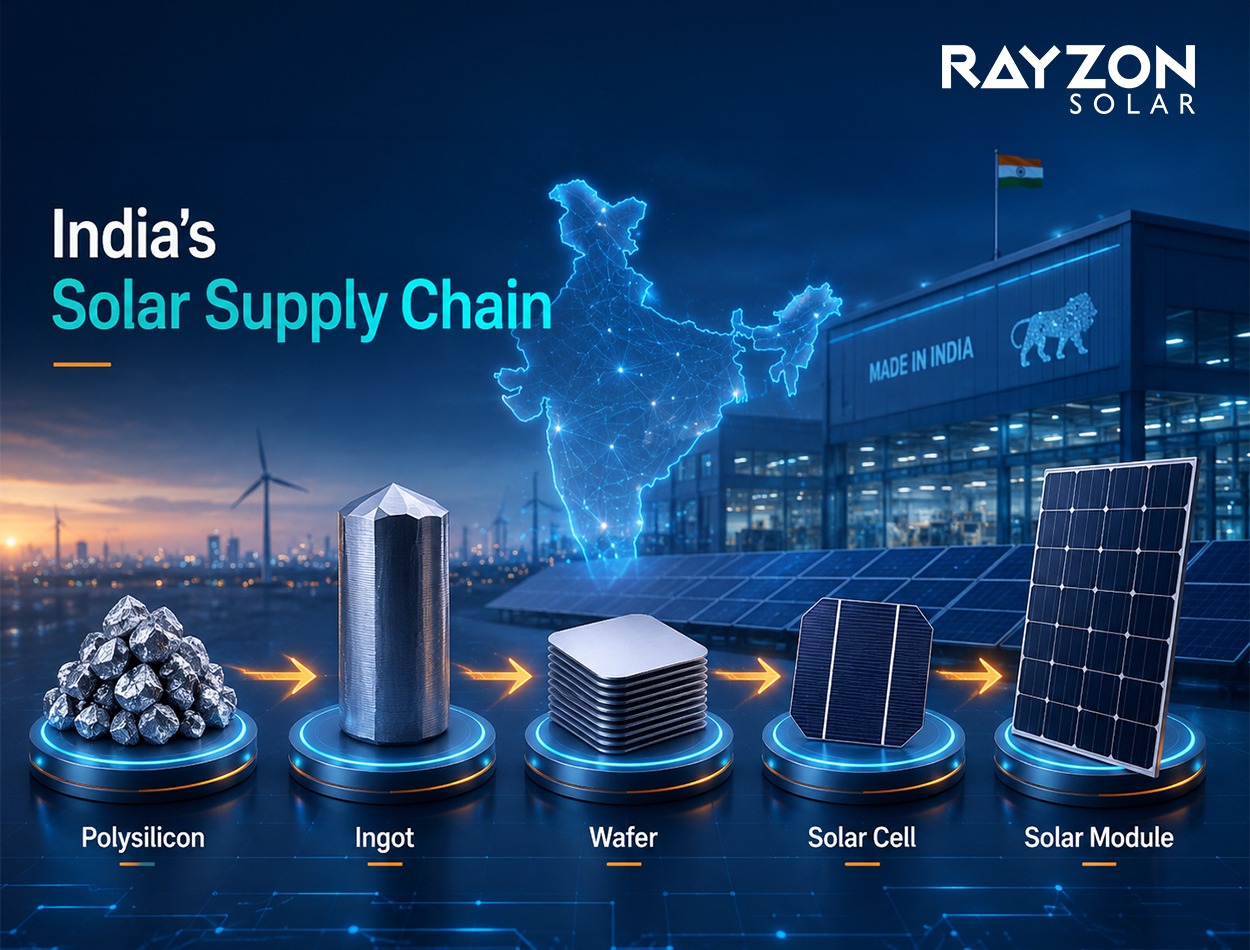
The biggest challenge begins with polysilicon. India still depends heavily on imports for this critical raw material, while China dominates global production. Without domestic polysilicon, manufacturers remain exposed to supply disruptions and price volatility.
The next gap lies in the wafer and ingot ecosystem. Although India has announced policies to encourage local manufacturing, commercial capacity remains limited compared to downstream production. The government's decision to mandate domestically manufactured wafers and ingots for many projects from 2028 reflects this strategic priority.
Another overlooked dependency is metallization paste. This silver-based material enables efficient current collection inside solar cells. India imports most of its metallization paste because local production remains at an early stage. This dependency affects both manufacturing costs and supply-chain resilience.
Equipment localization presents another hurdle. Indian companies manufacture selected module assembly equipment, but advanced machinery for polysilicon, wafer and cell production still comes largely from overseas suppliers. High capital costs, technology barriers and limited domestic vendor ecosystems continue to slow localisation efforts.
Despite these challenges, India's progress is significant. The Production Linked Incentive (PLI) scheme has accelerated investments in cell and module manufacturing. According to IEEFA and JMK Research, India reached around 120 GW of module capacity and 29 GW of cell capacity by mid-2025, although upstream manufacturing continues to trail downstream expansion.
A fully integrated solar supply chain will require coordinated investment across raw materials, manufacturing equipment, speciality chemicals and advanced processing technologies. Strong policy support, research partnerships and private-sector investment will determine how quickly India closes these gaps.
India has already built a solid manufacturing foundation. The next phase is creating an ecosystem where every critical component, from polysilicon to finished modules, is produced with greater domestic capability, resilience and global competitiveness.