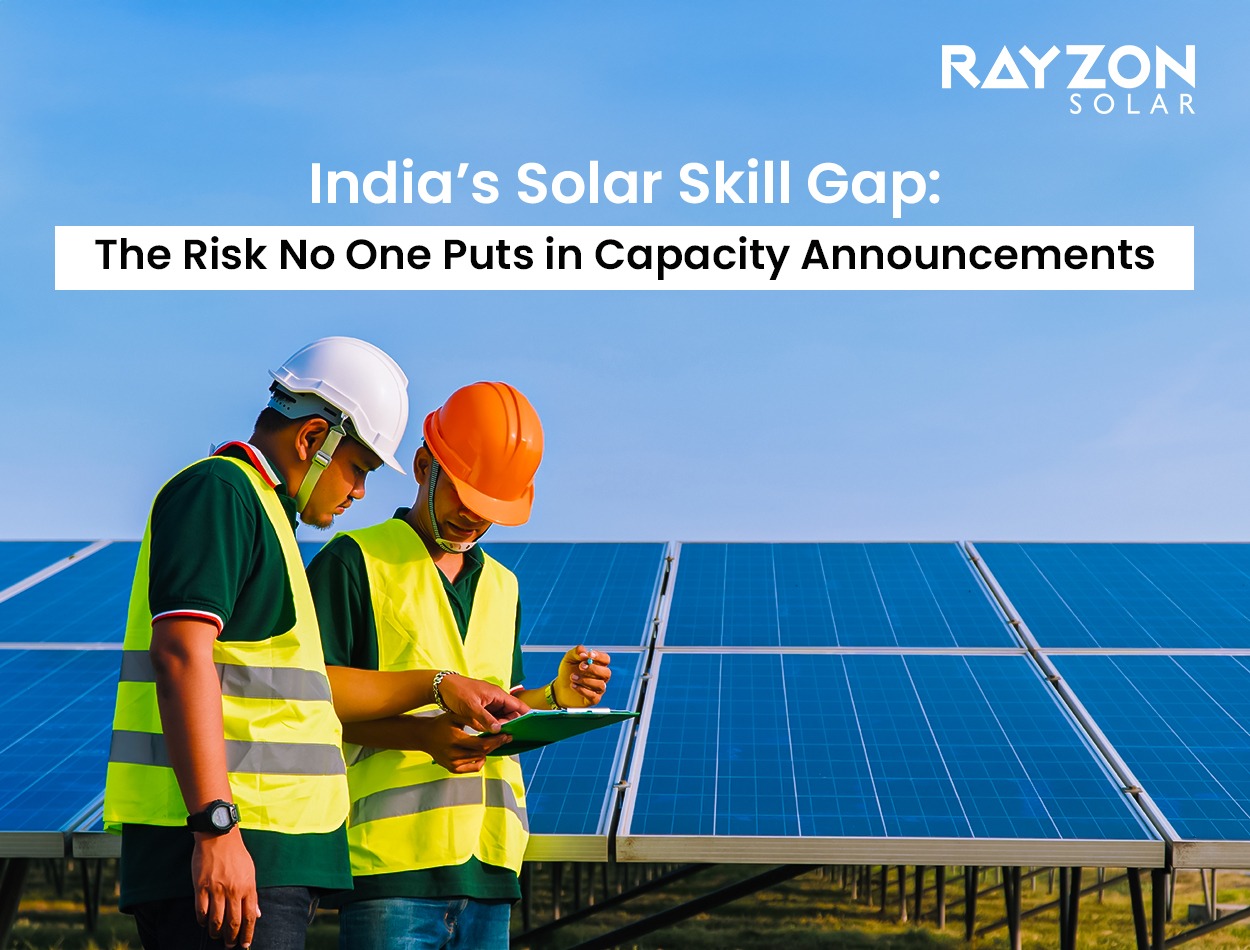
India’s Solar Skill Gap: The Risk No One Puts in Capacity Announcements
India’s solar manufacturing story is often told through capacity numbers. Gigawatts commissioned, gigawatts announced, gigawatts under construction. That narrative is powerful, but it leaves out a quieter constraint that insiders' public forums suggest: the shortage of experienced talent. Talk about more frequently than
Modern solar factories are highly automated, but automation does not eliminate human judgment. Machines place cells and laminate modules with precision, yet the stability of a production line depends on engineers who understand process drift, technicians who detect anomalies early, and quality teams that can interpret data beyond what dashboards display. When yields fluctuate or defect patterns shift subtly, it is people — not robotics — who diagnose and correct the issue.
The challenge becomes sharper during rapid expansion. Scaling from one or two lines to multi-gigawatt production requires more than additional equipment. It requires supervisors who have seen multiple production cycles, process engineers who understand failure modes deeply, and cross-functional coordination between procurement, quality, and operations. These capabilities develop over years of hands-on exposure, not in short training modules.
Backward integration adds another layer of complexity. Moving into cell manufacturing or aluminium frame production is strategically sound, but it introduces material science considerations, thermal behavior analysis, and tighter quality tolerances. The technical depth required increases significantly. Companies expanding across the value chain, including Rayzon Solar, are operating in a space where human capability becomes as important as capital expenditure.
There is also a retention dimension. Experienced engineers in renewable manufacturing are increasingly in global demand. When skilled professionals leave, they take institutional knowledge with them — knowledge that often exists outside formal documentation. Replacing that expertise is not immediate, and during that transition, performance consistency can suffer.
For developers, EPC contractors, and investors, this is not an abstract HR issue. A strong technical workforce translates into predictable output, faster problem resolution, and more reliable warranty handling. Conversely, a thin talent base can introduce operational friction that only becomes visible after deployment.
India’s ambition to be a global solar manufacturing hub is realistic. The capital investment is visible and substantial. The less visible requirement is sustained investment in structured training, mentorship, and long-term career development inside manufacturing ecosystems. Capacity can be installed in months. Capability takes years to mature.
If the industry aligns both at the same pace, growth will be durable. If not, the gap will quietly influence performance long before it appears in headlines.
.jpg)