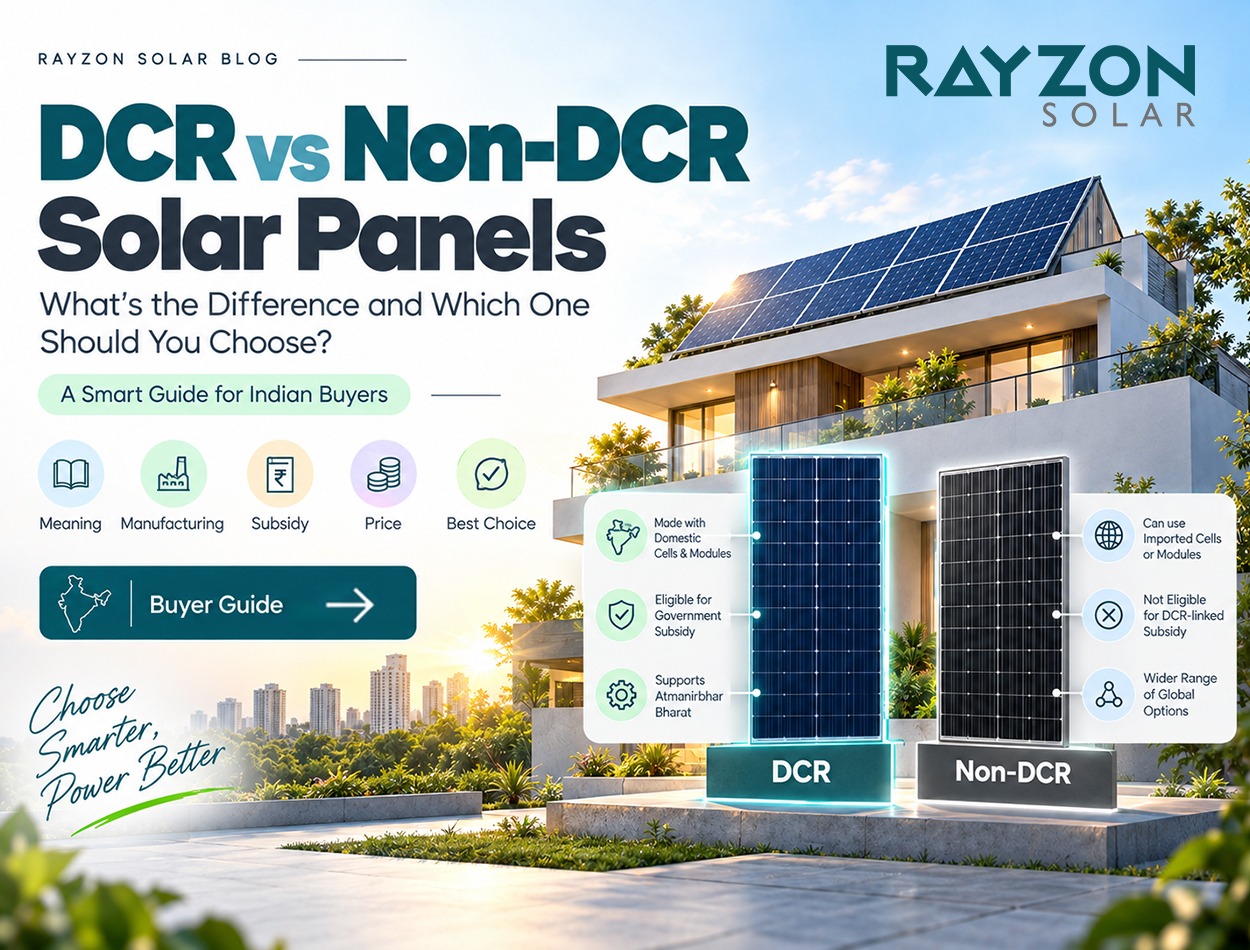
The Evolution of Solar Panels: DCR vs. Non-DCR Technologies
Two homeowners get quotes for the same 3 kW rooftop solar system. One quote is ₹15,000 higher. The panels look almost identical. So, what is going on? Very often, the answer is DCR vs Non-DCR solar panels. This small three-letter difference can affect your project cost, government-scheme eligibility and the type of solar module you can install.It also creates plenty of confusion.
A panel can say “Made in India” and still not meet the DCR requirement for a particular government scheme. An ALMM-listed module is not automatically DCR-compliant either.And no, DCR does not mean “better solar panel”. Let’s untangle all of it.
In this guide, we will explain the DCR full form, DCR meaning, DCR usage, NDCR meaning, the difference between DCR and Non-DCR panels, their price implications, subsidy rules, ALMM and BIS requirements, and how to verify a panel before you buy it.
The topic matters even more for homeowners considering the PM Surya Ghar: Muft Bijli Yojana, because the scheme’s implementation documents require solar modules to meet the applicable DCR requirements.
In solar projects covered by applicable MNRE schemes, DCR generally requires the specified solar PV cells and modules to meet the prescribed domestic-manufacturing requirements. A module assembled in India is not automatically DCR-compliant if it uses cells that do not satisfy the applicable domestic-content rules. Non-DCR panels can be used in projects where the applicable scheme or tender does not require DCR.
What Is DCR?
DCR full form in Solar
The DCR full form is Domestic Content Requirement. In simple terms, DCR is a requirement used under specified government solar schemes and programmes to ensure that the solar cells and modules used in those projects meet prescribed domestic-manufacturing conditions. The Ministry of New and Renewable Energy, or MNRE, sets the applicable requirements.
MNRE has also issued specific clarifications on what qualifies as a domestically manufactured crystalline-silicon solar cell. Under its March 2025 clarification, the manufacturing process must use an undiffused silicon wafer and the required cell-manufacturing steps must take place in India. So, DCR is more than a sticker on a solar panel. It is about where and how the relevant components are manufactured.
What Makes a Solar Panel DCR-Compliant?
Think of a solar module as a sandwich. The solar cells sit inside the module. The module manufacturer then assembles those cells into the finished panel. For a project with a DCR requirement, you cannot simply look at the location where the final panel was assembled. You need to check the applicable domestic-content rules for both the cells and modules.
MNRE's current clarification states that, for crystalline-silicon cells under schemes requiring domestically manufactured cells, simply importing a diffused silicon wafer and manufacturing the cell from it in India does not make that cell domestically manufactured for DCR purposes. That creates an important distinction: “Made in India” does not automatically mean “DCR”.
A company may assemble a solar module in India using imported cells. The finished module may therefore have Indian assembly. But that alone does not establish DCR compliance where domestic cells are required. Always check the exact model, cell origin and applicable scheme requirement.
Why Did India Introduce DCR?
DCR sits within India's broader effort to develop a domestic solar manufacturing ecosystem.
The policy aims to:
- Encourage domestic solar-cell and module manufacturing.
- Reduce dependence on imported solar components.
- Build a stronger Indian solar supply chain.
- Support manufacturing capacity and associated employment.
- Create demand for domestically manufactured solar products.
- Complement broader initiatives such as the Production Linked Incentive scheme.
MNRE's CPSU Scheme Phase-II, for example, explicitly mandates the use of domestically manufactured solar PV cells and modules. MNRE says the scheme also creates demand for domestic manufacturing. So the idea is fairly straightforward. If public support is involved, the government can attach domestic-content conditions to that support.
What Is a Non-DCR Solar Panel?
A Non-DCR solar panel, often written as NDCR, is a solar module that does not meet the applicable Domestic Content Requirement for a project where DCR is mandated.
Non-DCR does not mean illegal. It does not automatically mean low quality either. A Non-DCR module can use modern technologies such as TOPCon, HJT or bifacial designs. Its difference from a DCR module mainly relates to the applicable domestic-content requirement, not automatically to its efficiency or reliability.
Non-DCR modules can therefore make sense for projects where DCR is not a requirement. A module can be assembled in India but still be Non-DCR if its cells do not satisfy the applicable DCR requirement. That is why the manufacturing label alone is not enough.
DCR vs Non-DCR Solar Panels: Key Differences
Here is the simplest way to look at it.
|
Parameter |
DCR Solar Panel |
Non-DCR Solar Panel |
|
Meaning |
Meets applicable Domestic Content Requirement |
Does not meet the applicable DCR requirement |
|
Cell origin |
Must satisfy applicable domestic-cell rules |
May use imported cells |
|
Module assembly |
Must satisfy applicable domestic-module rules |
May be manufactured/assembled domestically or imported, depending on product |
|
Government-scheme eligibility |
Eligible where DCR is mandated and other conditions are met |
Not eligible where DCR is mandatory |
|
Technology |
Can include technologies permitted by the applicable programme |
Can include technologies permitted by the project |
|
Price |
Often carries a domestic-manufacturing premium |
Often costs less, depending on market conditions |
|
Quality |
DCR status itself does not determine quality |
DCR status itself does not determine quality |
|
Best fit |
DCR-mandated schemes and tenders |
Unsubsidised/private projects where DCR is not required |
What about the price per watt?
Market pricing changes quickly. It also changes with module technology, wattage, manufacturer, order size, project volume, taxes, logistics and market conditions. So avoid treating a fixed ₹/W number as a universal DCR price. The ₹6–₹10 per watt differential sometimes quoted in the market should be treated as an indicative market range, not an official government benchmark. For a live project, get a current quotation for the exact module model.
DCR vs ALMM vs BIS: Three Different Things
This is where things get messy. People often use DCR, ALMM and BIS as if they mean the same thing. They don't. They answer different questions.
What Is ALMM?
ALMM stands for Approved List of Models and Manufacturers. MNRE maintains the ALMM framework for approved solar PV models and manufacturers. The current ALMM framework includes List-I for solar PV modules and List-II for solar PV cells. MNRE states that models and manufacturers included in ALMM List-I are eligible for specified government and government-assisted projects, government schemes and programmes, and certain other categories such as open-access and net-metering projects, subject to the applicable rules.
In simple language, ALMM asks: “Is this model/manufacturer approved under the applicable MNRE list?”
What Is BIS Certification?
BIS stands for the Bureau of Indian Standards. BIS standards deal with product standards, safety and performance requirements. For example, BIS lists standards applicable to crystalline-silicon terrestrial PV modules, including IS 14286 and IS/IEC 61730 requirements.
So, BIS asks: “Does the product meet the applicable Indian standard and certification requirements?”
DCR vs ALMM vs BIS
|
Requirement |
What It Checks |
Governing/Relevant Authority |
|
DCR |
Domestic manufacturing/content requirements under applicable schemes |
MNRE |
|
ALMM |
Approved models and manufacturers under the applicable ALMM framework |
MNRE |
|
BIS |
Applicable product standards and safety/performance requirements |
Bureau of Indian Standards |
These checks can overlap in a project. But they are not interchangeable.
Can a Panel Be ALMM-Listed but Not DCR-Compliant?
Yes, ALMM and DCR answer different questions. An ALMM listing establishes that the relevant model/manufacturer appears on the applicable MNRE list. DCR establishes compliance with the applicable domestic-content requirement. Therefore, never assume that ALMM-listed = DCR-compliant. This distinction becomes especially important because MNRE now maintains separate ALMM lists for modules and cells.
When Is DCR Mandatory in India?
There is no single “DCR applies everywhere” rule. DCR applies when the relevant scheme, programme, tender or government requirement mandates it. Some important examples include:
1. PM Surya Ghar: Muft Bijli Yojana
The implementation documentation for the rooftop-solar programme includes DCR compliance checks and requires DCR equipment, including domestically manufactured modules and cells, under the applicable requirements. For a homeowner claiming the central financial assistance under the scheme, DCR compliance is therefore a critical procurement check.
2. PM-KUSUM
PM-KUSUM covers several solarisation applications, including standalone solar pumps and grid-connected agricultural pump solarisation. Its requirements can differ by component and applicable amendment. For example, MNRE has issued specific DCR-related orders and clarifications for PM-KUSUM. So don't rely on an old “DCR mandatory for all PM-KUSUM” statement. Check the current component-specific requirement.
3. CPSU Scheme Phase-II
CPSU Scheme Phase-II explicitly mandates the use of domestically manufactured solar PV cells and modules.
4. Government and Tender-Based Projects
Government tenders and scheme documents can specify domestic-content requirements. The exact tender wins here. Always read the latest tender conditions rather than relying on a generic DCR rule.
When Can You Choose Non-DCR Panels?
A Non-DCR panel can be considered when your project does not have a DCR requirement. For example, a private project that does not claim a subsidy or participate in a tender requiring domestic content may have more flexibility.
That can include certain:
- Commercial rooftop projects.
- Industrial rooftop projects.
- Private solar installations.
- Open-market projects.
But there is an important catch. “No subsidy” does not automatically mean “no DCR.” Other project rules may still apply. For example, ALMM requirements can apply to specified categories of projects independently of DCR. MNRE's current ALMM framework specifically lists categories where List-I modules are required. So check the rules for your exact project.
DCR Solar Panel Price: Is the Premium Worth It?
This is usually the question sitting at the end of every solar buyer's conversation.
“Fine. DCR is required. But how much more will I pay?”
The answer changes with the market. DCR modules can carry a price premium because domestic manufacturing capacity, cell availability, technology and supply-demand conditions affect the cost. A commonly quoted market differential is around ₹6–₹10 per watt, but this should not be treated as a fixed 2026 market price. Let's use an illustration instead. Suppose the difference between two comparable module options is ₹8/W.
For a 3 kW system:
3,000 W × ₹8 = ₹24,000
That is the module-level price difference.
Now consider a residential customer who qualifies for the maximum central subsidy under PM Surya Ghar.
The scheme's published subsidy structure provides ₹30,000 per kW for the first 2 kW and ₹18,000 for the next 1 kW, with the total subsidy capped at ₹78,000. That changes the calculation.
For a subsidy-linked residential project, the right question is not: “Which panel costs less?”
It is: “Which option keeps my project eligible while giving me the best overall system economics?”
That is a much smarter calculation. For an unsubsidised private project, however, the calculation can look different.
There, the buyer may focus more heavily on:
- Module price.
- Efficiency.
- Annual degradation.
- Energy yield.
- Warranty.
- Financing cost.
- Balance-of-system cost.
- O&M.
- Lifetime electricity generation.
In other words, DCR is a project-eligibility decision before it becomes a price decision.
Does DCR Mean Better Solar Panel Quality?
No! Period. This is one of the biggest myths around DCR. DCR is primarily a domestic-content classification.
It does not automatically tell you how efficiently a panel converts sunlight into electricity.It does not automatically tell you how slowly it will degrade. And it does not automatically tell you how well it will perform in high temperatures.
Those things depend on the actual module.
Look at:
- Cell technology.
- Module efficiency.
- Temperature coefficient.
- Power degradation.
- Product warranty.
- Performance warranty.
- Glass and encapsulant quality.
- Mechanical-load ratings.
- Relevant BIS/IEC compliance.
- Manufacturer quality control.
- Manufacturing traceability.
BIS maintains standards covering PV module qualification and safety requirements, including standards based on IEC 61215 and IEC 61730. So don't buy a panel because someone says:
“DCR means better quality”
That's not how DCR works.
DCR Solar Panels: Advantages and Disadvantages
Advantages
- Required for projects where applicable government rules mandate DCR.
- Can help maintain eligibility for applicable subsidy programmes.
- Supports domestic solar manufacturing.
- Helps buyers comply with government tenders that specify domestic content.
- Provides a clear domestic-manufacturing requirement for covered projects.
Disadvantages
- Can cost more than some Non-DCR alternatives.
- The available model/technology choice can depend on current domestic manufacturing capacity.
- Buyers must verify documentation carefully.
- DCR status alone does not guarantee superior module performance.
Non-DCR Solar Panels: Advantages and Disadvantages
Advantages
- Can offer lower upfront module pricing in some market conditions.
- May provide access to a wider range of imported-cell or imported-module options.
- Can suit projects where DCR is not required.
- Can provide flexibility in technology and sourcing.
Disadvantages
- Cannot satisfy a project requirement that specifically mandates DCR.
- Cannot be used to claim a subsidy where DCR compliance is a condition.
- Project-specific ALMM and other regulatory requirements may still apply.
- Lower purchase price does not automatically mean lower lifetime cost.
How to Verify If a Solar Panel Is DCR-Compliant
This is the part buyers should screenshot.
Don't just trust a salesperson saying:
“Sir, panel is domestic or Indian”
Ask for evidence.
Step 1: Ask for DCR documentation
Ask the manufacturer or authorised vendor for the relevant DCR declaration/self-certification linked to the exact module model.
Step 2: Check the cell and module details
Verify the manufacturing information for both:
- Solar cell.
- Solar module.
The two are not the same thing. MNRE's DCR clarification makes the manufacturing process relevant to whether a crystalline-silicon cell qualifies as domestically manufactured.
Step 3: Check ALMM separately
- Go to MNRE's current ALMM list.
- Search for the exact manufacturer and model.
- Do not use ALMM as a shortcut for DCR verification.
- MNRE publishes updated ALMM lists and currently maintains separate module and cell lists.
Step 4: Match the documents with the actual module
Check:
- Manufacturer name.
- Model number.
- Cell technology.
- Rated wattage.
- Serial number.
- Relevant documentation.
If the paperwork says one model and the roof has another, stop.Get clarification before proceeding.
Step 5: Put the requirement on the invoice
For a subsidy-linked or tender-linked project, ask the installer to clearly document the applicable DCR requirement against the supplied module/model. That creates a useful paper trail.
DCR or Non-DCR: Which One Should You Choose?
There is no universal answer. It depends on your project.
Choose DCR when:
- Your project requires DCR under a government scheme.
- You are claiming a subsidy that requires DCR compliance.
- Your tender specifically mandates domestic cells/modules.
- Your project documentation requires DCR certification.
Consider Non-DCR when:
- Your project does not have a DCR requirement.
- You are not depending on a DCR-linked subsidy.
- Your project allows alternative sourcing.
- You want to compare a wider range of products and prices.
One rule works almost everywhere: Check the project requirement first. Compare panels second. That simple order can save you from an expensive mistake.
Choosing a Reliable Solar Panel Manufacturer in India
DCR or Non-DCR is only one part of the buying decision. You also need to examine the manufacturer.
Look at its:
- Manufacturing capability.
- Product portfolio.
- Certifications.
- Testing processes.
- Warranty terms.
- Quality-control systems.
- After-sales support.
- Manufacturing traceability.
- Project track record.
Whether you choose DCR or Non-DCR panels, working with an established solar panel manufacturer in India can help ensure that your system has proper documentation, testing and long-term support.
Explore DCR and Non-DCR Solar Panel Options
Once you understand DCR, the next step is comparing actual modules. Don't compare only the price per watt.
Compare:
- Wattage.
- Efficiency.
- Cell technology.
- Bifacial capability.
- Degradation rate.
- Warranty.
- Dimensions.
- Weight.
- Temperature coefficient.
- DCR status.
- Applicable certifications.
- Project eligibility.
You can explore Rayzon Solar's range of solar panels across different technologies and project requirements.
Conclusion
DCR sounds complicated. It doesn't have to be. The DCR full form is Domestic Content Requirement. In solar, it refers to domestic-manufacturing conditions that apply to specified cells and modules under government schemes, programmes and tenders.
The most important thing to remember is this: DCR does not mean better quality.
It means the product meets a particular domestic-content requirement. If you are applying for a subsidy or participating in a project where DCR is mandatory, verify DCR before buying the panel.
If your private project does not require DCR, you can compare DCR and Non-DCR options based on price, technology, efficiency, warranty and lifetime economics. And never confuse DCR with ALMM or BIS. They serve different purposes. When in doubt, check the latest MNRE requirement for your exact scheme and project. Because with solar, the cheapest panel is not always the cheapest decision. And the most expensive panel is not automatically the best one either.
The right panel is the one that fits the project, meets the rules and delivers the economics you actually need.
Frequently Asked Questions
What is DCR full form in solar panels?
DCR stands for Domestic Content Requirement. In applicable Indian government solar schemes and programmes, DCR sets domestic-manufacturing requirements for specified solar cells and modules. MNRE has issued detailed requirements defining when crystalline-silicon cells qualify as domestically manufactured.
Is a DCR panel mandatory for PM Surya Ghar Yojana?
For residential rooftop projects claiming the central financial assistance under PM Surya Ghar, the applicable programme requirements include DCR compliance for solar modules. The implementation documentation includes DCR verification and requires DCR equipment, including domestically manufactured modules and cells.
Are Non-DCR solar panels illegal in India?
No. Non-DCR solar panels are not automatically illegal. DCR is a project-specific domestic-content requirement. A Non-DCR module may be used where the applicable project, scheme or tender does not require DCR. Other requirements, such as applicable ALMM or BIS requirements, may still apply.
Which is better: DCR or Non-DCR solar panels?
Neither is inherently better. DCR matters when domestic-content compliance is required. Non-DCR modules may offer more sourcing flexibility where DCR does not apply. For either option, buyers should compare efficiency, technology, degradation, warranty, certifications and lifetime economics.
Do DCR solar panels generate more electricity than Non-DCR panels?
No. DCR status itself does not determine electricity generation. Energy output depends on factors such as module efficiency, cell technology, temperature coefficient, irradiation, system design and operating conditions. Two modules with the same technical specifications can have similar performance regardless of their DCR classification.
How much more expensive are DCR panels than Non-DCR panels in India?
There is no government-fixed DCR price premium. Market pricing changes with technology, manufacturer, supply, order volume and location. A ₹6–₹10 per watt difference is sometimes quoted in the market, but buyers should treat it as an indicative range rather than an official 2026 benchmark.
Can I mix DCR and Non-DCR panels in one solar system?
Technically, a solar system can contain modules with different characteristics, but a subsidy-linked or tender-linked project must meet its applicable module requirements. If a scheme requires DCR modules, using Non-DCR modules can make the project non-compliant. Confirm the exact scheme conditions before installation.
Is DCR required for PM-KUSUM solar pumps?
DCR requirements under PM-KUSUM depend on the applicable component, guidelines and subsequent amendments or clarifications. MNRE has issued DCR-related directions for PM-KUSUM, including specific historical waivers and amendments. Therefore, check the latest requirement applicable to your particular Component B or C project rather than relying on a generic statement.
How do I check whether a solar panel is genuinely DCR-compliant?
Ask the manufacturer or authorised vendor for DCR documentation linked to the exact model. Verify the cell and module manufacturing details, check the model against the applicable MNRE documentation and verify ALMM separately. Do not assume that an ALMM-listed module is automatically DCR-compliant.
Does DCR apply to solar inverters?
DCR requirements discussed in MNRE solar-cell and module policies concern solar PV cells and modules. Inverters follow separate technical, safety and certification requirements. BIS, for example, lists standards and compulsory-registration requirements applicable to photovoltaic-system equipment, including relevant inverter standards.