Mismatch Losses in Solar Plants: The Hidden Efficiency Killer
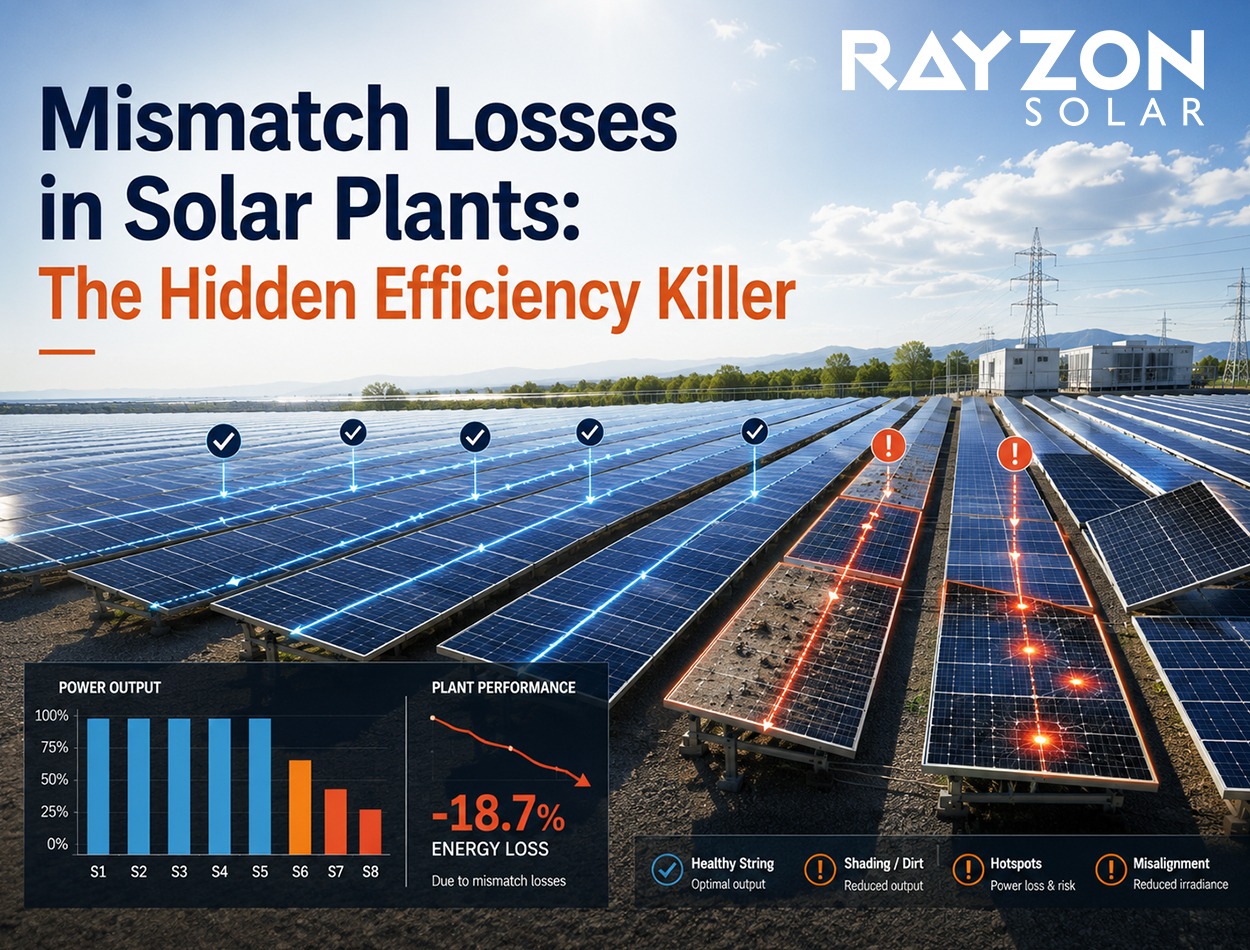
Even a high-efficiency solar plant can lose energy because of one hidden issue - mismatch losses. These losses occur when solar modules or strings do not operate at the same electrical characteristics. The result is lower energy yield and reduced plant performance.
Mismatch mainly appears in two forms:
Current Mismatch
Modules connected in series carry the same current. If one module generates lower current because of manufacturing variation, shading, dust, or degradation, the entire string current drops.
Current mismatch creates higher losses than voltage mismatch because the weakest module limits the whole string.
Voltage Mismatch
Parallel strings operate at a common voltage. When strings have different voltage characteristics, the inverter cannot extract peak power from every string simultaneously.
This issue becomes common in large utility-scale plants with uneven module ageing or mixed string lengths.
Why Module Binning Matters
In a manufacturing process it’s impossible to get uniformed and matching electrical characteristics on all modules, however they can help to reduce this mismatch losses through stringent module binning. This process groups modules in a tighter band of similar electrical characteristics before shipment.
Proper binning helps reduce array-level losses caused by manufacturing variation and improves energy consistency across strings.
Modern PV systems usually maintain mismatch losses below 1%. However, poor binning/sorting, installation practices, inconsistent modules, or shading can increase losses significantly.
EPC-Level Mitigation Strategies
EPC companies can reduce mismatch losses through smart engineering practices:
- Using modules from the same electrical bin
- Designing equal string lengths
- Avoiding uneven shading and mixed orientations
- Conducting string-level IV testing
- Using advanced MPPT designs where required
Small electrical mismatches can create large annual energy losses in utility-scale projects. Careful module selection and disciplined EPC execution remain essential for maximising solar plant efficiency.