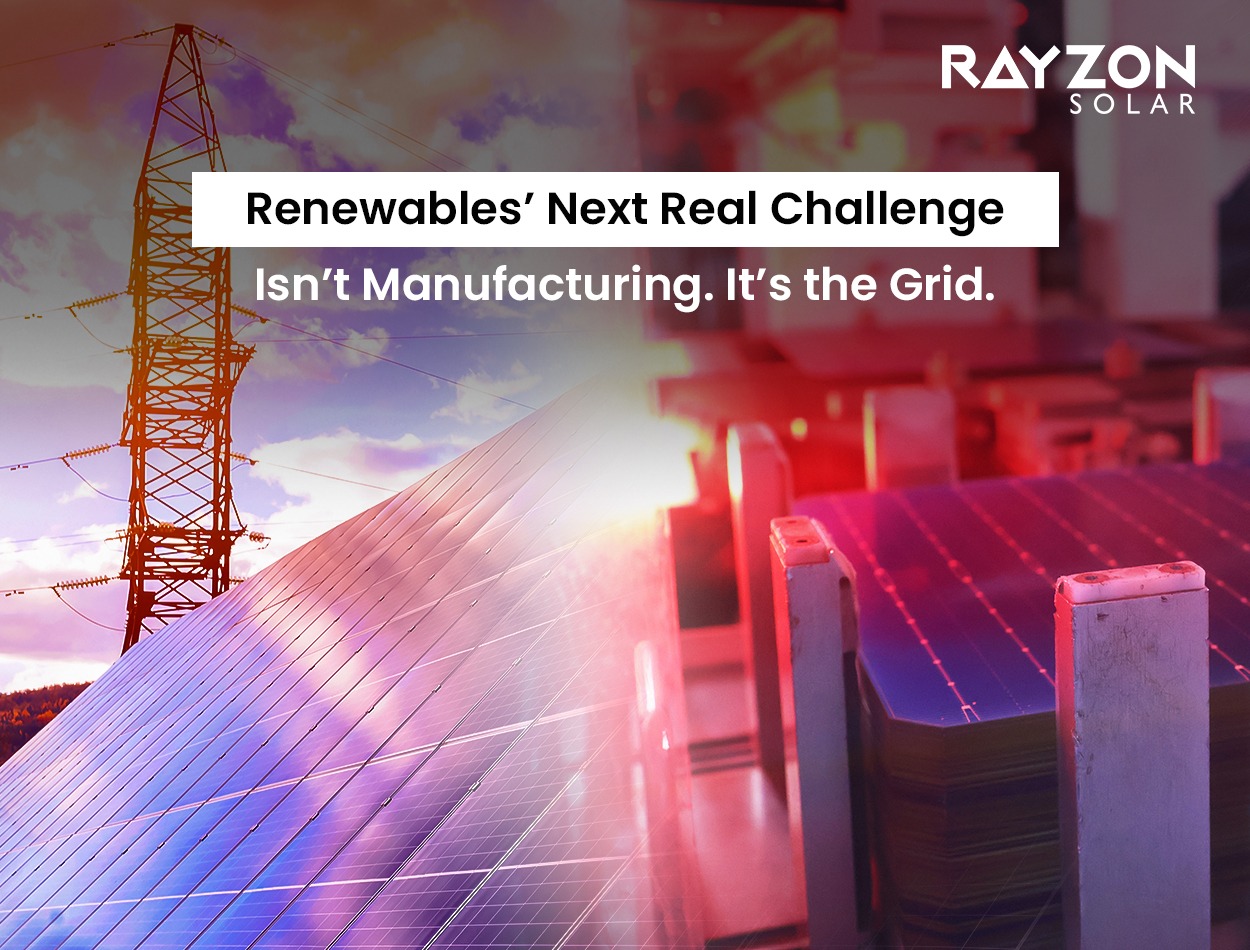
Renewables’ Next Real Challenge Isn’t Manufacturing. It’s the Grid.
If you attend enough renewable energy conferences, you start noticing a pattern. The spotlight is always on manufacturing capacity, new module technologies, efficiency milestones, or export numbers. Those are important conversations. But there’s another one quietly building in control rooms and transmission offices across India — and it doesn’t get nearly the same attention.
The grid is under pressure.
India’s solar capacity has grown rapidly over the last few years, and that growth is something to be proud of. But large-scale renewable penetration changes how power systems behave. Solar generation peaks in the middle of the day. Demand doesn’t always follow the same curve. That mismatch creates operational complexity that doesn’t show up in manufacturing capacity announcements.
In high-penetration regions, grid operators are already dealing with voltage fluctuations, frequency balancing challenges, and midday surplus management. When generation exceeds local demand or transmission capability, curtailment becomes the uncomfortable solution. Curtailment is rarely discussed in marketing decks, but it directly affects project revenues and long-term investor confidence. This is what happens when technology succeeds at scaling while infrastructure lags behind.
What makes this more interesting is that manufacturing decisions increasingly intersect with grid behaviour. Module temperature coefficients, low-light performance, inverter compatibility, and system-level integration matter more when grids operate close to their flexibility limits. In other words, performance on paper is no longer enough; performance within a dynamic grid environment is what counts.
Manufacturers who understand this shift are thinking beyond wattage. They’re looking at how their products behave under real-world utility-scale deployment, particularly in regions with high solar density. Companies like Rayzon Solar, which are expanding capacity while also moving toward deeper integration, are operating in a phase where system-level awareness becomes strategically important.
The next phase of India’s solar growth will depend less on how many gigawatts are announced and more on how intelligently generation integrates with storage, transmission planning, and flexible demand management. Grid upgrades, energy storage deployment, and smarter inverters are no longer side conversations — they are central to sustaining growth.
Solar has won the cost argument. The real test now is whether infrastructure evolves fast enough to absorb what manufacturing is producing. That is not as glamorous as announcing a new line, but it is far more decisive for the next decade.