Solar Panel Degradation Explained: Key Causes and Performance Insights
India is experiencing a solar energy revolution. With over 70 GW of installed solar capacity and ambitious renewable energy targets, more homeowners, businesses, and industries are investing in solar power systems. But here's something most buyers don't realize until later: solar panel degradation is a natural process that affects every solar installation over time.
Understanding solar panel degradation isn't just about knowing your panels will lose some efficiency—it's about making smarter investment decisions. When you know how much panels degrade annually, what causes this loss, and how long they actually last in Indian conditions, you can calculate realistic returns and choose quality products that protect your investment.
In this comprehensive guide, we'll break down everything you need to know about solar panel efficiency degradation, from typical annual degradation of solar panels to proven methods that extend panel life in India's challenging climate
What Is Solar Panel Degradation?
Solar panel degradation refers to the gradual reduction in the electricity-generating capacity of solar panels over time due to environmental exposure, material ageing, and operational stress. Think of it like a car—no matter how well you maintain it, normal wear and tear happens.
When you install a new solar panel rated at 550W, it will initially produce close to that capacity under standard test conditions. However, year after year, the power output decreases slightly. This isn't a defect—it's physics. The semiconductor materials inside solar cells naturally degrade when exposed to sunlight, temperature fluctuations, and environmental factors.
There are two types of degradation you should know about:
- Temporary degradation: This includes issues like dust accumulation, bird droppings, or snow cover that reduce output temporarily. Once cleaned or removed, performance returns to normal.
- Permanent degradation: This is the irreversible, slow decline in efficiency due to material aging, UV exposure, and internal cell damage. This is what we focus on when discussing solar panel degradation rat
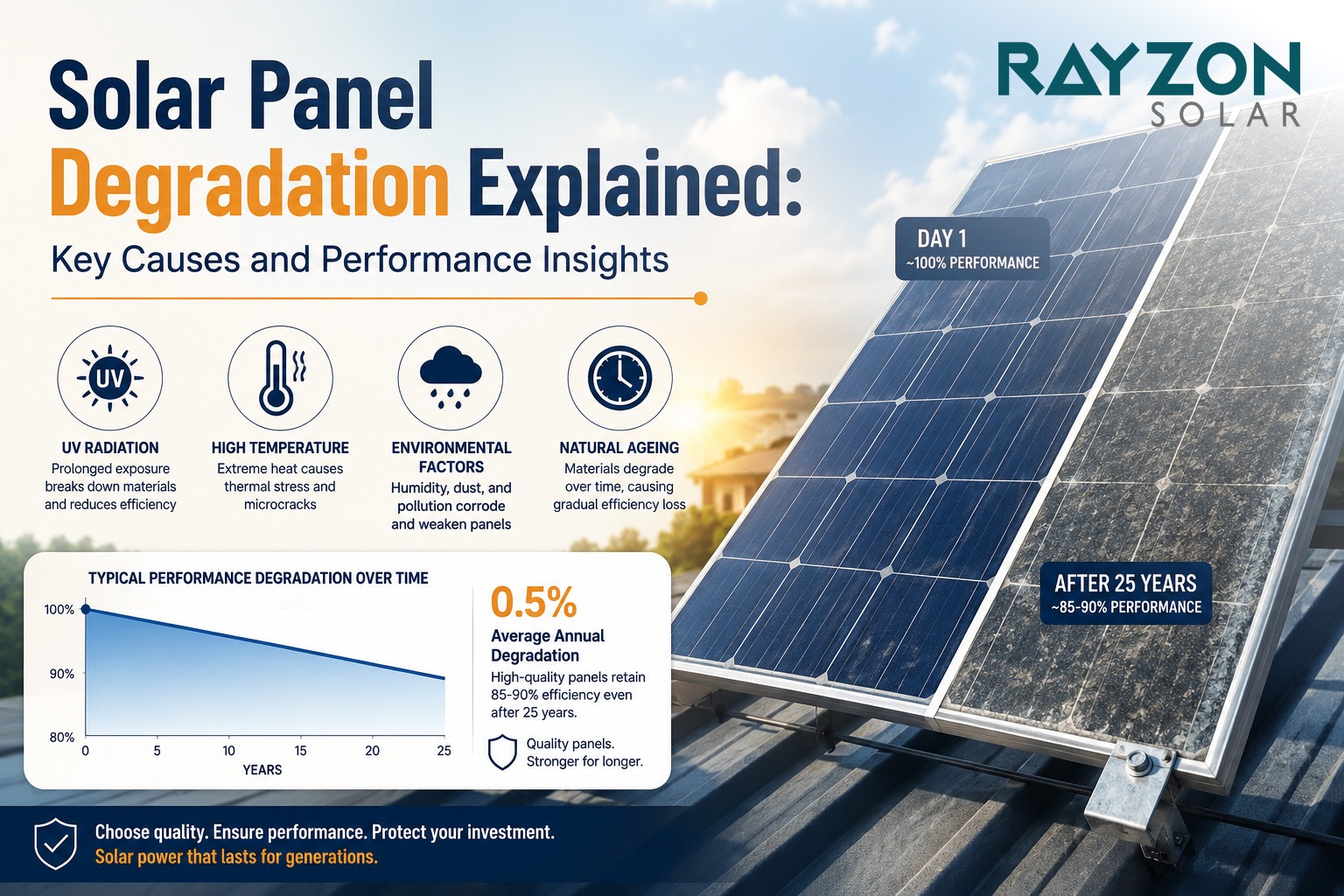
Example: A 550W solar panel may produce around 540W after five years and approximately 475W after twenty-five years, depending on quality and maintenance.
“Solar panel degradation refers to the gradual reduction in the electricity-generating capacity of solar panels over time due to environmental exposure, material ageing, and operational stress.”
How Much Do Solar Panels Degrade Every Year?
The standard solar panel degradation rate has improved dramatically over the last two decades. A meta-analysis of over 54,000 systems worldwide conducted by NREL confirmed that modern solar panels degrade at a median rate of 0.5% to 0.7% per year, showing a major improvement, over legacy panels manufactured before 2010 which exhibited decay rates exceeding 1.1% per year. The annual degradation of solar panels dictates the long-term electricity generation trajectory of a system. When plotted, the long-term solar panel degradation curve typically shows a stabilization phase. While legacy systems saw accelerated decay, high-quality modern systems exhibit a highly linear and predictable decline after an initial stabilization period.
For premium Tier-1 manufacturers, the annual drop is often restricted to approximately 0.3% to 0.5%, whereas low-quality or sub-standard modules can degrade at rates exceeding 1.0% annually, often accelerating as the encapsulation layers begin to fail. This variation emphasizes the critical role that material quality plays in determining the long-term viability of the installation.
The expected performance decay across various module technologies is structured in the following table:
|
Solar Panel Type |
Typical Annual Degradation |
25-Year Retained Output |
|
Premium Monocrystalline (N-Type HJT/IBC) |
0.25%–0.5% |
88.0%–93.0% |
|
Standard Monocrystalline (P-Type PERC) |
0.5%–0.7% |
84.0%–86.5% |
|
Polycrystalline (Legacy Modules) |
0.7%–1.0% |
75.0%–80.0% |
|
Low-Quality Modules (Off-Brand) |
1.0%+ |
< 75.0% |
How much efficiency do solar panels lose?"
Most modern solar panels lose around 0.5% efficiency per year, meaning they can still operate at 85–90% efficiency even after 25 years.
What Causes Solar Panel Degradation?
A comprehensive analysis of what causes solar panel degradation highlights the role of UV-induced polymer cracking. In examining why do solar panels degrade; researchers identify thermal cycling as a primary catalyst. To evaluate if do solar panels degrade in storage, studies look at temperature and moisture levels within warehouses. These factors, combined with severe field operating conditions, form a web of chemical, thermal, and mechanical stress. The physical progression of these mechanisms is a primary catalyst of accelerated solar panel degradation over time
Exposure to UV Radiation
Solar panels work by absorbing sunlight, but that same UV radiation slowly breaks down the panel's protective encapsulant and backsheet materials. Over years of exposure, this can lead to discoloration and reduced light transmission to the solar cells.
Indian context: States like Rajasthan, Gujarat, and Maharashtra experience extremely high UV exposure throughout the year, making UV-resistant panel coatings especially important.
High Temperature & Heat Stress
Solar panels actually lose efficiency as they get hotter. More critically, extreme heat causes thermal expansion and contraction cycles that can create microcracks in solar cells over time.
Indian summer temperatures routinely exceed 45°C in many regions. Rooftop systems in cities like Delhi, Ahmedabad, and Hyderabad can reach surface temperatures of 70-80°C, accelerating the degradation of solar panels.
Humidity & Moisture Ingress
When moisture penetrates panel edges or damaged seals, it can corrode electrical connections and degrade cell performance. This is particularly problematic in humid coastal areas.
High-risk areas in India: Mumbai, Chennai, Kolkata, Goa, Kerala, and other coastal regions where humidity levels remain high year-round.
Dust & Pollution Accumulation
While dust is technically a temporary issue, chronic soiling accelerates permanent degradation by creating hotspots—localized areas of excessive heat that damage cells. Pollution particles can also chemically interact with panel surfaces.
India's industrial belts and cities with high pollution levels see faster panel degradation without regular cleaning. Delhi NCR, industrial areas of Gujarat and Maharashtra, and mining regions are particularly affected.
Microcracks in Solar Cells
These are invisible fractures in silicon cells that can occur during manufacturing, transportation, installation, or from wind and snow loads. Microcracks interrupt electrical flow and progressively worsen over time.
Prevention tip: Choose panels from manufacturers with robust quality control and hire experienced installers who handle modules carefully.
Potential Induced Degradation (PID)
Potential induced degradation of solar cells and panels is a phenomenon where voltage leakage occurs between the solar cells and the panel frame, causing power loss. PID typically happens in systems with high negative voltage to ground.
PID can cause significant power losses—sometimes 20-30% or more—within just a few years if panels aren't PID-resistant. Modern premium panels are designed with anti-PID technologies, but cheaper panels remain vulnerable.
Light-Induced Degradation (LID)
LID occurs when crystalline silicon panels experience a one-time efficiency drop during their first few hours or days of sunlight exposure. This is a well-known phenomenon in standard silicon panels.
The good news? LID is typically factored into manufacturer warranties. Most panels stabilize after this initial drop, and newer technologies like TOPCon and HJT have dramatically reduced LID effects
Delamination & Material Ageing
Delamination is when the protective layers of a solar panel begin to separate, often visible as bubbling or yellowing. This exposes the solar cells to moisture and air, accelerating degradation.
In India's hot climate, poor-quality adhesives and encapsulants degrade faster, making panel quality even more critical.
Types of Solar Panel Degradation
Solar panel degradation can be classified into three main types:
Early Degradation
Also called initial degradation, this is a normal power output drop that occurs within the first few weeks or months of operation. It's mainly due to LID and is usually accounted for in manufacturer specifications.
Linear Degradation
This is the steady, predictable annual degradation of solar panels over their lifetime—the 0.5% to 0.8% yearly decline we discussed earlier. This is what warranty calculations are based on.
Catastrophic Failure
Sudden, severe damage caused by manufacturing defects, extreme weather events, or installation errors. Examples include complete panel failure from severe hail damage, major electrical faults, or structural collapse. These are covered under product warranties, not performance warranties.
Solar Panel Degradation Rate in India
The localized solar panel degradation rate varies widely across geographic zones. Because India features extreme environments ranging from hot deserts to highly humid coastal regions, standard European durability models do not accurately predict how panels perform in the field. The annual degradation of solar panels is heavily influenced by these localized climate challenges.
A comprehensive study by PV Evolution Labs (PVEL) evaluating 36 operational solar assets in India recorded an average annual degradation rate of 1.47% across all sites. However, the study highlighted a stark geographic divergence: systems in colder, mountainous northern regions degraded at nearly half that rate (0.7% annually), whereas assets in extremely hot or highly humid regions experienced much faster deterioration.
The primary regional environmental degradation risks across India are structured in the following table:
|
Region |
Major Degradation Risk |
Operational Impact |
|
Rajasthan / Desert Areas |
Heat & dust storms |
Severe physical abrasion, extreme thermal cycling, cell microcracking |
|
Gujarat / Coastal West |
Salt corrosion & heat |
Accelerated chemical rust, EVA browning, PID |
|
Maharashtra / Central |
Humidity & urban pollution |
Rapid encapsulant delamination, soot-induced hot-spots |
|
Delhi NCR / North |
Smog, soot & heavy dust |
Severe soiling losses, high light obstruction, diode strain |
|
Kerala / Coastal South |
Heavy moisture & rainfall |
Severe moisture ingress, copper track corrosion, insulation failure |
How Long Do Solar Panels Last?
The useful lifespan of a high-quality solar panel is typically between 25 and 30 years. It is important to note that a panel does not simply stop generating electricity after this period; rather, its power output declines to a level where replacing it with modern, high-efficiency modules becomes financially logical. A rigorous solar panel degradation calculation allows asset managers to forecast future cash flows.
To understand how this calculation works under real-world conditions, let's look at a standard linear decay model:
P(t) = P0 x (1 - d x t)
Where:
- P(t) is the estimated power output at year t.
- P0 is the initial nameplate power output of the module.
- d is the annual degradation rate.
- t is the operational time in years.
Using this formula, if a premium 400W monocrystalline panel has an annual degradation rate of 0.5% (d = 0.005):
P(25) = 400 x (1 - 0.005 x 24) = 400 x (1 - 0.12) = 352W
This calculation demonstrates that even after 25 years of continuous outdoor exposure, the module still delivers 88% of its original rated power, confirming its durability as a long-term financial asset.
Note: Most high-quality solar panels can continue generating electricity for 25–30 years while maintaining around 80–90% of their original output.
Solar Panel Degradation vs Efficiency Loss
Many people confuse these terms, but they're different:
- Efficiency refers to how well a panel converts sunlight into electricity at any given moment. A 22% efficient panel converts 22% of incoming solar energy into electricity. This is an instantaneous performance measure.
- Degradation is the long-term trend of declining power output over years. It's measured as a percentage loss per year, not as current conversion capability.
|
Factor |
Conversion Efficiency |
Degradation Trend |
|
Primary Meaning |
Current sunlight-to-electricity conversion capability |
Irreversible, long-term maximum power reduction |
|
Measurement Window |
Measured instantaneously under real-time conditions |
Tracked systematically over years of field service |
|
Reversibility |
Reversible (e.g., improves when panels cool or clean) |
Irreversible (permanent material and physical changes) |
|
Primary Drivers |
Instantaneous cell temperature, irradiance level |
Environmental exposure, material aging, PID |
Monocrystalline vs Polycrystalline Solar Panel Degradation
The structural alignment of the silicon wafers determines how well a module resists long-term wear. This structural difference explains why solar panel efficiency degradation is less pronounced in monocrystalline units compared to polycrystalline ones. The comparative performance of these two cell designs is structured around the following parameters:
- Long-Term Stability: Monocrystalline cells are sliced from a single, high-purity silicon crystal with a uniform lattice and no grain boundaries, offering high resistance to PID and LID. In contrast, polycrystalline cells contain multiple fused crystals, resulting in grain boundaries that serve as structural weak points. This makes them highly vulnerable to thermomechanical stress and moisture, leading to a faster annual degradation rate (0.7%–1.0%) compared to monocrystalline (0.3%–0.5%).
- Temperature Performance: Monocrystalline panels feature a superior temperature coefficient (-0.24%/°C to -0.30%/°C), meaning they lose significantly less output during peak summer heat. Polycrystalline panels have poorer, higher negative temperature coefficients (often exceeding -0.40%/°C), causing rapid power drops and excessive thermomechanical expansion that accelerates microcracks.
- Warranty Support: Thanks to single-crystal purity, monocrystalline panels carry stronger protection, guaranteeing 88%–92% power retention after 25 to 30 years alongside 10-to-15-year product warranties. Polycrystalline modules are typically backed only by standard 25-year performance warranties guaranteeing a lower 80% output, reflecting their higher long-term operational risks.
- Lifespan: Monocrystalline systems deliver a reliable operational lifespan of 25 to 30+ years, and can remain active for up to 40 years with diligent maintenance. Polycrystalline panels have a shorter economic lifespan of 20 to 25 years, as their faster degradation levels force earlier and more costly system replacements.
|
Feature |
Monocrystalline Modules |
Polycrystalline Modules |
|
Degradation Rate |
Lower (typically 0.3% to 0.5% per year) |
Slightly Higher (typically 0.7% to 1.0% per year) |
|
Heat Resistance |
Better (lower negative temperature coefficient) |
Moderate (higher performance drops in extreme heat) |
|
Expected Lifespan |
Longer (typically 25 to 30+ years) |
Moderate (typically 20 to 25 years) |
|
Relative Cost |
Higher upfront capital expenditure |
Lower upfront capital expenditure |
How Manufacturers Test Solar Panel Degradation
Reputable manufacturers test how degradation of solar panel is calculated through rigorous accelerated ageing protocols based on IEC (International Electrotechnical Commission) standards:
- Thermal Cycling Test: Panels undergo 200+ cycles of extreme temperature swings (-40°C to +85°C) to simulate years of day-night cycles.
- Damp Heat Test: Panels are exposed to 85°C and 85% humidity for 1000+ hours to test moisture resistance.
- UV Exposure Test: Prolonged UV radiation exposure simulates years of sunlight damage.
- Mechanical Load Test: Wind and snow load simulations test structural integrity.
Panels passing these tests are certified to IEC 61215 (crystalline) or IEC 61646 (thin-film) standards. For Indian buyers, choosing IEC-certified panels from Tier-1 manufacturers is crucial for ensuring quality and longevity.
Solar Panel Warranty Explained
Warranties provide essential financial protection against premature performance decline. Asserting that the warranted solar panel degradation rate must not exceed industry-standard limits is a primary buyer protection.
Product Warranty
The product warranty covers physical manufacturing defects, faulty workmanship, and structural failures. This protects buyers against physical issues such as frame warping, junction box failures, or early delamination.
Performance Warranty
This guarantees minimum power output over time and is directly related to degradation factor solar panels. Standard warranties typically guarantee:
- 90-97% output after 10 years
- 80-85% output after 25 year
Premium panels now offer linear warranties: These guarantee consistent annual degradation (e.g., maximum 0.5% per year) rather than just end-of-period minimums, providing better long-term confidence.
Buyer tip: Always read warranty documents carefully. Check what's actually covered, claim procedures, and whether the manufacturer has a solid service network in India
Signs of Solar Panel Degradation
Identifying early indicators of performance loss allows system operators to address issues before they lead to serious system failures. If operators ask why do solar panels degrade in their specific installations, they must examine several visual and electrical signals.
- Reduced Electricity Generation: Your monitoring system shows consistent output decline beyond normal seasonal variation.
- Visible Discoloration: Yellowing, browning, or bubbling of panel surfaces.
- Cracks: Visible cracks in cells or glass (even hairline cracks reduce performance).
- Hotspots: Detected via thermal imaging—areas generating excessive heat.
- Inverter Warnings: Frequent fault codes or error messages from your inverter.
- Sudden Drop in Savings: Your electricity bill savings have decreased noticeably without changes in consumption.
Pro tip: Use monitoring systems that track output trends over time. Catching degradation early can help you claim warranties or prevent further damage.
How to Reduce Solar Panel Degradation
To directly mitigate what causes solar panel degradation, system designers must specify high-quality encapsulants. By addressing each chemical degradation factor solar panels encounter, operators can significantly extend the system's operational life.
Choose High-Quality Tier-1 Solar Panels
Selecting Tier-1 certified modules ensures the system uses high-purity silicon wafers and reliable encapsulants. Tier-1 manufacturers use advanced quality control systems that prevent minor physical defects from slipping past inspection.
Proper Installation
Modules must be installed with adequate clearance (typically 3 to 4 inches above the roof surface). This structural gap allows air to circulate under the panels, creating convective cooling that lowers operating temperatures and reduces thermal cycling stress.
Regular Cleaning & Maintenance
Keeping the glass surface clean of dust, bird droppings, and industrial smog prevents hotspot formation. In India, cleaning frequency should be adjusted based on the regional environment:
|
Location Type |
Recommended Cleaning Frequency |
Primary Objective |
|
Dusty Areas (e.g., Northwest India) |
Every 1–2 weeks |
Prevent dust-driven light blocking and hotspots |
|
Urban Areas / Metro Cities |
Monthly |
Clear industrial smog and dust buildup |
|
Coastal Areas |
Monthly inspection |
Monitor and clear salt spray to prevent corrosion |
|
Moderate Climate Zones |
Every 2–3 months |
Basic maintenance and clearing of organic debris |
Periodic Inspection
Performing regular thermal imaging inspections with infrared cameras allows operators to identify and isolate localized cell hotspots before they damage the surrounding encapsulant.
Use Quality Inverters & BOS Components
Using high-quality inverters and balance-of-system (BOS) components prevents voltage spikes and grounding issues that can accelerate Potential Induced Degradation. Studies show that approximately 80% of total solar plant downtime is caused by inverter failures rather than defects in the panels themselves
Does Solar Panel Degradation Affect ROI?
Yes, the financial impact of the annual degradation of solar panels reveals that a lower loss rate preserves lifetime energy yields and protects project economics. This financial analysis relies on a solar panel degradation calculation that contrasts high-quality panels with cheaper, faster-degrading alternatives. Directly tracking how solar panel degradation influences the amortized lifetime value is crucial for commercial and residential installations alike.
Consider a standard 10 kW residential rooftop system with an initial generation of 15,000 kWh in Year 1. This financial analysis uses a standard solar panel degradation calculation to project cumulative generation over twenty-five years. Comparing a legacy P-type PERC system (0.7% annual degradation) with an N-type TOPCon system (0.4% annual degradation) illustrates this impact:
- P-Type PERC System (0.7% degradation)
- Year 10 Generation: approx 14,085kWh
- Year 25 Generation: approx 12,600 kWh (84.0% of original capacity)
- Cumulative 25-Year Generation: approx 345,000 kWh
- N-Type TOPCon System (0.4% degradation)
- Year 10 Generation: approx 14,468kWh
- Year 25 Generation: approx 13,620 kWh (90.8% of original capacity)
- Cumulative 25-Year Generation: approx 362,000 kWh
This minor 0.3% difference in the annual rate yields approximately 17,000 kWh of extra electricity over the project lifespan. At an average commercial power rate of ₹8 per kWh, this represents over ₹1,36,000 in additional savings, easily justifying the small upfront cost premium of premium n-type modules.
Are Modern Solar Panels Becoming More Durable?
Yes. Solar technology is advancing rapidly, and newer panels show significantly improved durability:
- TOPCon Panels: Reduced LID and better temperature coefficients mean slower degradation.
- HJT (Heterojunction) Panels: Exhibit very low degradation rates (often under 0.3% annually) and excellent heat performance.
- Improved Encapsulation: New materials better resist UV, moisture, and delamination.
- Anti-PID Technologies: Cell designs and coatings that prevent potential induced degradation.
The Indian solar market is shifting toward these high-efficiency, low-degradation modules as prices become more competitive. If you're investing now, these technologies offer the best long-term value.
Frequently Asked Questions (FAQ)
What is the average degradation rate of solar panels?
Most modern solar panels degrade at approximately 0.5% to 0.8% per year. Premium panels can achieve rates as low as 0.3% annually.
Do solar panels stop working after 25 years?
No. Solar panels don't suddenly stop working after 25 years. They continue generating electricity but at reduced capacity—typically 80-90% of original output, depending on quality.
Which solar panels have the lowest degradation?
Premium monocrystalline panels using TOPCon or HJT technology currently have the lowest degradation rates, often under 0.4% per year.
Does heat increase solar panel degradation?
Yes. High temperatures accelerate material aging and thermal stress, increasing degradation rates. This makes choosing heat-resistant panels crucial for India.
How can I reduce solar panel degradation?
Choose high-quality Tier-1 panels, ensure proper installation with good ventilation, maintain regular cleaning schedules, and conduct periodic professional inspections.
What is PID in solar panels?
PID (Potential Induced Degradation) is voltage leakage between solar cells and the frame that can cause significant power loss. Modern anti-PID panels prevent this issue
Are monocrystalline panels more durable?
Yes. Monocrystalline panels generally show lower degradation rates, better heat tolerance, and longer lifespans compared to polycrystalline panels.
How long do solar panels last in India?
Quality solar panels can last 25-30 years in India, though degradation may be slightly faster in extreme heat and high-pollution areas. Proper maintenance extends lifespan significantly.
Does cleaning reduce degradation?
Regular cleaning doesn't directly reduce permanent degradation but prevents hotspot formation and maintains optimal performance, indirectly protecting against accelerated aging.
Conclusion
Solar panel degradation is a natural, unavoidable process—but it's also highly manageable when you make informed decisions. Understanding the solar panel degradation rate, recognizing what causes solar panel degradation, and knowing how to minimize it transforms solar from a simple purchase into a strategic long-term investment.
For Indian solar owners, the message is clear: panel quality isn't negotiable. Our climate—with its extreme temperatures, high UV exposure, monsoon humidity, and dust—demands panels built to withstand these challenges. Premium panels may cost more upfront, but their lower degradation rates deliver substantially better returns over 25-30 years.
Combine quality panels with professional installation, regular maintenance, and periodic inspections, and you'll maximize your solar investment's lifespan and profitability. Remember that even with degradation, your panels will still be generating valuable electricity decades from now—making solar energy one of the smartest financial and environmental choices you can make.
Ready to invest in high-quality solar panels with industry-leading warranties? Contact our solar experts today to find the best degradation-resistant panels for your location and budget.