The Guide to Solar Panel Types in India: Efficiency, Cost, and Technology Breakdown
Choosing from the various types of solar panel is the first step toward achieving total energy independence for Indian households. Since each of the types of solar panel interacts differently with our high-heat environment, selecting the correct technology is vital for long-term ROI. In 2026, the Indian energy landscape is shifting rapidly, with electricity tariffs in states like Gujarat increasing by 5% to 8% annually, making the adoption of rooftop solar a financial necessity rather than just an environmental choice.
As the nation moves toward its target of 500 GW of non-fossil fuel energy capacity by 2030, the market has seen an explosion in the availability of diverse types of solar panels. These modules come in various forms based on technology, efficiency, and usage, each suited for different needs and budgets. With the growing demand for reliable solar panel solutions in India, homeowners and businesses are increasingly looking for high-efficiency technologies that deliver long-term savings and dependable performance. Trusted manufacturers like Rayzon Solar are helping accelerate this transition by offering advanced solar technologies tailored for Indian climate conditions.
This guide provides a comprehensive breakdown of solar panel types and efficiency to help you navigate the complex landscape of the Indian renewable sector.
What Are Solar Panels?
Solar panels, formally known as photovoltaic (PV) modules, are semiconductor devices that convert sunlight directly into electricity. This conversion happens at the atomic level using the photovoltaic effect, where photons from sunlight excite electrons in a silicon cell, creating a flow of direct current (DC) power.
The manufacturing of high-quality panels is a complex 18-step journey. It begins with silicon purification via the Siemens process, followed by the formation of single-crystal ingots, diamond-wire wafer slicing, and chemical texturization to create a pyramid-like surface that maximizes light absorption. This electricity is then managed by an inverter to power your home’s AC appliances.
Main Types of Solar Panels: A Technical Core
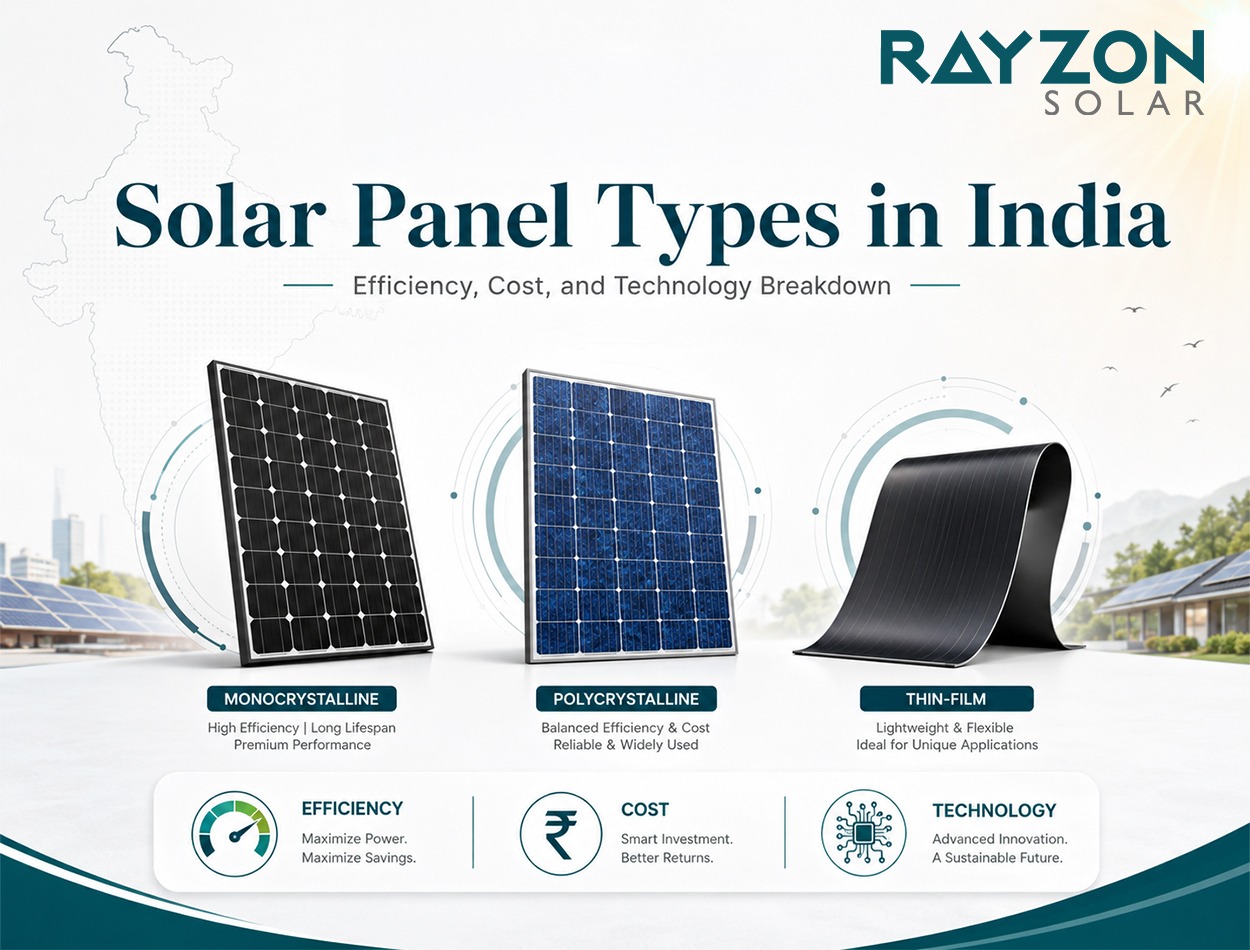
The Indian market currently accommodates several different types of solar panels, each offering a unique balance of cost, performance, and durability.
1 Monocrystalline Solar Panels
Monocrystalline panels are widely considered the best type of solar panel for home use in urban environments where rooftop space is limited. These are made from a single, high-purity silicon crystal grown through the Czochralski method, resulting in a uniform dark black appearance with rounded edges.
Pros :
- Elite Efficiency: They offer the highest efficiency ratings on the market, typically between 18% and 22%.
- Superior Heat Tolerance: With a lower temperature coefficient (typically -0.3% to -0.4% per degree Celsius), they maintain output better during intense Indian summers.
- Space-Efficient: Because they produce more power per square foot, you need fewer panels to meet your energy goals.
- Long-Term Durability: Most premium brands offer 25-to-30-year performance warranties.
Cons:
- Higher Initial Cost: These are generally 15% to 25% more expensive than polycrystalline alternatives.
- Shading Sensitivity:Performance can drop significantly if even a small portion of the panel is shaded by trees or chimneys.
- Production Waste:The process of cutting cylindrical ingots into square wafers creates more silicon waste.
Best for: Urban homes, premium villas, and commercial setups with limited roof area.
2 Polycrystalline Solar Panels
Polycrystalline modules, identified by their bluish, speckled appearance, are made by melting multiple silicon fragments together. While they have historically been the most common types of solar panels in India due to their affordability, they are gradually being phased out by high-efficiency mono modules.
Pros:
- Cost-Effective:They are significantly cheaper to manufacture, which translates to a lower price per watt for the consumer.
- Sustainable Manufacturing: The process results in less silicon waste compared to monocrystalline production.
- Reliable Performance: A proven technology that has been the backbone of the Indian solar revolution for decades.
- Budget-Friendly: Ideal for homeowners looking for the lowest entry cost.
Cons:
- Lower Efficiency: Efficiency typically peaks between 15% and 17%, meaning they generate less power in the same area.
- Lower Heat Resistance: They have a higher temperature coefficient, causing a sharper drop in power during 45°C afternoons.
- Larger Footprint: You will need roughly 20-30% more rooftop space compared to a monocrystalline system of the same capacity.
Best for: Budget-conscious users, rural installations, and industrial projects with massive unshaded areas.
3 Thin-Film Solar Panels
Thin-film panels utilize ultra-thin layers of photovoltaic materials like Cadmium Telluride (CdTe) or Amorphous Silicon (a-Si) deposited onto glass or plastic.
Pros:
- Extreme Flexibility:They are lightweight and can be applied to curved surfaces or building facades.
- Heat-Friendly: These panels exhibit very low temperature coefficients, keeping them stable in extreme heat.
- Lightweight: At approximately 3.5 kg per square meter, they are ideal for older roofs that cannot handle heavy crystalline glass.
Cons:
- Low Efficiency: Ratings are generally between 10% and 12%, making them unsuitable for most residential rooftops.
- Massive Space Needs: You need a vast amount of area to generate the same electricity as a standard crystalline system.
- Shorter Lifespan: Typically last only 10 to 20 years, significantly less than silicon-based panels.
Best for: Large-scale industrial projects, portable chargers, and Building-Integrated Photovoltaics (BIPV).
Advanced Solar Panel Technologies (Emerging in India)
As the industry matures, identifying the most efficient type of solar panels requires looking at next-generation cell architectures.
1 Bifacial Solar Panels
These are engineered to generate power from both the front and back sides by capturing reflected sunlight (albedo) from the roof or ground.
- Performance Gain: They can increase energy yield by up to 25% depending on the surface reflectivity.
- Durability: Usually designed with dual-glass construction for enhanced environmental protection.
2 TOPCon Solar Panels
TOPCon (Tunnel Oxide Passivated Contact) is the latest gold standard in the Indian solar market.
- Next-Gen Efficiency: These panels use N-Type wafers and a thin tunnel oxide layer to reach efficiencies exceeding 22.5% in mass production.
- Durability: They offer the lowest annual degradation rate (0.4%) and an expected lifespan of 30+ years.
3 PERC Solar Panels
Mono PERC (Passivated Emitter and Rear Cell) technology adds a passivation layer to the back of the cell to reflect light back through the silicon, improving efficiency to 21-22% and offering excellent low-light performance.
Solar Panel Types Comparison Table
The following solar panel types comparison summarizes the key technical specifications for 2026.
|
Technology Type |
Efficiency Range |
Avg. Cost (per Watt) |
Best Use Case |
Expected Lifespan |
|
Monocrystalline |
18% – 22% |
₹30 – ₹45 |
Premium residential |
25 – 40 years |
|
Polycrystalline |
15% – 17% |
₹25 – ₹35 |
Budget-conscious |
20 – 25 years |
|
Thin-Film |
10% – 12% |
₹20 – ₹30 |
Large industrial |
10 – 20 years |
|
Bifacial |
22% – 25%+ |
₹32 – ₹42 |
Commercial/Reflective roofs |
30+ years |
|
TOPCon |
22.5% – 26% |
₹35 – ₹45 |
Future-ready homes |
30+ years |
Which Type of Solar Panel Is Best for India?
When deciding which type of solar panel is best in india, one must weigh climate against budget.
- Climate (Heat & Dust): In regions like Rajasthan or Gujarat, high temperatures can kill efficiency. TOPCon and Monocrystalline panels are the winners here due to their superior temperature coefficients.
- Space Availability: For urban 2-3 BHK homes, you likely only have 250-400 sq. ft. of clear roof area. High-wattage TOPCon panels allow you to reach 3-5 kW capacity in that tight space.
- Budget: While Polycrystalline remains the cheapest upfront, the faster ROI and higher lifetime savings of different types of solar panels like Monocrystalline make them a better investment for residential users.
Final Recommendation: For homeowners, Mono PERC or TOPCon are the best choices. For large-scale budget projects where space is no bar, Polycrystalline remains viable
Cost Comparison of Solar Panels in India
Understanding the trade-off between solar panel types and cost involves analyzing both the panel price and the turnkey system cost.
- 1 kW System: Costs between ₹45,000 and ₹70,000 before subsidy.
- 3 kW System: Costs between ₹1,50,000 and ₹1,80,000 before subsidy.
- 5 kW System: Costs between ₹2,25,000 and ₹3,00,000 before subsidy.
On a per-watt basis, you can expect to pay ₹30-₹38 for Monocrystalline and ₹25-₹32 for Polycrystalline. However, the PM Surya Ghar Muft Bijli Yojana provides a massive fixed subsidy of up to ₹78,000 for residential systems, which can bring your net investment down by 40-60%.
Factors to Consider Before Choosing: A Strategy Checklist
Before committing to specific types of rooftop solar panels, use this checklist:
- Roof Space: Do you have 80-100 sq. ft. of shadow-free area per kW of capacity?
- Domestic Content Requirement (DCR): If you want the government subsidy, you MUST use DCR-compliant panels (cells and modules both made in India).
- ALMM Listing: Ensure the manufacturer is on the Approved List of Models and Manufacturers (ALMM) to guarantee quality and subsidy eligibility.
- Inverter Choice: High-efficiency panels work best with Tier-1 inverters (String or Micro-inverters).
- Net Metering: Does your local DISCOM (like DGVCL or Torrent Power) support net-metering credits?
- Solar Consultation Services: Partnering with experienced providers like Rayzon Solar can help you evaluate the right panel technology, subsidy eligibility, and installation planning for your property. Professional solar consultation services also simplify system sizing and long-term ROI assessment.
Benefits of Choosing the Right Solar Panel Type
Selecting the best type of solar panel for your specific home leads to:
- Higher Savings: Efficient panels offset the most expensive units of grid power first.
- Faster ROI: With current subsidies, most Indian households recover their total investment in just 3 to 4 years.
- Long-Term Peace of Mind: Modern N-type TOPCon modules degrade at a much slower rate, ensuring 87% of original capacity even after 30 years.
The Rayzon Green Benefit: Professional Implementatio
A major advantage for Indian homeowners is partnering with Rayzon Green, the dedicated EPC (Engineering, Procurement, and Construction) subsidiary of Rayzon Solar. Rayzon Green provides a visionary "end-to-end" experience, handling everything from high-resolution site profiling and technical system design to DISCOM coordination and hassle-free subsidy processing. By ensuring every installation is 100% DCR-compliant and uses ALMM-listed technology, they transform a complex technical project into a seamless financial victory for the consumer.
Conclusion
Recap: Choosing the right types of solar panel is the foundation of a successful energy transition for your family. By prioritizing high-efficiency modules and leveraging the technical expertise of installers like Rayzon Green, you can effectively eliminate your electricity bills for decades. Don't just install a system—invest in a 25-year power plant that secures your financial future.
Frequently Asked Questions (FAQs)
Which type of solar panel is best in India?
For residential rooftops, Monocrystalline or TOPCon panels are the best due to their high efficiency in small spaces and superior performance during extreme Indian summers.
What is the difference between mono and poly panels?
Monocrystalline panels are made from a single crystal and are more efficient/sleek, while polycrystalline panels are made from fragments and are more affordable but require more space.
Are expensive panels worth it?
Yes. High-efficiency types of solar panels for houses generate more electricity over 25 years, leading to faster payback (3-4 years) and significantly higher lifetime savings.
Which solar panel lasts longest?
TOPCon modules generally have the longest lifespan, with performance warranties stretching to 30 years and linear degradation as low as 0.4% per year.
Do solar panels work in cloudy weather?
Yes, but at a reduced capacity. Modern modules like Mono PERC can still generate 10-25% of their rated power by capturing diffused sunlight on overcast days.
What is TOPCon technology?
TOPCon (Tunnel Oxide Passivated Contact) is a next-gen architecture that uses a thin tunnel oxide layer to prevent electron loss, resulting in efficiency above 22.5% and better heat tolerance.