Why the Industry Abandoned p-Type Wafers - The Doping Physics Behind the n-Type Transition
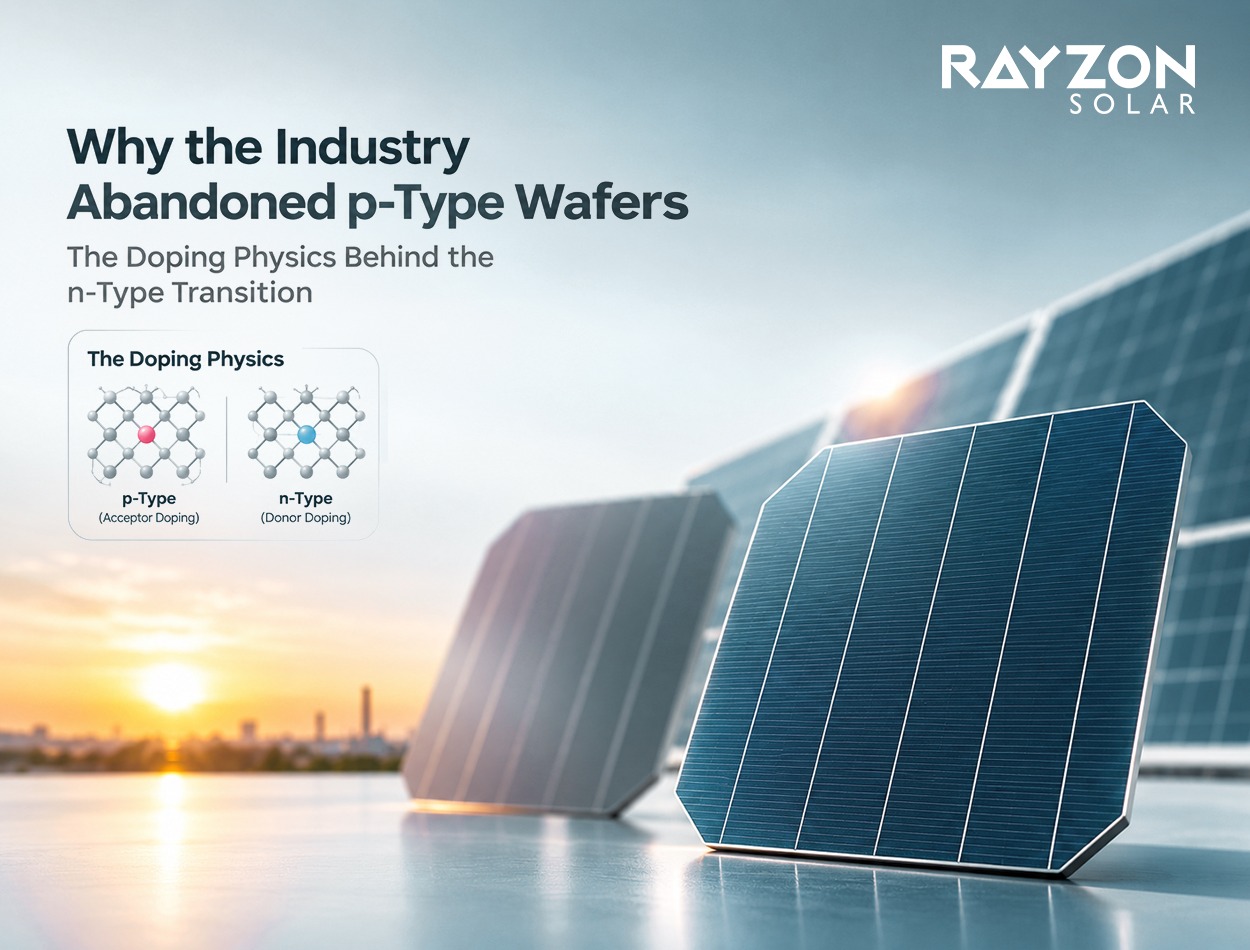
Every solar panel starts with a silicon wafer, and the dopant that manufacturers add to that wafer shapes its performance for decades. For years, p-type wafers with boron set the industry standard. Today, n-type wafers with phosphorus have taken over, and the reason lies in physics that directly affects the energy buyers receive.
Manufacturers grow most monocrystalline wafers with the Czochralski method, and the silicon picks up oxygen during crystal growth. In p-type wafers, that oxygen can pair with boron once sunlight hits the cell. The resulting boron-oxygen complex traps charge carriers before they can become current, and it shortens minority-carrier lifetime. Researchers have documented this mechanism thoroughly. It causes light-induced degradation (LID), a measurable efficiency loss during the first hours or days of sunlight exposure.
On the other hand N-type wafers avoid this problem at its source. Phosphorus doping puts no boron in the bulk, so the boron-oxygen complex never forms. N-type silicon also tends to offer a longer minority-carrier lifetime, which means the cell collects more of the light-generated charge as usable power.
The story does not end with LID. The industry found ways to reduce it in p-type wafers, including gallium doping and hydrogenation, and p-type PERC modules served the market well for years. In our view, headroom drove the larger shift. P-type PERC cells are approaching their practical efficiency ceiling, while n-type architectures such as TOPCon have more room to grow on efficiency curve. N-type’s lifetime advantage lets manufacturers use that room.
For buyers, this typically brings three advantages. Early-life output becomes more predictable because less power disappears to LID after installation. Efficiency potential rises, so the same roof or land area can generate more power. Long-term performance can improve, which makes the warranty’s degradation figures worth a close look.
Even so, n-type alone does not guarantee quality. Cell design, manufacturing consistency and precise process control matter just as much as the wafer. Before you buy, ask the supplier for first-year and annual degradation figures, independent test reports and the exact cell technology in the module.
RAYZON Solar builds its modules with TOPCon technology and reached 11.3 GW of production capacity in the final quarter of FY 2025-26. The L’lios TOPCon range follows the direction the industry is moving advanced cell technology paired with disciplined manufacturing. That combination helps buyers invest with confidence in long-term energy yield.