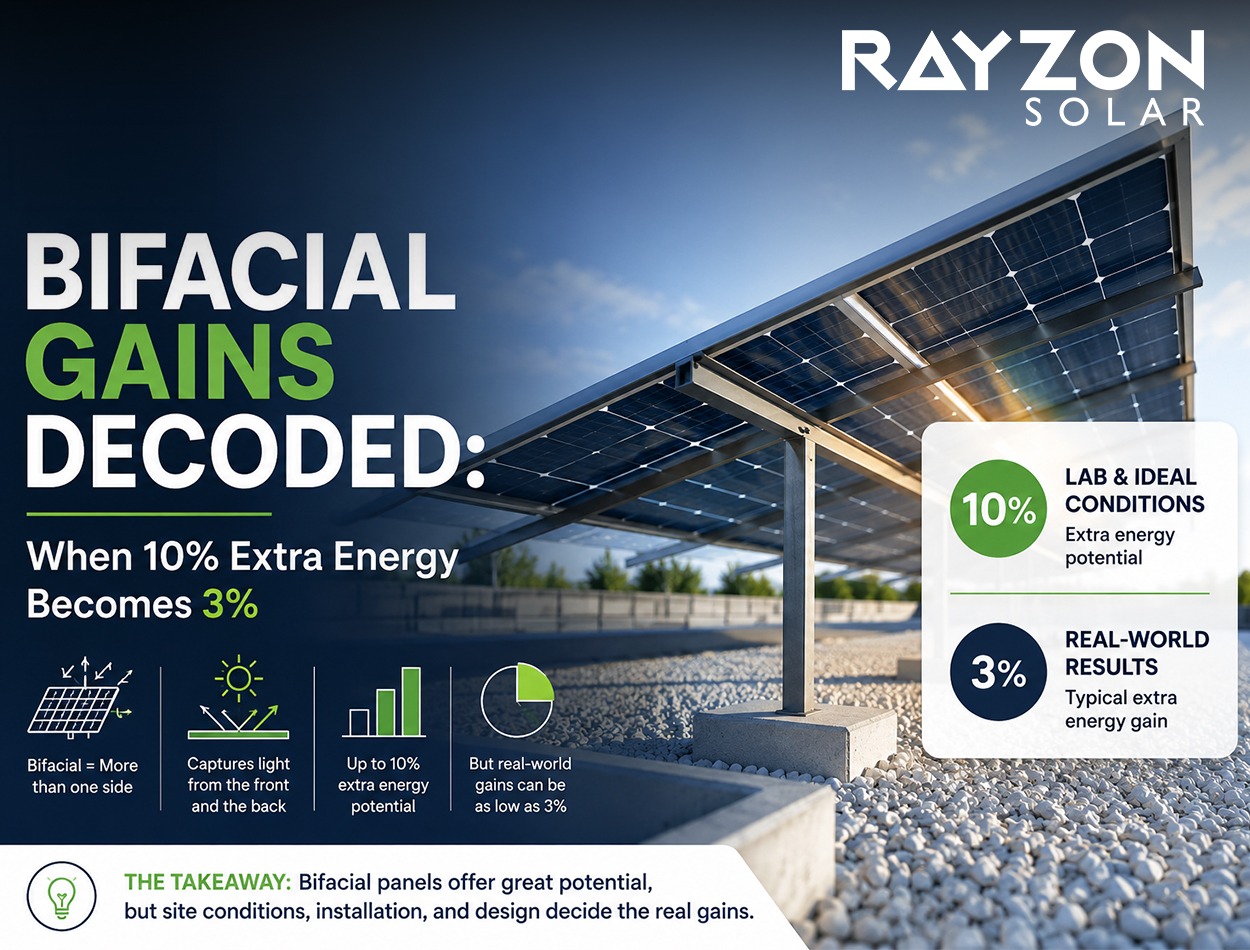
Bifacial Gains Decoded: When 10% Extra Energy Becomes 3%
Bifacial solar modules promise higher energy yield. Many product brochures highlight “up to 10%–20% extra generation.” Yet, real-world projects often deliver much less.
Why?
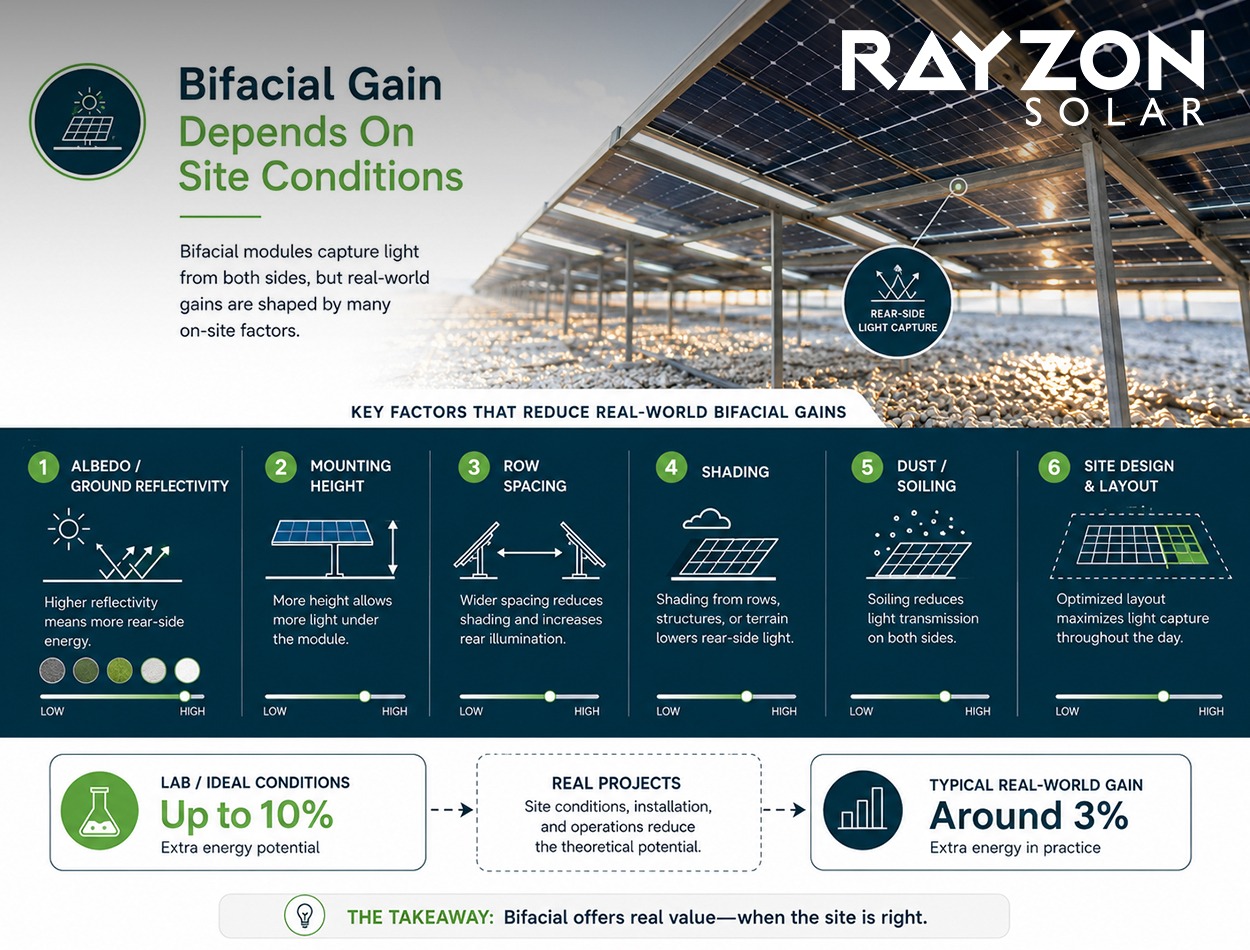
As the name suggests, bi-facial solar modules is a module that has the capability to generate energy from both sides as and when light hits the surface. However, Bifacial gain depends more on system design, rather than only module technology. The biggest factor in deciding energy generation is albedo. Albedo measures how much light the ground reflects.
As we understand from basic physics, any white background, like white gravel, concrete, and snow, would reflect more light, helping in additional generation as compared to grass or dark soil, which would reflect less.
According to research from the National Renewable Energy Laboratory (NREL), systems installed on low-albedo surfaces below 0.25 often achieve less than 10% bifacial gain globally. In practical conditions, poorly optimised systems can drop closer to 3%-5% additional gain.
Another important factor beyond Albedo is the height at which solar modules are mounted. When modules sit too close to the ground, the rear side receives limited reflected light. Structural shadows further reduce rear irradiance. Studies done at NREL show that raising modules from 0.5 m to 1.5 m can improve bifacial gain by several percentage points. However, height alone does not solve all the problems.
Row spacing plays a critical role. Tight row spacing creates self-shading between arrays. Those shading blocks reflected light from reaching the rear side. Wider spacing improves rear irradiance but increases land use and balance-of-system costs.
Many developers overestimate bifacial gains because they rely on generic assumptions instead of site-specific simulations. Some EPC proposals assume fixed gains of 10%–15% without accounting for actual ground reflectivity, seasonal conditions, or shading losses.
Industry experts now recommend bifacial modelling tools such as ray-tracing simulations for accurate yield estimation. Even NREL’s bifacial studies highlight that tilt angle, albedo, spacing, and array size interact differently across sites.
Bifacial technology can deliver strong gains. But the rear side does not produce “free energy.” Smart design unlocks performance. Poor design limits it.
In solar, a claimed 10% gain can quickly become 3% when site conditions, mounting geometry, and reflectivity are often ignored.